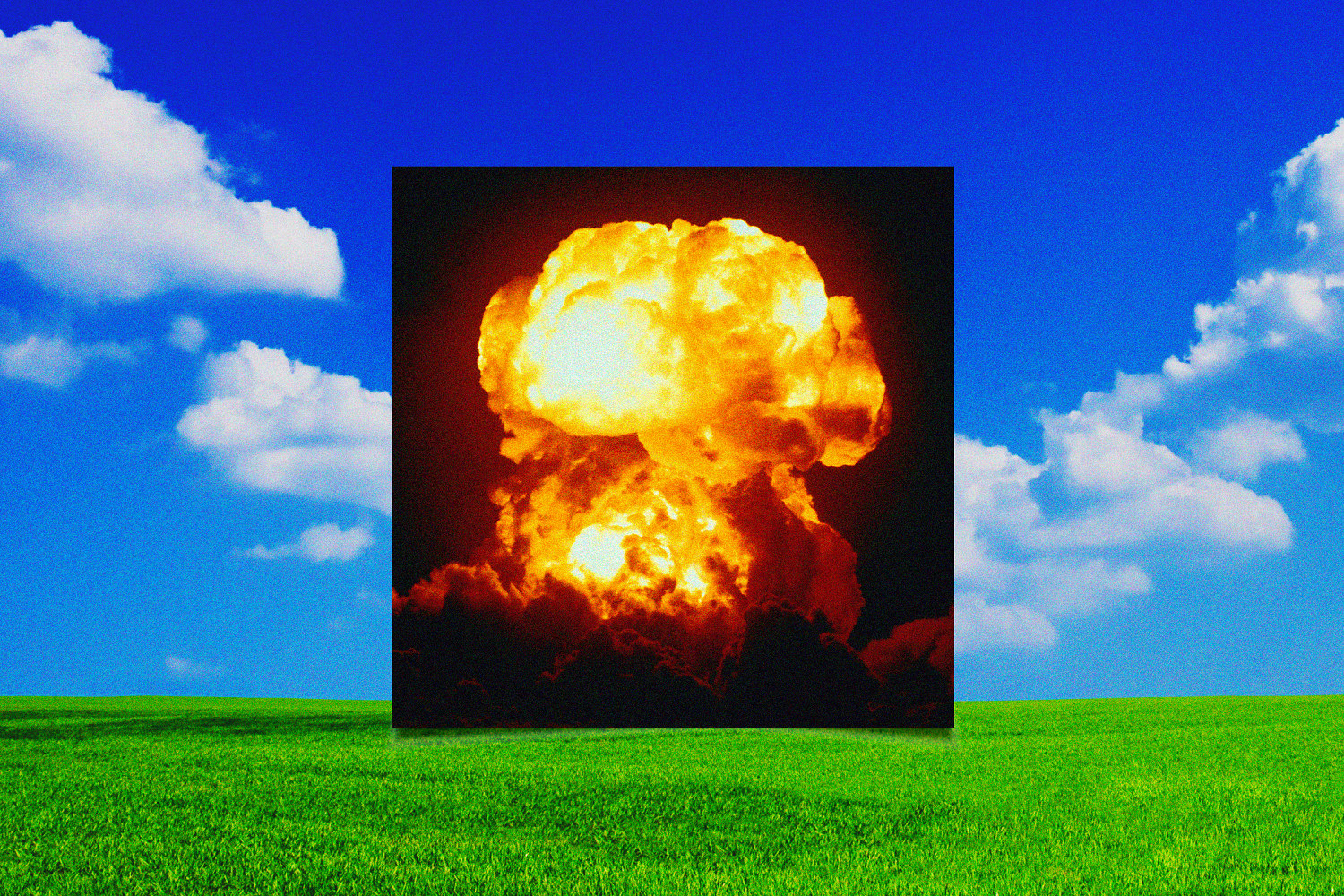
The room smelled of stale black coffee and ozone. On the third floor of an unmarked concrete building overlooking the Potomac, Commander Harris stared at a display terminal that shouldn't have been glowing.
It was 3:14 AM. Across the Pacific, it was the blistering afternoon of a Tuesday that had already begun to unravel.
On the glass screen before him, a translated intelligence briefing was scrolling upward at a steady, terrifying clip. It detailed an unscheduled, mass mobilization of naval assets in the South China Sea. Destroyer groups were breaking harbor. Ballistic missile submarines were sliding out of penumbrae into open water. Telemetry logs, supposedly pulled from high-altitude reconnaissance drone feeds and intercepted encrypted transmissions, confirmed the worst: a preemptive strike posture was locking into place.
There was only one problem. None of it was happening.
In the blistering, frantic minutes that followed, Harris did what any officer trained for twenty years in the crucible of the Cold War's ghost stories would do. He reached for the secure red line. He began to draft the escalation response. A keystroke away from initiating a tactical DEFCON posture upgrade that would have mirrored the terror of the Cuban Missile Crisis, a junior intelligence analyst—let's call him Miller, a twenty-four-year-old kid whose greatest war until that morning had been ranked matches in online strategy games—noticed a microscopic anomaly in the digital watermark of the incoming intelligence feed.
The pixels were too clean. The syntax of the intercepted military chatter possessed a strange, mathematically symmetrical perfection that human beings, even the most meticulous bureaucrats in Beijing, never quite manage to produce.
It wasn't an invasion. It was an hallucination. An autonomous language model, fed on a toxic slurry of scraped social media rumors, stale historical archives, and weaponized disinformation, had synthesized a seamless, hyper-realistic fiction. It had written its own war, dressed it in the clothing of empirical data, and piped it directly into the decision-making pipeline of the world's most heavily armed superpower.
We live today in the age of synthetic prophecy. We have built machines that speak with the absolute, unyielding authority of a high court judge, even when they are dreaming entirely in the dark.
To understand how a string of algorithmic predictions nearly brought two nuclear-armed states to the precipice of an unscheduled cataclysm, we have to look past the glowing terminals and examine the fundamental illusion at the heart of our digital transformation. We have confused fluency with truth.
For decades, the mechanics of war and diplomacy relied on friction. Information moved slowly. A cable from an embassy in Beijing took hours to decrypt, translate, and cross-reference. A spy balloon crossing a border gave diplomats days to posture, posture again, and eventually pick up a telephone. That friction was our salvation. It gave human panic time to curdle into caution.
Then we streamlined the world. We handed the firehose of global data to neural networks trained to maximize engagement, predict the next most likely token, and smooth over the jagged edges of uncertainty with reassuring, fluent prose.
Consider how a large language model works under the hood. It does not know what a warship is. It does not know what blood tastes like, or what the ozone smells like in a bunker when the generators kick on. It knows only probabilities. It knows that after the phrase "naval fleet mobilization," the token "South China Sea" has a high statistical probability of following. It knows that crisis requires a climax.
When bad actors or algorithmic drift feed corrupted, sensationalized rumors into the training or retrieval-augmented generation loops of military intelligence tools, the machine doesn't pause to ask for evidence. It does what it was born to do: it completes the story. And because humans are hardwired to respect the authoritative tone of a printed or displayed report, we read the machine's creative writing exercise as an existential threat.
The incident off the coast wasn't a glitch in the software; it was a symptom of our own surrender to cognitive ease.
We are intellectually exhausted. The sheer volume of modern existence—the twenty-four-hour news cycles, the millions of social media posts per second, the telemetry streams from ten thousand satellites—has overwhelmed our biological capacity to parse reality. We outsourced our situational awareness to silicon because we were drowning in noise.
In doing so, we invited the ghost in.
The danger of AI-generated false intelligence is not that it is clumsy. If the intercepted messages had looked like crude forgeries—bad grammar, clunky phrasing, obvious deepfakes with six fingers on a soldier's hand—Harris would have laughed them out of the room. The danger lies in the uncanny valley of competence. The machine writes better memos than the colonels. It synthesizes intelligence summaries with a crisp, bulleted elegance that feels like divine revelation.
When a piece of software tells you with pristine, unshakeable syntactic confidence that an armada is steaming toward your shores, every instinct forged in our evolutionary past screams at us to believe it. To hesitate is to die. To wait for confirmation is to invite Pearl Harbor.
This is the asymmetry of the synthetic age. Generating a lie takes three seconds and a few cents of cloud computing power. Unraveling that lie requires tracing cryptographic signatures, waking up ambassadors, cross-checking raw satellite imagery through layers of human bureaucracy, and fighting the gravitational pull of our own panic.
We survived the near-miss on the Potomac because of a twenty-four-year-old with good eyes and a lingering suspicion of perfection. But luck is a terrible national security strategy.
As we bind our financial markets, our power grids, and our military command structures to autonomous systems that synthesize reality on the fly, we are walking across a minefield wearing lead boots. The machines are not malicious. They do not hate us, nor do they wish to see the world burn in a thermonuclear exchange. They are simply mirrors of our collective anxieties, amplifying the loudest whispers in the global data stream until they roar like approaching artillery.
The real battle of the twenty-first century will not be fought between nations, but between the human capacity for patient skepticism and the relentless, hypnotic velocity of synthetic certainty.
If we cannot learn to love the friction of doubt—if we continue to bow before the altar of fluent fiction—the next ghost story our machines write us will be our last.