The recent interception of a Chinese-manufactured unmanned aerial vehicle (UAV) over Saudi-controlled airspace serves as a diagnostic marker for a shifting regional security architecture. This event is not merely a tactical loss of hardware; it is a point of data indicating the intersection of three critical variables: the reliability of commercial-off-the-shelf (COTS) components in military theaters, the hardening of Saudi-Emirati integrated air defense systems (IADS), and the diplomatic friction resulting from Iranian procurement strategies. To understand the friction between Tehran, Riyadh, and Abu Dhabi, one must move past the surface-level reporting of "demanded explanations" and instead analyze the underlying mechanics of drone warfare and regional signaling.
The Tripartite Logic of Regional UAV Proliferation
The deployment of these systems follows a specific logic of asymmetric engagement. Iran’s use or provision of Chinese-origin UAVs to proxy groups operates within a framework of plausible deniability and low-cost imposition. By using hardware that traces back to Chinese manufacturing rather than domestic Iranian facilities, the actor introduces a layer of forensic ambiguity.
- The Cost Imbalance Ratio: A primary driver of this strategy is the disparity between the cost of the offensive asset and the defensive interceptor. A Chinese-made reconnaissance or loitering munition may cost between $20,000 and $150,000, whereas a Patriot (MIM-104) interceptor or similar high-tier surface-to-air missile (SAM) costs upwards of $2 million per shot.
- Sovereignty Probing: Flying these assets into Saudi or UAE airspace allows the operator to map the response times and radar signatures of localized air defenses.
- Political Leverage: Iran’s demand for "explanations" regarding the downing of such craft reverses the traditional burden of proof, attempting to frame the interception as an act of aggression against legitimate regional surveillance rather than a defensive necessity.
Forensic Analysis of Chinese UAV Performance in High-Heat Environments
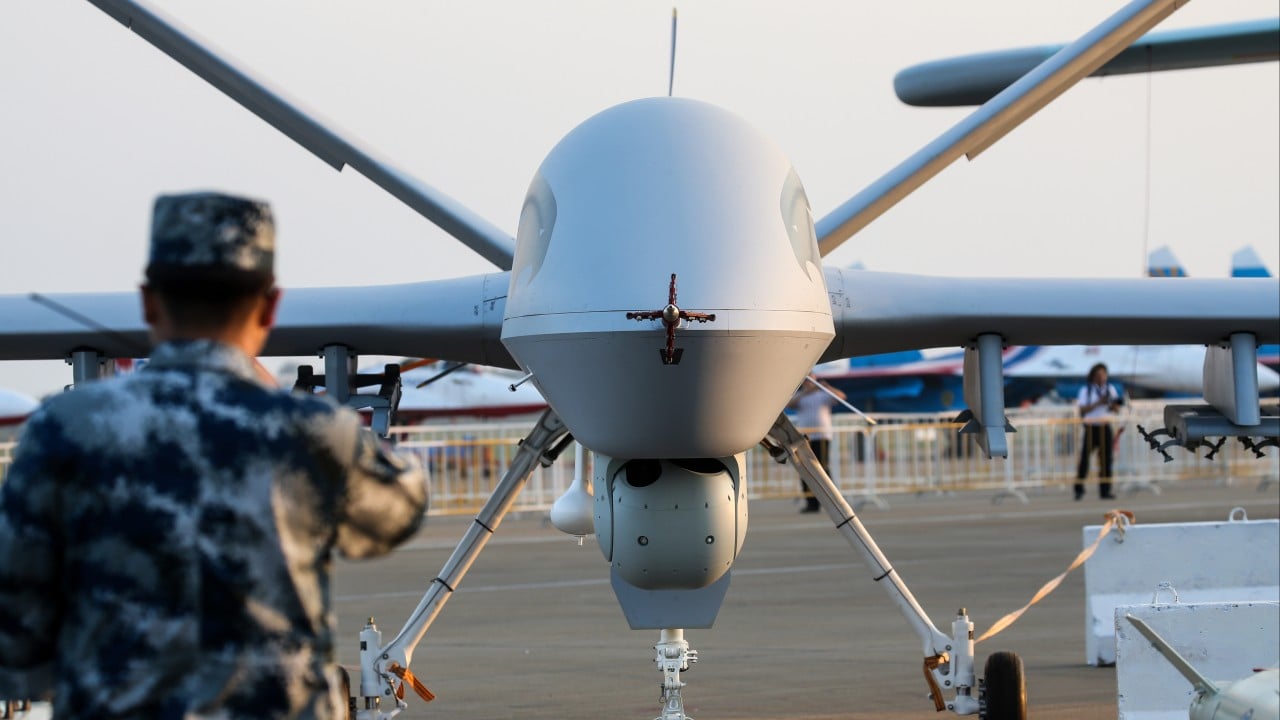
The technical failure or successful interception of these drones often stems from thermal bottlenecks and signal degradation. While Chinese aerospace firms have scaled production, the export versions of their mid-tier UAVs—such as the Wing Loong series or smaller CH-variant derivatives—frequently underperform in the specific atmospheric conditions of the Persian Gulf.
Thermal Throttling and Engine Failure
The internal combustion engines or electric motors in these units are often optimized for temperate climates. In the extreme heat of the Arabian Peninsula, air density decreases, reducing the lift-to-drag ratio and forcing engines to run at higher RPMs to maintain altitude. This leads to accelerated wear and thermal shutdown. If the drone shot down was not downed by kinetic impact but by electronic warfare (EW), the failure likely occurred in the C2 (Command and Control) link.
Link Vulnerability
Most export-grade Chinese drones utilize non-frequency-hopping radio links or predictable satellite relays. Saudi and Emirati forces have significantly upgraded their EW capabilities, focusing on:
- GPS Spoofing: Overriding the drone's internal navigation to force a landing or a "return to home" protocol that reveals the launch site.
- Signal Jamming: Flooding the uplink frequency to trigger the drone’s fail-safe, which often results in a controlled descent or a predictable flight path easily targeted by short-range air defense (SHORAD) systems.
The Saudi-Emirati Integrated Air Defense (IADS) Evolution
The effectiveness of the interception points to the maturation of the "Vision 2030" military modernization. Previously, Saudi air defenses were criticized for gaps in low-altitude coverage. The current architecture has transitioned into a layered defense:
- High Altitude: Patriot and THAAD systems for ballistic threats.
- Medium Altitude: Crotale NG and upgraded Hawk systems.
- Low Altitude/Point Defense: Pantsir-S1 (in the UAE’s case) and various directed energy or laser-based prototypes designed specifically for the "small drone" problem.
The downing of a Chinese drone suggests that the IADS is now successfully filtering out "clutter"—birds, weather patterns, and small civilian drones—to identify the specific RCS (Radar Cross Section) of a military-grade UAV. This signal processing capability is a result of years of data ingestion from Houthi-led drone strikes, which provided the "training data" necessary to refine radar algorithms.
The Diplomatic Friction Point: The Beijing Variable
Iran’s demand for an explanation from the Saudis and the UAE is a calculated maneuver involving China. Since China is a primary economic partner for all three nations, the presence of Chinese hardware creates a diplomatic triangle.
- The Iranian Position: By claiming the drone was for non-hostile purposes (likely citing maritime surveillance or border security), Tehran seeks to portray Riyadh as an over-reactive actor that disrupts regional stability and disrespects Chinese technology.
- The Saudi/UAE Position: The seizure of the wreckage provides physical evidence of the specific components used. If these components violate end-user certificates or international sanctions, Riyadh gains leverage in Beijing, potentially pressuring China to restrict the flow of dual-use technology to Iran.
This creates a bottleneck for Iranian procurement. If their primary source of low-cost components becomes politically "hot," the cost of their drone program increases as they are forced to shift to more expensive, less reliable, or harder-to-acquire domestic or black-market alternatives.
Assessing the Logic of "Demanding Explanations"
The rhetoric from Tehran is a form of Lawfare—the use of legal and diplomatic frameworks to achieve a military objective. By demanding an explanation, Iran is attempting to establish a "right of flight" for its assets in the region.
- The Sovereignty Argument: Iran argues that the drone was in international airspace or a "shared" security corridor.
- The Reciprocity Trap: If Saudi Arabia provides a detailed technical explanation of why they shot it down, they risk revealing their "Engagement Logic"—the specific criteria and radar triggers used to authorize a kinetic strike.
Riyadh’s silence or brief dismissal is the tactically superior move, as it maintains "Strategic Ambiguity" regarding their defensive capabilities.
The Cost Function of Continued Encroachment
Every time a drone is intercepted, the operator loses more than just the unit cost. They lose the "Information Advantage."
Component Deconstruction
Recovered wreckage allows Saudi intelligence to perform a "teardown." This reveals:
- The origin of the microchips (often identifying the specific distributors in Asia or Europe).
- The sophistication of the encryption on the data link.
- The fuel efficiency and loitering endurance, which allows analysts to calculate the exact range of the launch site.
The Failure of Plausible Deniability
The "Chinese-made" label is losing its efficacy as a mask. As regional intelligence agencies build a database of serial numbers and component batches, they can trace a specific drone back to the exact shipment that arrived in an Iranian port. This turns a tactical asset into a liability by providing the "smoking gun" needed for international sanctions or diplomatic isolation.
The Strategic Play: Transitioning to Counter-Battery Logic
The defense of the Persian Gulf is moving away from purely reactive interception and toward "Left of Launch" strategies. This involves neutralizing the threat before the drone ever enters the air.
- Supply Chain Interdiction: Working with Chinese authorities to tighten end-user monitoring.
- Cyber Attribution: Identifying the specific units operating the C2 stations and targeting their digital infrastructure.
- Kinetic Deterrence: Signalling that the response to a UAV incursion will not just be the destruction of the drone, but a proportional strike on the launch infrastructure.
The demand for explanations from Tehran is a sign of frustration, not strength. It indicates that the previous era of "free" surveillance and low-risk harassment is being closed by a more sophisticated, data-driven, and integrated defensive posture from the GCC states. The strategic recommendation for regional actors is to maintain the refusal of technical disclosure. Disclose the event to signal vigilance, but withhold the "how" to ensure the adversary must continue to guess at the cost of their next deployment.