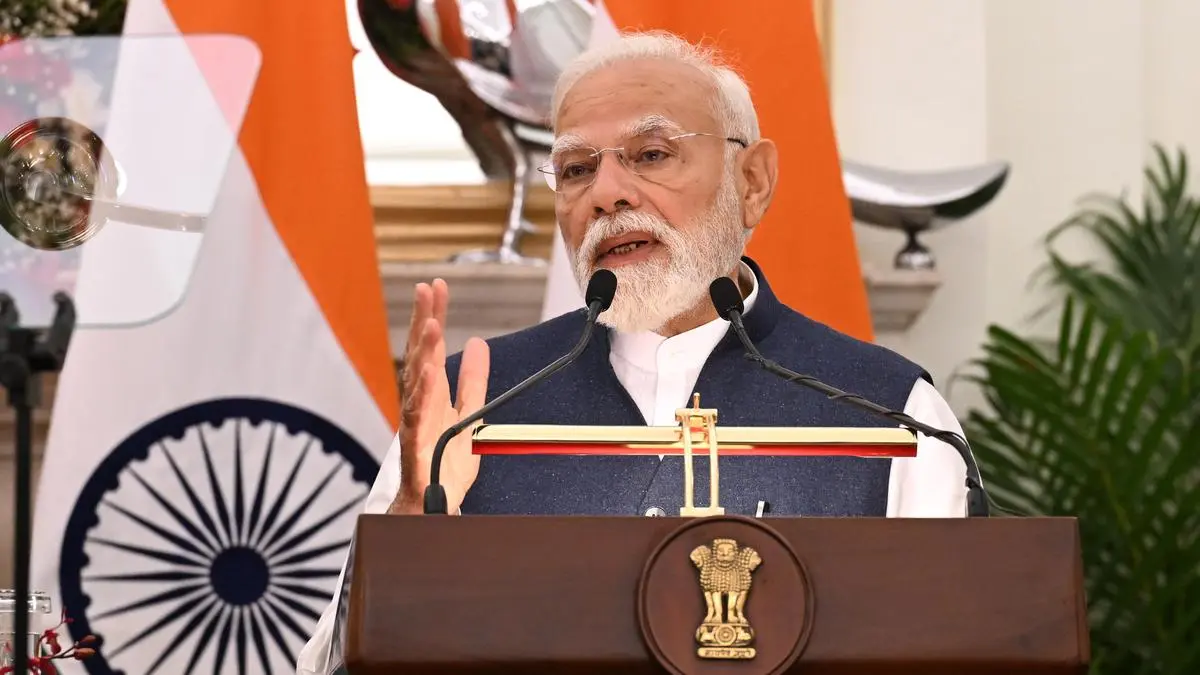
Modern warfare has reached a point of diminishing returns where the cost of kinetic engagement exceeds the value of the territorial or political equity gained. Prime Minister Narendra Modi’s assertion that "military conflict cannot resolve problems" is not a moral platitude; it is a recognition of the shifting mechanics of global power. In the contexts of West Asia and Ukraine, the traditional victory condition—total capitulation of the enemy—is rendered obsolete by integrated global supply chains, the democratization of high-precision lethality, and the "asymmetric drain" of prolonged attrition. To understand why diplomacy is now a functional necessity rather than a choice, one must analyze the structural barriers to military resolution in the 21st century.
The Logic of Indecisive Attrition
The failure of military force to produce definitive political outcomes in Ukraine and West Asia stems from a fundamental mismatch between 20th-century doctrine and 21st-century technological reality. When conflict enters a state of indecisive attrition, the "Cost of Victory" ($C_v$) begins to scale exponentially while the "Value of Objective" ($V_o$) remains static or depreciates due to infrastructure destruction. Meanwhile, you can read similar developments here: Why the World Ignores Indiscriminate Shelling in Balochistan.
The current stalemate in Eastern Europe illustrates this. The democratization of ISR (Intelligence, Surveillance, and Reconnaissance) via low-cost drones and satellite constellations has eliminated the "fog of war" required for decisive maneuvers. Because neither side can achieve tactical surprise, the conflict reverts to a primitive contest of industrial capacity. In this environment, military force does not resolve the problem; it merely transforms a political dispute into a permanent economic sinkhole. India’s insistence on "dialogue and diplomacy" serves as a recognition that the global economy cannot absorb the inflationary shocks of a permanent war footing in critical energy and grain corridors.
Three Pillars of the Indian Strategic Framework
India’s position is defined by three distinct logical pillars that prioritize systemic stability over ideological alignment. To understand the complete picture, check out the detailed article by NPR.
1. The Principle of Territorial Integrity vs. Proxy Realities
India’s stance on Ukraine is anchored in the sanctity of borders, yet it acknowledges the reality of security architectures. The "problem" in Ukraine is a collision of two incompatible security frameworks: NATO’s expansionism and Russia’s perceived sphere of influence. Military force cannot bridge this gap because it addresses the symptoms (territorial control) rather than the cause (mutual insecurity). India positions itself as a mediator because it maintains "strategic autonomy," allowing it to communicate across these decoupled frameworks without being subsumed by either.
2. Energy Security and the Multi-Polar Buffer
For a developing economy, global instability is a direct threat to the internal "Social Contract." High energy prices act as a regressive tax on the population. By refusing to join Western-led sanction regimes while simultaneously calling for peace, India exercises a "Multi-Polar Buffer." This strategy ensures that India’s domestic growth—the primary driver of its global relevance—is not sacrificed to a conflict it did not initiate. The logic is simple: a weakened India is a less effective stabilizer in the Indo-Pacific.
3. The Fragility of the Global South’s Supply Nodes
West Asia (the Middle East) represents a different set of variables. Here, conflict is not just about territory; it is about the security of maritime "choke points" like the Strait of Hormuz and the Bab el-Mandeb. Any military escalation here risks a "cascading failure" in global logistics. India’s diplomatic engagement with both Israel and the Arab world is a de-risking strategy. The "problem" of Israeli-Palestinian relations or regional Iranian-Saudi tensions cannot be resolved by arms because the destruction of regional infrastructure would trigger a global depression.
The Mechanism of the Asymmetric Drain
Military conflict today is characterized by an "Asymmetric Drain" where non-state actors or smaller powers can use low-cost technology to neutralize high-cost assets. A $20,000 drone destroying a $5 million tank or a $100 million air defense battery illustrates a catastrophic failure in the economic efficiency of war.
- Financial Exhaustion: Modern munitions are produced at a rate far lower than their consumption in active theater.
- Social Erosion: Long-term conflicts lead to demographic collapses, particularly in Eastern Europe, where the working-age population is being depleted.
- Diplomatic Parity: The rise of the BRICS+ bloc means that Western economic coercion (sanctions) no longer carries the "totalizing" effect it once did. Alternative payment systems and trade routes are being built in real-time as a response to the weaponization of the dollar.
These factors explain why PM Modi’s rhetoric emphasizes that "this is not an era of war." It is an era of Competitive Interdependence. The goal of a modern state is to maximize its leverage within the network, not to destroy the network itself.
Quantifying the Failure of Coercion
The "problem" that military force seeks to solve is usually the behavior of a sovereign state. History suggests that kinetic pressure rarely changes a regime's core security calculus; instead, it tends to harden it. This is the "Coercion Paradox."
In West Asia, the cycle of strike and counter-strike has not diminished the influence of proxy networks or secured long-term peace for Israel. In Ukraine, the front lines have moved incrementally despite hundreds of billions of dollars in hardware. The "resolution" is absent because military force is a binary tool being applied to a multivariate problem. Diplomacy, by contrast, allows for "Gray Zone" settlements—agreements that are technically imperfect but allow for the restoration of trade and the cessation of human capital loss.
Strategic Realignment: The Indian Template
India’s approach suggests a new template for mid-tier and emerging superpowers. This template moves away from the "Cold War" model of binary alliances and toward a "Networked" model.
- Issue-Based Coalitions: Engaging with the Quad for maritime security while engaging with the SCO (Shanghai Cooperation Organisation) for regional stability.
- Economic Realpolitik: Sourcing discounted Russian oil to keep domestic inflation low while expanding tech partnerships with the United States.
- Human-Centric Diplomacy: Prioritizing the evacuation of citizens and the delivery of humanitarian aid (as seen in Operation Ganga and aid to Gaza) to build "Moral Capital" that can be converted into diplomatic leverage later.
The limitation of this strategy is that it requires a high degree of "Diplomatic Agility." If a conflict escalates to a nuclear or total-war threshold, the middle ground disappears. However, as long as the conflicts remain contained within regional borders, India’s "Master of the Middle" position remains the most logically sound path for a state seeking to transition from a regional power to a global pillar.
The Path to a Post-Kinetic Settlement
To resolve the crises in West Asia and Ukraine, the international community must pivot toward an "Incentive-Based Architecture." This involves creating economic corridors—like the India-Middle East-Europe Economic Corridor (IMEC)—that make conflict prohibitively expensive for all participants.
The ultimate strategic play is the institutionalization of the "Global South" as a voting bloc that can veto the escalatory tendencies of the P5 (Permanent members of the UN Security Council). By centering the discourse on food security, energy stability, and debt sustainability, India is effectively changing the "Product" of international diplomacy. The product is no longer "Victory"; the product is "Systemic Continuity."
The resolution of the Ukraine and West Asia conflicts will not come from a breakthrough on the battlefield. It will come from the gradual exhaustion of the belligerents' ability to finance their own destruction, followed by a negotiated settlement facilitated by non-aligned powers who have maintained their economic and moral liquidity. The strategic imperative for global leadership is now the management of peace, not the execution of war.