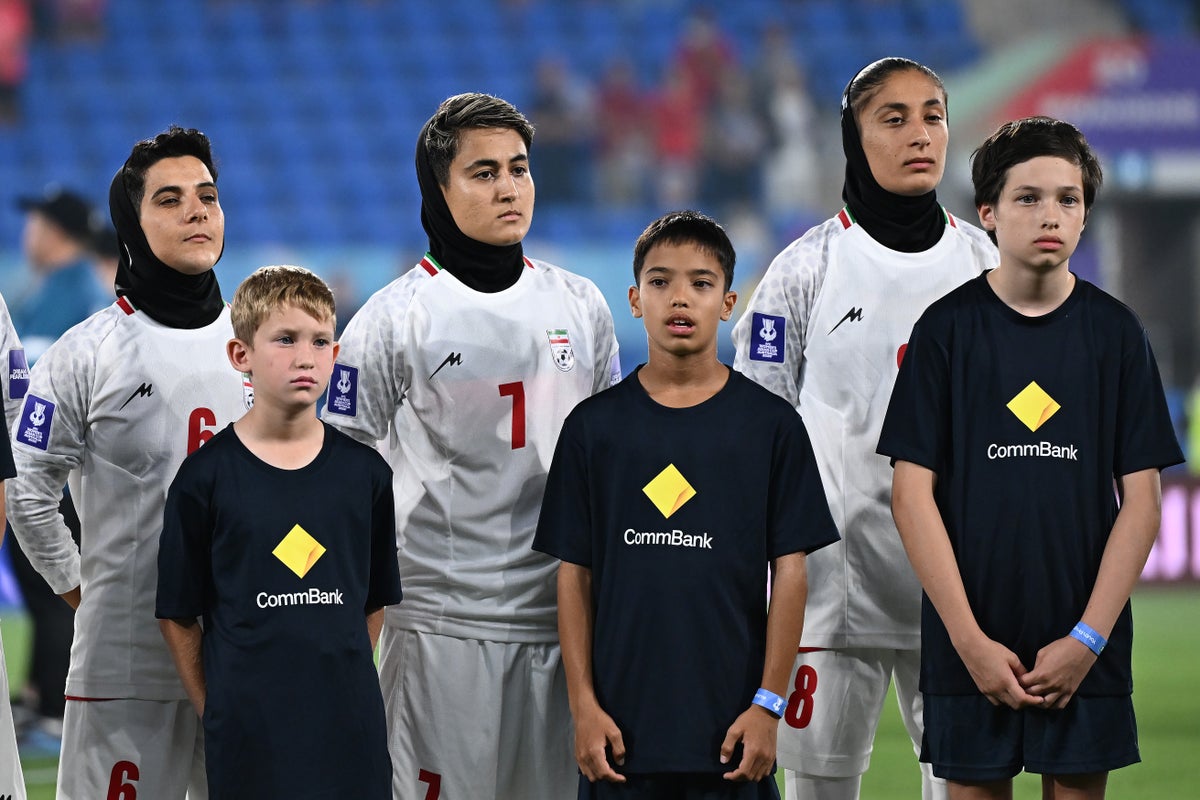
Athletic platforms serve as high-visibility vector spaces for political signaling. When authoritarian state structures collide with international sporting events, institutional control mechanisms often break down under the weight of individual risk calculations. The decision of two Iranian women's national football team members, Atefeh Ramezanisadeh and Fatemeh Pasandideh, to remain silent during their national anthem at the Women's Asian Cup in Australia laid bare the mechanics of state dissent, the friction of international asylum protocols, and the severe personal trade-offs embedded in public defiance.
Deconstructing this event requires analyzing the structural constraints faced by athletes operating under coercive governance models. State-sponsored athletic delegations function not merely as sports teams, but as external legitimacy engines for the home government. When athletes deviate from prescribed performative behaviors, they disrupt the state's narrative continuity.
The mechanics of this disruption operate across three distinct operational tiers.
First is the signal-to-noise ratio of passive resistance. Active protests can be intercepted, censored, or reframed by state-controlled media apparatuses. Silence, conversely, creates an interpretive vacuum. When Ramezanisadeh and Pasandideh stood silent on the pitch ahead of their match against South Korea, they exploited ambiguity. Observers initially split hypotheses between mourning external military strikes and protesting domestic state crackdowns. This ambiguity protects the actor in the immediate term while maximizing cognitive dissonance for the ruling regime.
Second is the cost function of repatriation. For athletes embedded in authoritarian systems, defection carries an asymmetric penalty. The expected utility of remaining abroad must outweigh the deterministic cost of severing familial ties, facing state-sanctioned branding as traitors, and risking retributive actions against relatives remaining within national borders. The decision matrix is rarely binary; it involves navigating sudden legal limbo, diplomatic interventions by foreign heads of state, and the psychological burden of permanent exile.
Third is the velocity of institutional response. Host nation immigration frameworks are typically designed for protracted administrative processing, not high-speed geopolitical extraction. Australian immigration officials faced a compressed timeline where a symbolic gesture on a sports field rapidly escalated into a bilateral diplomatic focal point involving international leaders. The friction between standard refugee status determination and immediate political expedience tests the capacity of host states to absorb high-profile dissidents without destabilizing broader diplomatic channels.
The aftermath highlights why the majority of the initial delegation ultimately reversed their asylum stance and returned home, while only two individuals carried the defection through to citizenship. Sustained exile demands a high threshold of psychological resilience and economic independence. The transition from elite national representatives to semi-professional athletes playing for local clubs like the Wynnum Wolves represents a profound downward occupational shift, mitigated only by the absolute preservation of personal safety and ideological alignment.
Future geopolitical friction at international sporting fixtures will continue to test the structural integrity of state delegations. Authoritarian states will likely implement tighter surveillance vectors, preemptive vetting, and mandatory collateral protocols—such as retaining family members as informal leverage—to suppress dissent before delegations depart sovereign territory. Governing bodies like FIFA and regional confederations face mounting pressure to establish independent protective infrastructure that decouples athletic participation from state-enforced compliance, altering the risk calculus for athletes who choose to use the world stage as an instrument of accountability.
To evaluate similar defection risks in international sports administration, map the severity of domestic state crackdowns directly against the international visibility index of the hosting tournament to project the probability threshold of high-consequence public protest.