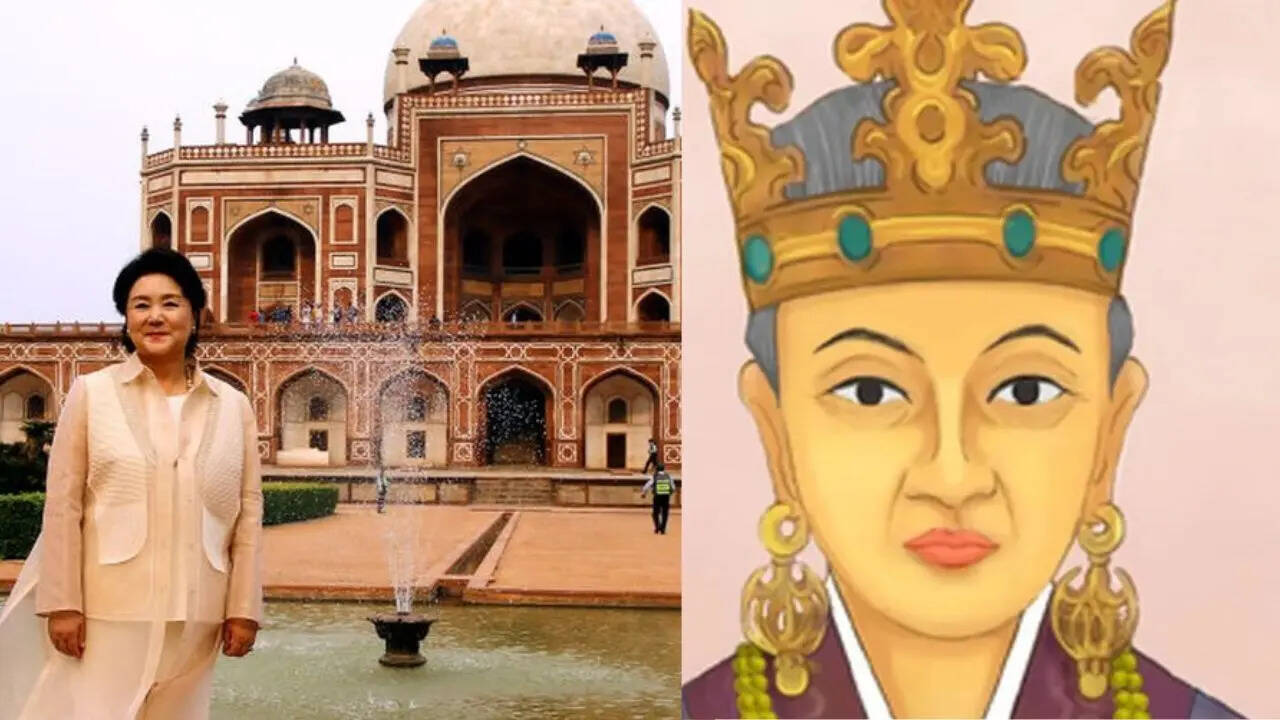
The contemporary diplomatic partnership between South Korea and India rests on a foundation text written in the 13th century. According to the Samguk Yusa (Memorabilia of the Three Kingdoms), compiled by the monk Ilyeon, a 16-year-old princess named Suriratna arrived by sea on the shores of the Geumgwan Gaya kingdom in 48 CE. She claimed her parents, the rulers of a distant realm called Ayuta, were commanded in a dream by the Heavenly Lord to send her to marry King Kim Suro. Renamed Queen Heo Hwang-ok, her lineage currently claims more than six million living descendants in South Korea, spanning the Gimhae Kim, Gimhae Heo, and Incheon Yi clans.
This narrative functions less as static folklore and more as an active geopolitical mechanism. When evaluated using historical, linguistic, and genetic frameworks, the account reveals structural gaps between state-sponsored heritage diplomacy and empirical verification. Examining the mechanisms of this 2,000-year-old connection demonstrates how ancient foundational myths are leveraged to serve modern strategic alliances.
The Three Pillars of Mythological Transmission
To understand how a text written 1,200 years after the alleged event achieved its current geopolitical weight, the narrative must be separated into three distinct components.
   [Textual Foundation] --------> [Material Artifacts] --------> [Modern Diplomacy]
   (Samguk Yusa / "Ayuta")       (Twin-Fish / Pasaeseoktap)     (Sister Cities / Soft Power)
1. The Textual Pillar: The Ambiguity of Ayuta
The primary source material, the Garakguk-gi (Record of the Garak Kingdom) preserved within the Samguk Yusa, provides the phonetic identifier "Ayuta" ($\text{阿踰陀}$). Modern diplomatic initiatives explicitly equate Ayuta with the northern Indian city of Ayodhya. However, historical geography exposes a logistical bottleneck: Ayodhya is a landlocked city located along the Sarayu River in Uttar Pradesh, hundreds of kilometers from the ocean.
Alternative hypotheses attempt to resolve this logistical contradiction by shifting the geographic focus to maritime trade routes:
- The Dravidian Hypothesis: Proponents point to the ancient coastal polities of southern India, such as the Ay kingdom or the Pandya dynasty of Tamil Nadu, citing extensive historical maritime trade.
- The Southeast Asian Hypothesis: Early 20th-century scholars posited a link to the Ayutthaya Kingdom in Thailand. This correlation fails chronologically; Ayutthaya was not founded until 1350 CE, long after the Samguk Yusa was compiled.
- The Central Asian Hypothesis: Alternative models suggest Ayuta may refer to land-based trade hubs in Western China or Tibet, arguing that the Samguk Yusa descriptions were later modified to fit Buddhist cosmic geography.
2. The Material Pillar: Epigraphic and Geological Proxies
Definitive epigraphic records confirming Queen Heo’s journey do not exist in Indian historical texts. Physical evidence is limited to two major archeological artifacts located in Gimhae, South Korea:
- The Twin-Fish Emblem: The royal tombs of King Suro and Queen Heo feature two fish facing each other. This motif is absent in broader Korean iconography from the period but closely mirrors the Matsya dual-fish motifs common in the historical art of Uttar Pradesh and ancient Indian maritime states.
- The Pasaeseoktap (Stone Pagoda): Positioned near Queen Heo's tomb, this structure is composed of red-tinted stone slabs with high iron content, a material anomalous to the geology of the Korean peninsula. Traditional narratives claim these stones were placed on the vessel to stabilize the hull against ocean currents. Petrographic analysis indicates the stone originated in South Asia, confirming an ancient transfer of material across maritime corridors, though it does not verify the identity of the passenger.
3. The Genealogical Pillar: Clan Cohesion and Hereditary Capital
The survival of the narrative depends heavily on the patrilineal kinship systems of South Korea. While the standard patriarchal rule dictates that children inherit the father's surname, the Samguk Yusa notes that King Suro permitted two of their twelve sons to take the surname Heo.
This structural compromise created a distinct lineage group. The Karak Clan Society, which manages the ancestral rites for the Gimhae Kim and Heo families, operates as a powerful civic institution. This group provides the institutional framework required to sustain the narrative across generations, transforming an ancient text into an organized domestic constituency.
The Soft-Power Cost Function: Strategic Placemaking
The transformation of the Heo Hwang-ok narrative from a local lineage chronicle into a transnational diplomatic asset follows a clear strategic logic. Bilateral state initiatives use the myth to establish historical depth for contemporary economic and security relationships.
+---------------------------------------------------------------------------------+
|                         Bilateral Value Generation Model                        |
+----------------------------------+----------------------------------------------+
| Input Mechanism                  | Strategic Output                             |
+----------------------------------+----------------------------------------------+
| 2000: Gimhae-Ayodhya Agreement   | Established institutional sister-city nexus  |
| 2001: Sarayu River Memorial      | Created physical infrastructure for tourism  |
| 2018: First Lady State Visit     | High-level diplomatic signaling              |
| 2025: Bronze Statue Unveiling    | Permanent iconographic validation of myth   |
+----------------------------------+----------------------------------------------+
This state-backed investment works through targeted placemaking. By establishing physical monuments on the banks of the Sarayu River in Ayodhya and hosting high-profile state visits—such as South Korean First Lady Kim Jung-sook's attendance at the 2018 groundbreaking ceremony—both nations build cultural capital. This shared heritage infrastructure reduces diplomatic friction and provides a soft-power foundation that supports bilateral trade, defense procurement, and technological cooperation.
Empirical Boundaries and Methodological Vulnerabilities
A rigorous analysis requires identifying the empirical vulnerabilities of the Indo-Korean narrative. Relying on this myth for bilateral diplomacy introduces three distinct analytical challenges.
The Chronological Anachronism
The Samguk Yusa dates Queen Heo’s arrival to 48 CE. During the mid-first century, the polities on the southern coast of the Korean peninsula existed as a loose confederation of chiefdoms known as Samhan, rather than centralized, literate bureaucratic states capable of receiving formal foreign embassies. The institutionalization of the Gaya state occurred much later. The narrative in the text projects 13th-century Buddhist political concepts back onto a protohistoric tribal structure.
Genetic Divergence
Attempts to validate the lineage using molecular anthropology have yielded mixed results. Early mitochondrial DNA (mtDNA) analysis conducted in 2004 on human remains from Gaya-era tombs identified certain southern Asian haplogroups, which proponents used to argue for an Indian origin.
However, subsequent comparative genomic studies have complicated these findings. A 2026 comprehensive analysis of genetic material from the Gaya region indicates that the southern genetic markers match the indigenous Jomon populations of the Japanese archipelago and coastal East Asian maritime communities rather than South Asian populations. This genetic data suggests that while ancient Gaya maintained extensive maritime trade connections, claims of large-scale South Asian migration or a royal marriage line lack clear biological evidence.
Linguistic Coincidence Versus Systematic Philology
A common argument for the connection relies on phonetic similarities between the Tamil language and Korean, noting roughly 1,800 words with comparable sounds and definitions (e.g., Appa for father, Amma for mother).
While these similarities point to a shared maritime trade pidgin along the ancient Indian Ocean and East China Sea routes, mainstream historical linguistics views them with skepticism. Without systematic sound correspondences or shared grammatical frameworks, these parallel terms are classified as products of lexical borrowing via trade networks rather than evidence of regular migrations or shared language roots.
Strategic Recommendation
Diplomatic policymakers should decouple the cultural utility of the Heo Hwang-ok narrative from the requirement for absolute historical proof. Treating the account as a literal historical event exposes state rhetoric to disruption whenever new archaeological or genetic data contradicts the narrative.
The most resilient strategy is to frame the legend as a historical metaphor for early global connectivity. Instead of trying to prove an unverified first-century royal marriage, bilateral initiatives should focus on the documented maritime trade networks that carried goods, technologies, and ideas between South Asia and the Korean peninsula. Highlighting the real history of ancient trade paths rather than an unproven royal genealogy protects the cultural relationship from shifting scientific consensus while preserving its value for modern diplomacy.