In a quiet room on the upper floors of a state-owned administration building in central Moscow, the digital clocks do not tick. They change silently, minute by minute, green numbers shifting against dark glass. Below, the damp chill of late autumn presses against the asphalt. Cars move with muffled urgency through the grey slush, their headlights cutting narrow beams through the gathering dusk. Inside, men in heavy wool suits lean over maps that smell of old paper and fresh printer toner. They are tracing lines with their fingers. Red lines. Blue lines. The lines where a sovereign border meets the weight of history.
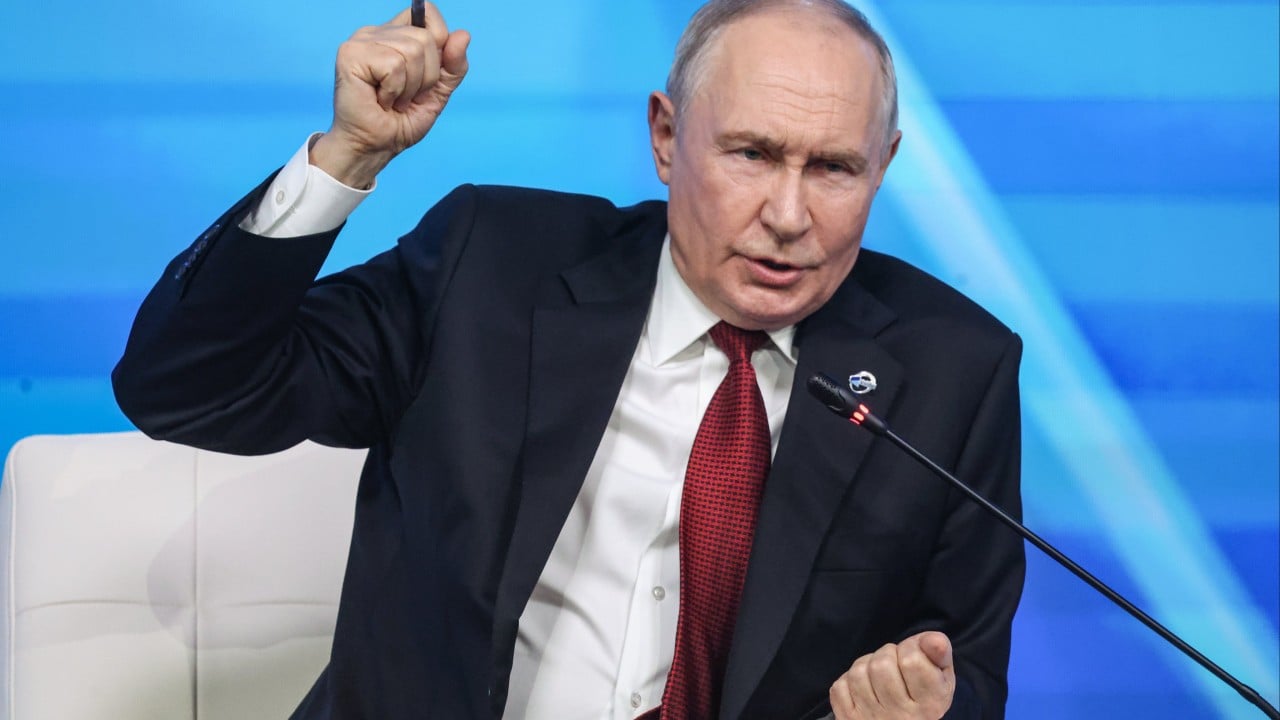
We talk about escalation as if it were a weather event. A sudden storm blowing in from an open sea, unpredictable and untamed. But escalation is manufactured. It is assembled in quiet rooms by people who drink weak tea from porcelain cups and weigh verbs against casualties. When Vladimir Putin adjusted his posture behind a polished mahogany desk and spoke of the arsenal, he was not simply issuing a warning. He was drawing a mathematical boundary.
Consider the geometry of modern fear.
For decades, the architecture of global stability rested on a fragile, terrifying balance known as deterrence. It is a concept that sounds clean on a whiteboard, almost academic. Two adversaries stand on opposite sides of a chasm, each holding a switch that can detonate the ground beneath them both. As long as both believe the other will press the button, neither moves. This is the doctrine of mutually assured destruction. It is cold. It is clinical. And it relies entirely on a shared, rational understanding of survival.
What happens when one side believes the ground beneath them is already eroding?
To understand the warning issued from Moscow, you have to step away from the podium and look at the map through the eyes of a state apparatus that has spent centuries obsessed with depth. Russia is geographically vast, a sprawling continent of forests and steppes, yet it has historically perceived itself as profoundly vulnerable. Flat plains roll westward toward Europe, offering no natural barriers against invading armies. From the perspective of Russian strategic planners—a perspective forged in the ash of Napoleon’s march and the staggering, unimaginable blood toll of the Great Patriotic War—security is measured in distance. Buffer zones. Strategic depth.
When foreign weapons begin to strike within internationally recognized borders—or what Moscow perceives as its vital red lines—the psychological calculation shifts from deterrence to desperation. And desperation is a volatile solvent. It dissolves academic theories. It burns through diplomatic protocols.
Listen to the phrasing used in the capital. It is deliberate. It is saturated with legalistic caution and apocalyptic weight. When leadership states that all weapons in the arsenal remain on the table should territorial integrity face an existential threat, they are speaking the language of absolute finality.
Imagine, for a moment, an air defense battery stationed in a freezing forest somewhere in the western provinces. The crew is young. Twenty-two. Twenty-three. They wear quilted parkas stiff with frost. They share cigarettes in the dark, watching the radar screens pulse with green light. To them, politics is an abstraction broadcast from flat-screen televisions in the barracks. But the red blip approaching at Mach 3 is not an abstraction. It is a physical reality hurtling toward their coordinates at a speed that defies human reaction time.
When a policy maker in Washington or Brussels authorizes a strike across a border, they are looking at a tactical advantage on a digital dashboard. When that strike lands, the shockwave translates instantly down the chain of command until it reaches that freezing forest. The distance between a policy memo and a mushroom cloud is measured not in miles, but in the speed of escalating retaliation.
This is the invisible machinery that keeps diplomats awake at night.
We have lived so long beneath the umbrella of the nuclear age that we have grown numb to its architecture. We treat the Doomsday Clock like a faulty wall clock in a public school—something that ticks away in the background, ignored until someone makes a grim joke about it. We consume news of troop movements and missile tests between sips of morning coffee, scrolling past high-resolution satellite imagery as easily as we scroll past restaurant reviews.
The danger is not that we will stumble into a global war by accident. Wars of this magnitude are rarely accidents; they are the cumulative result of thousands of small, deliberate miscalculations. Each side takes a step forward, certain that the other will blink. Each side mistakes restraint for weakness. Each side misreads the internal political pressures driving their opponent.
Putin’s recent statements are a symptom of a narrowing corridor. As economic sanctions bite deeper, as diplomatic channels fray into mutual accusations, and as the battlefield settles into a grinding war of attrition, the options for changing the strategic dynamic dwindle. When conventional levers fail to achieve political objectives, the temptation to elevate the stakes—to introduce ambiguity about where the ultimate boundary lies—becomes overwhelming.
This is the shadow that falls across every capital today. It is a shadow woven from historical paranoia, modern missile technology, and the terrifying elasticity of the word "territory."
We are standing at a structural hinge in history. The decisions being made in government offices and military command centers over the coming months will not merely determine the outcome of a regional conflict. They are rewriting the rules of what nations can do to one another when the guardrails of the twentieth century have rusted through.
The tea in the porcelain cups grows cold. The red lines on the map remain fixed, waiting for someone to cross them. And out there in the dark, the digital clocks keep changing, silent and relentless, measuring out the time we have left to remember how close the edge really is.