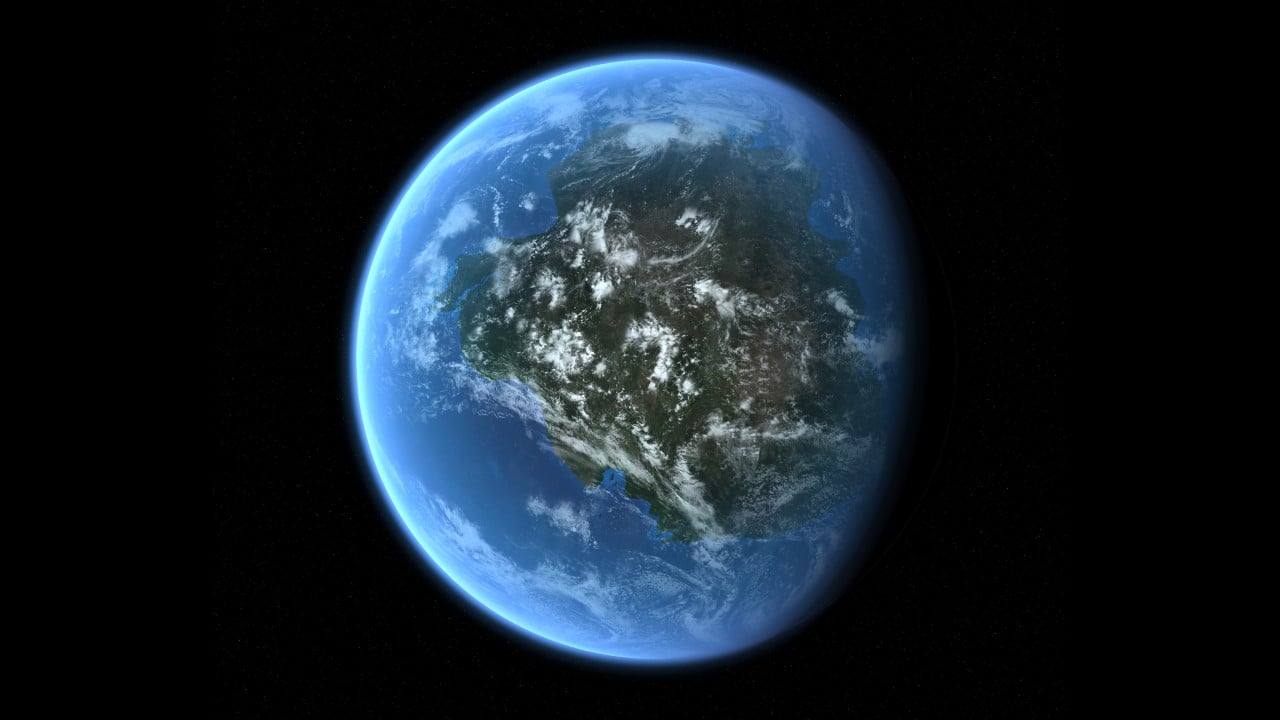
For decades, school textbooks got a fundamental fact about ancient Earth wrong. We were taught that Gondwana, the massive southern landmass, missed out on true supercontinent status because it allegedly covered only about 64 percent of the world's continental crust. In geology, rigid definitions require a landmass to grab roughly 75 percent of the globe's land to earn the title of an official supercontinent. Gondwana fell short. Or so we thought.
A landmark study published in Science Advances changes everything. Led by researchers from the Chinese Academy of Geological Sciences and Curtin University, an international team reconstructed Earth's crust from 500 million years ago and found that Gondwana was massive. It didn't cover 64 percent of the earth. It covered a staggering 80 percent.
How Massive Crustal Fragments Were Hiding in Plain Sight
Finding a missing chunk of an ancient landmass isn't like stumbling across a lost city in the jungle. The pieces are microscopic, chemical, and buried deep beneath modern mountain ranges.
To map this lost world, the research team used a massive database of granite samples harvested with the help of artificial intelligence applications. They analyzed over 25,000 individual samples using samarium-neodymium (Sm-Nd) isotopic dating. This technique acts like a geological time machine. The younger age tells you when magma crystallized into granite, while the older age reveals the deep, ancient crustal source from which that magma came.
By tracking these isotopic signatures globally, the scientists realized that huge slices of old Gondwanan crust hadn't vanished. They had been dragged, folded, and completely swallowed up by younger orogenic mountain belts across North America, Europe, and Asia. Geological processes crumpled the edges of the ancient continent so severely that generations of scientists simply lost track of where Gondwana ended and newer crust began.
Once these hidden fragments were accounted for, the true scale of the landmass emerged. The researchers named this expanded entity "Greater Gondwana".
Rewriting the Timeline of Early Life
Size is fascinating, but what makes this discovery genuinely important is its timing. Greater Gondwana reached its massive scale roughly 500 million years ago—right on the doorstep of the Cambrian explosion, the pivotal epoch when complex animal life suddenly diversified across the oceans.
For years, paleoclimatologists and evolutionary biologists debated what triggered this sudden biological boom. The new study points directly to the geography of Greater Gondwana.
When the supercontinent fully assembled, it became ringed by an enormous volcanic arc system stretching at least 32,000 kilometers—roughly equal to the entire circumference of the Earth. Think of it as a prehistoric, planetary-scale version of the Pacific Ring of Fire.
Volcanoes pump out massive quantities of carbon dioxide and water vapor. A global ring of active volcanoes operating continuously along the edges of an 80-percent landmass would have supercharged the atmosphere, warmed a recovering post-ice age planet, and washed vital nutrients directly into the shallow seas. That chemical cocktail helped kick-start the explosion of multicellular life.
What This Means for Modern Earth Science
This discovery exposes the limits of how we map deep planetary history. Geologists have spent centuries looking at modern continental outlines and trying to peel them backward like wallpaper. But crust is constantly recycled, subducted, and mashed together during tectonic collisions.
By combining advanced isotopic geochemistry with large-scale data harvesting, researchers have proven that our planet's history is far more interconnected than regional mapping suggests. Fragments of a southern supercontinent are sitting right now beneath the mountains of the Northern Hemisphere, quietly altering how we understand the ancient mechanics of our world.