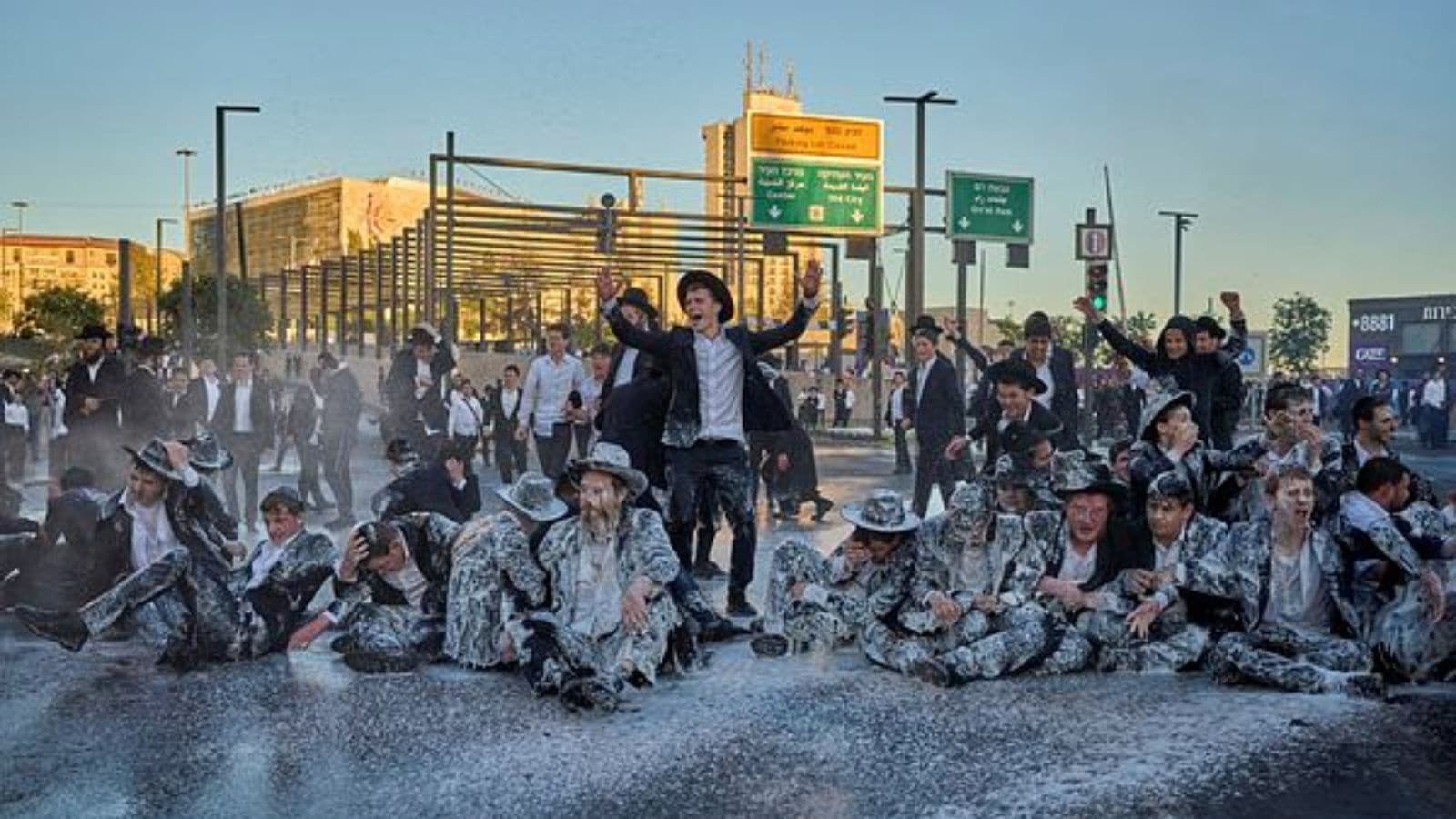
The physical targeting of state infrastructure by ultra-Orthodox (Haredi) factions signals a structural shift in how anti-conscription elements interact with Israeli law enforcement. When hundreds of protesters attempted to breach the gates of the Lev HaBira police station in Jerusalem’s Russian Compound and engaged in coordinated clashes in Beit Shemesh, the action moved beyond traditional civil disobedience. This escalation operates as a predictable response to targeted enforcement against draft evasion, utilizing tactical disruption to challenge the state's judicial and security apparatus.
Understanding this shift requires moving past basic descriptions of public disorder. The expansion of hostilities to the Jewish Sabbath—a period when halakhic law strictly restricts physical labor and civic engagement—indicates that radical factions now view state enforcement as an existential threat that overrides traditional temporal boundaries. The escalation is driven by a distinct cause-and-effect loop: targeted judicial enforcement triggers kinetic resistance, which then tests the capacity limits of localized law enforcement.
The Escalation Cycle of Targeted Enforcement
The riots in Jerusalem and Beit Shemesh were not isolated events; they were direct tactical responses to the arrest of 62 individuals following a violent demonstration at the home of Supreme Court Deputy President Noam Sohlberg. This dynamic highlights a distinct operational feedback loop within ultra-Orthodox enclaves.
[Judicial Mandate / Draft Arrests]
               │
               ▼
[Targeted Enforcement Action]
               │
               ▼
[Radical Mobilization & Direct Action]
               │
               ▼
[Localized Law Enforcement Attrition]
               │
               └───────(Loops back to more arrests/escalation)
The cycle consists of three distinct phases:
- The Enforcement Trigger: Israel’s military faces sustained manpower shortages due to multi-front active combat operations. This reality accelerates judicial mandates to dismantle the historical blanket conscription exemptions previously afforded to the Haredi sector. When the state executes warrants on draft evaders or holds individuals for property destruction—such as the vandalism at Justice Sohlberg’s residence—it crosses a red line defined by radical theological factions.
- Asymmetrical Kinetic Response: Because the state utilizes centralized infrastructure to process detainees, radicalized elements focus their geographic pressure directly on those processing hubs. Attempting to force entry into the Lev HaBira station and attacking the perimeter gates in Beit Shemesh are direct efforts to interrupt the state's processing capability through physical crowding and asset distraction.
- Symmetric Attrition: Localized police units are forced to reallocate resources from standard municipal patrol duties to high-density crowd control. This requires deploying specialized Border Police units to re-establish perimeter control, transforming a legal dispute into a resource-intensive security operation.
Tactical Shifts and Temporal Anomalies
The occurrence of these riots on Friday night and early Saturday morning represents a significant departure from historical patterns of Haredi protest. Typically, community leadership strictly enforces the cessation of political agitation before sundown on Friday to preserve the sanctity of the Sabbath. Breaking this norm reveals a critical shift in the internal logic of radical groups like the Jerusalem Faction.
The justification rests on the theological principle of Pikuach Nefesh (the preservation of life) or the perception of a "war on religion." By framing the conscription of yeshiva students as spiritual destruction, radical actors treat defense against enforcement as an emergency that supersedes Sabbath restrictions. Consequently, the tactical timeline expands to a 24-hour cycle, denying law enforcement the standard operational lulls usually provided by the religious calendar.
This operational shift manifests in two distinct geographic patterns:
Urban Choke-Point Tactics (Jerusalem)
In high-density urban environments, protesters leverage narrow thoroughfares to restrict police mobility. The targeting of the Russian Compound police station functions as a containment strategy, attempting to lock law enforcement assets inside their own headquarters while using civilian crowds as a human shield against mounting a rapid response.
Distributed Projectile Volleys (Beit Shemesh)
In suburban enclaves like Beit Shemesh, the tactic shifts toward decentralized asset degradation. Rioters use stones, debris, and improvised incendiaries against police vehicles and personnel. This approach increases the distance between the crowd and the police line, diluting the effectiveness of standard crowd-dispersal measures like batons and short-range stun grenades.
Strategic Realities and Systemic Friction
The friction between the state and Haredi anti-draft factions exposes clear limits within both political and security frameworks. For law enforcement, the primary constraint is resource allocation. The Israel Police and Border Police are structured to manage localized civil unrest, but maintaining continuous high-alert deployments across multiple major sectors—Jerusalem, Beit Shemesh, Bnei Brak, and West Bank settlements—strains personnel reserves and reduces response times for non-political criminal activity.
Politically, the enforcement of draft orders lacks a uniform legislative framework, leaving individual police actions looking like ad-hoc responses rather than a systemic policy. This regulatory ambiguity creates a dangerous perception of vulnerability. Radical elements believe that increasing the operational and political cost of arrests will force the state back toward a policy of non-enforcement.
Conversely, non-involved citizens face rising physical risks. The assault on an uninvolved secular individual in Jerusalem, who sustained head injuries during the demonstration, shows how quickly targeted political protests can expand into wider sectarian conflict.
The security apparatus cannot rely on temporary tactical dispersals to solve a structural compliance crisis. As long as the military requirement for manpower drives the judicial system to target draft evaders, radicalized factions will continue to treat police infrastructure as legitimate targets for direct intervention. The tactical goal of these groups is clear: raise the administrative and physical cost of every single arrest until the state determines that systematic enforcement is operationally unsustainable.