The kinetic friction in the Strait of Hormuz demonstrates the limits of economic optimization when decoupled from absolute security enforcement. The 60-day memorandum of understanding signed on June 17 between the United States and Iran was designed to establish a temporary economic and military equilibrium. However, the June 25 strike by an Iranian one-way attack drone on the Singapore-flagged container ship M/V Ever Lovely exposes a foundational flaw in the agreement's architecture: the divergent interpretations of maritime transit corridors.
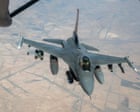
The resulting American counter-strikes on June 26—deploying six military aircraft against four coastal radar, missile, and drone storage facilities along the Iranian coast and Qeshm Island—were not merely punitive. They represented an forced recalibration of the maritime cost function, signaling that tactical interference with traffic normalization will face an immediate, asymmetric kinetic tax.
The Geography of Attrition: Twin Corridor Friction
The escalation stems from a zero-sum struggle over geographic control within the 21-mile-wide Strait of Hormuz. The structural bottleneck is defined by two competing transit frameworks, which turned a technical evacuation mechanism into a trigger for military conflict.
- The Southern Omani Track (The UN-Backed Corridor): Initiated by the United Nations International Maritime Organization (IMO) to evacuate the roughly 650 commercial vessels trapped in the Persian Gulf during the prior months of active conflict. This route hugs the Omani coastline, minimizing proximity to Iranian territorial waters and coastal missile batteries.
- The Northern Iranian Track (The PGSA-Regulated Corridor): Enforced by Iran's Persian Gulf Strait Authority (PGSA). Tehran demands that all commercial traffic utilize northern traffic separation schemes, subjecting vessels to Iranian inspection, active registry permission, and long-term transit tolls.
When the M/V Ever Lovely utilized the southern route without securing PGSA clearance, it crossed an unmapped institutional red line. The PGSA had explicitly warned that routes outside its designated framework would lose safe passage and liability guarantees. By launching four one-way attack drones at transiting vessels—three of which were intercepted—Iran sought to enforce its regulatory jurisdiction through kinetic denial, aiming to prove that alternative routing without Iranian acquiescence is commercially non-viable.
The Strait Economy: Volatility and Trapped Supply
The economic rationale behind the June 17 agreement was straightforward: remove the maritime risk premium to stabilize global energy and fertilizer supply chains. In the initial seven days following the signing, daily ship transits through the strait rose from single digits to 78 vessels on June 24, approaching historical baselines of approximately 130 transits per day.
This normalization curve immediately flattened following the drone strike. While the strait remains technically open, marine data indicates a sharp deceleration in traffic velocity.
Commercial Transit Optimization Curve (June 2026)

Pre-War Baseline:      ===============================> 130+ transits/day
Post-MOU Peak (June 24): =================> 78 transits/day
Post-Strike Slump:       ===========> 43 transits/day
The IMO suspended its mass evacuation framework after successfully clearing 115 vessels, leaving roughly 500 hulls trapped inside the Gulf. Commercial maritime operators now face an updated risk assessment. At least two crude tankers bound for international markets reversed course rather than enter the disputed Omani track. The commercial calculation is governed by insurance math rather than political declarations; without explicit safe-passage guarantees backed by either absolute deterrence or bilateral consensus, commercial underwriters will refuse hull and machinery coverage for the corridor.
Degraded Capabilities: The Architecture of the Strike
The American military response targeted the precise hardware used to execute the M/V Ever Lovely attack, focusing strictly on localized coastal denial assets rather than deep theater-wide infrastructure. Operating under U.S. Central Command, six strike aircraft hit four highly localized target nodes:
- Qeshm Island Array: A critical choke point managing the northern littoral approach. The strikes targeted subterranean drone storage bunkers and ready-to-launch platforms.
- Sirik Coastal Radar Sites: Early-warning and telemetry stations responsible for tracking commercial hulls along the Omani shore and providing terminal guidance data for anti-ship cruise missiles and slow-moving loitering munitions.
- Mainland Missile Relays: Mobile launcher hidden positions along the narrow coastal strip bordering the strait, intended to threaten naval surface groups.
By limiting the scope of the counter-offensive to an hour-long window and avoiding inland leadership or nuclear infrastructure, the U.S. attempted to maintain the outer boundaries of the June 17 ceasefire. The target selection was designed to degrade Iran's immediate tactical visibility over the southern corridor, temporarily disabling the coastal radar network required to coordinate multi-drone salvos against moving merchant ships.
Structural Fragility of the Diplomatic Framework
The operational lifetime of the current ceasefire is heavily compromised by built-in logical contradictions within the memorandum of understanding. The diplomatic strategy assumed that a 60-day pause would allow for concurrent negotiations on two complex, distinct fronts: the total reallocation of regional shipping tolls and the permanent monitoring of Iran's highly enriched uranium stockpiles.
This design suffers from an sequencing vulnerability. It demands immediate compliance with commercial shipping normalization while deferring the resolution of the core political disagreement—the legal status of the strait—to the end of the 60-day window.
Iran views control over the shipping lane as its primary leverage to secure the release of frozen capital and limit Western involvement in parallel Levantine ceasefire talks. If alternative routes like the Omani track successfully normalize traffic without Tehran's oversight, Iran's primary geopolitical asset is neutralized before the final negotiations even begin. The drone strike on the M/V Ever Lovely was a deliberate, calculated disruption meant to reintroduce the maritime risk premium and reclaim that leverage.
Operational Contingencies for Maritime Shipping
For shipping lines, logistics networks, and commodity traders navigating this diplomatic transition, relying on the political language of the memorandum is no longer a viable strategy. Operational resilience requires implementing a defensive, multi-tiered framework designed for persistent structural volatility:
- Enforce Asymmetric Routing Protocols: Commercial vessels must strictly utilize the southern Omani littoral corridor. Any deviation into northern channels to appease regional authorities exposes hulls to arbitrary regulatory detention or targeted interference.
- Establish Military Coordinated Escorts: Transits should be timed to match active U.S. Navy and coalition surface combatant schedules. Merchant vessels must integrate directly into Central Command's safe passage coordination networks rather than attempting solo transits under the assumption of passive ceasefire protections.
- Priced-In Insured Options: Freight contracts moving through the Persian Gulf must index freight rates to real-time war-risk premiums. Contracts should include automated diversion clauses that trigger off-loading at secure hubs outside the strait if kinetic activity pauses IMO clearance frameworks for more than 48 hours.