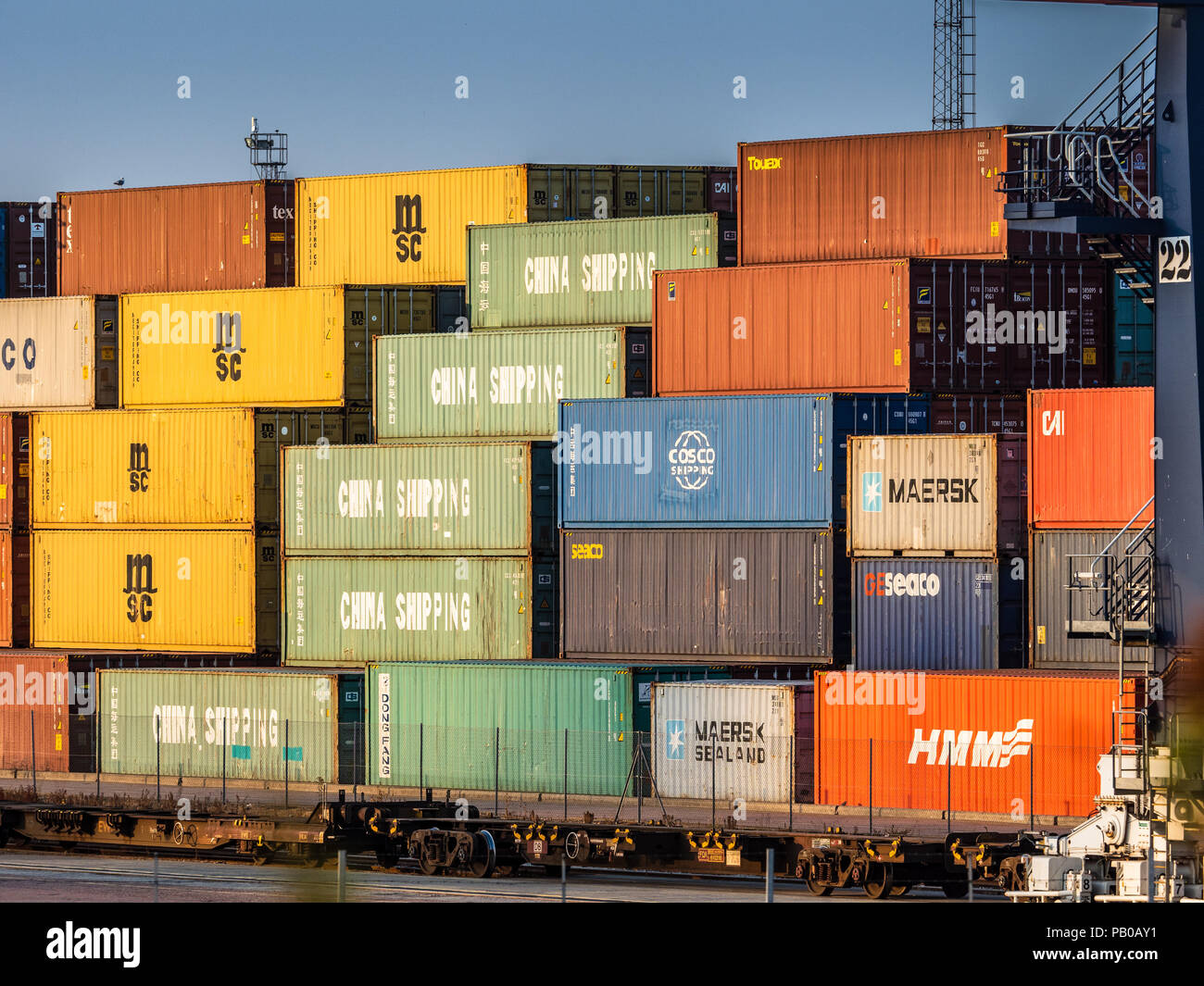
A single steel box sits on a pier in Ningbo, China. It is painted a salt-crusted blue, identical to the millions of other Lego-brick containers stacked across the horizon. Inside, there are no high-end microchips or luxury goods. Instead, it holds three thousand cheap, unbranded electric water kettles.
In a small flat in Leeds, a woman named Sarah buys one of these kettles for fifteen pounds. She doesn't know about the Ningbo pier. She doesn't know about the Strait of Hormuz. She certainly isn't thinking about the "China Shock" of the early 2000s, when a tidal wave of manufactured goods from the East gutted the factories of the West. But the price of her tea is about to become a battleground.
For decades, we lived in a world defined by the "Great Moderation." Inflation was a ghost story told by grandparents. Goods were cheap, plentiful, and always arrived on time. That era ended with a whimper during the pandemic, but it is being buried by the roar of missiles in the Middle East and the silent, overwhelming surge of Chinese industrial overcapacity.
We are standing at the edge of a second China shock, one that is being weaponized and accelerated by the threat of an Iran-Israel conflict.
The Ghost in the Machine
To understand why a regional war in the desert matters to Sarah’s kettle, we have to look back at the first shock. In 2001, China joined the World Trade Organization. It was a massive, sudden injection of labor and production into the global veins. It lowered prices for everyone, but it left the American Midwest and the North of England scarred with empty warehouses and "For Lease" signs.
Now, China is facing a different problem. Their domestic economy is cooling. Their people are saving instead of spending. To keep their giant industrial engine from seizing up, they are doing the only thing they know how to do: produce. They are churning out electric vehicles, solar panels, and consumer goods at a scale that defies logic.
This is a surplus looking for a home. When a country produces far more than its own people can buy, it must export that deflation to the rest of the world. It floods the market. It drives prices down so low that no local competitor can survive.
But there is a bottleneck.
The Choke Point
The Strait of Hormuz is a thin strip of water between Oman and Iran. It is the jugular vein of the global energy market. About a fifth of the world’s total oil consumption passes through this narrow passage. If a full-scale war erupts between Iran and its neighbors, or draws in the West, that vein gets pinched.
When oil prices spike because of Middle Eastern instability, the cost of everything else follows. You might think a surge in oil prices would counteract the "cheap" goods coming from China. Logic suggests that if shipping becomes expensive, the price of Sarah’s kettle should go up.
But that’s where the narrative breaks.
China is currently sitting on a mountain of manufacturing power that they cannot afford to turn off. If shipping costs rise because of a war in Iran, Chinese state-backed firms will likely swallow those costs to maintain their market share. They will keep the prices artificially low to ensure that their "second shock" of goods continues to drown out Western industry.
Consider a hypothetical factory owner in Ohio named Mike. Mike makes high-end industrial valves. His electricity costs are rising because of global energy volatility. His shipping costs are up. He looks at the market and sees a Chinese competitor selling the same valve for 40% less than his cost of materials.
Mike isn't just competing against a company; he is competing against a nation-state that is using a global energy crisis to cement its industrial dominance. The Iran war doesn't just make things expensive; it creates a vacuum that only Chinese manufacturing is currently prepared to fill.
The Hidden Tax of Chaos
War is an inflationary force. It destroys things. It requires massive government spending. It disrupts the delicate "just-in-time" delivery systems we’ve spent forty years perfecting. When the Red Sea becomes a shooting gallery, ships have to go around the Cape of Good Hope. That adds ten days and a million dollars in fuel to every journey.
Usually, this would lead to a general rise in prices—what economists call "cost-push inflation." But China is currently in a state of "de-facto deflation." Their prices are falling at home. By exporting their surplus into a world where energy is getting more expensive, they are effectively subsidizing the world's consumption in exchange for the total destruction of their competitors' industrial bases.
It’s a predatory kind of kindness.
We see this most clearly in the "Green Transition." The West wants solar panels and EVs. We want them now. But we can't make them as cheaply as the subsidized giants in Guangzhou. If a war in the Middle East sends gas prices to seven dollars a gallon, the desperation for electric cars will reach a fever pitch.
Who is ready to provide those cars? Not the legacy automakers in Detroit, who are still grappling with supply chains and high labor costs. It is the companies sitting on the other side of the "second shock."
The Human Margin
The stakes aren't found in GDP charts. They are found in the quiet conversations at kitchen tables.
If the Iran conflict escalates, the price of heating a home in January goes up. The price of filling a tank to get to work goes up. In that environment, the consumer becomes a heat-seeking missile for the lowest possible price. They stop caring about where a product is made or the long-term health of their local economy. They just need to survive the month.
This is how the second China shock becomes permanent. It isn't a slow infiltration; it’s a sudden flood during a storm. The war provides the storm. The Chinese manufacturing surplus provides the flood.
We often talk about "de-risking" or "de-coupling." These are cold, sterile words. They mean moving a factory from one zip code to another. But you can't de-couple from a global reality where your energy comes from one volatile region and your goods come from another.
We are addicted to the cheapness that the first shock provided. We built our entire lifestyle on the idea that a kettle should cost fifteen pounds and a t-shirt should cost five. We didn't account for the fact that the "cheapness" was a loan, and the interest is now being called in.
The Broken Compass
There is a specific kind of vertigo that comes with realizing the old rules no longer apply. For years, the "efficient" thing to do was to outsource. The "smart" thing was to rely on global trade. We assumed that trade would lead to peace—that if people bought and sold together, they wouldn't fight.
The Middle East proves that theory is fragile. China's industrial strategy proves that trade can be a form of siege.
When Sarah eventually plugs in her new kettle, she hears the water begin to hiss. It’s a comforting, domestic sound. But that hiss is powered by a grid struggling with energy costs, and the kettle itself is a fragment of a massive geopolitical tectonic shift.
If the Strait of Hormuz closes, the cost of the electricity to boil that water might double. If the second China shock continues unabated, the factory in the next town over that used to make appliances will never reopen.
The two forces are feeding each other. The geopolitical instability in the West’s energy corridors makes the East’s industrial surplus look like a lifeline. But lifelines can easily become nooses.
We are watching a metamorphosis of the global economy. It is no longer about who can innovate the fastest, but who can endure the most pain. China is betting that its centralized system can endure the pain of overproduction and low margins longer than the West can endure the pain of inflation and industrial decline.
A missile fired in the Gulf doesn't just hit a tanker. It ripples across the Indian Ocean, through the South China Sea, and lands directly in the grocery aisles of suburban America. The world has become so small that there is no longer any such thing as a "regional" conflict.
The blue container in Ningbo is finally being loaded onto a ship. The crane operator moves with a mechanical, rhythmic precision. He is one of millions, part of a machine designed to produce more than the world can handle. As the ship pulls away from the dock, it heads toward a world that is more expensive, more volatile, and more divided than it was when the container was first welded together.
The kettle is on its way. The price is low. The cost is unimaginable.