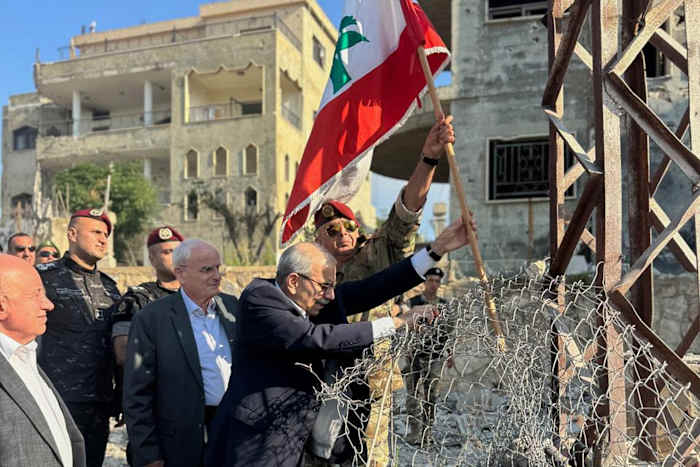
When Prime Minister Nawaf Salam stepped into the rubble of Zawtar Al Gharbieh to plant the Lebanese national flag, official cameras captured a triumph for state authority. The imagery suggested a turning point where a long-sought Washington-brokered agreement between Beirut and Jerusalem was finally shifting control from non-state actors back to sovereign troops. Yet beneath the ceremony lies an acute geopolitical gamble. The deal relies on a fragile "pilot zone" strategy designed to test whether a cash-strapped national army can disarm entrenched Hezbollah elements while convincing Israel to execute a total military withdrawal.
The immediate reality on the ground offers a far harsher picture than political photo opportunities imply. While military commanders raised the cedars flag against a backdrop of crushed concrete, displaced residents gathered at army checkpoints just beyond the village perimeter, barred from returning to their homes due to unexploded ordnance and active security sweeps. Frustration among locals quickly boiled over. For thousands of southern families, diplomatic promises of state protection ring hollow without immediate access, basic shelter, and tangible security guarantees.
A High Stakes Mechanics Test in Zawtar Al Gharbieh
The core of the deal rests on testing security arrangements in designated pilot zones across southern Lebanon. Rather than attempting a sweeping, instantaneous deployment across hundreds of square miles of contested terrain, international mediators constructed a phased rollout. In theory, these pilot sectors serve as proof-of-concept areas. The Lebanese Armed Forces enter areas vacated by Israeli forces, secure weapons stockpiles, and establish exclusive operational control. If successful, the model replicates across the broader border district.
Practical implementation exposes immediate structural flaws.
- Troop density shortfalls leave sovereign units stretched thin across vast swaths of damaged terrain.
- Intelligence gaps complicate efforts to identify covert subterranean infrastructure left behind by non-state fighters.
- Command friction persists between regional army commanders and local political authorities attempting to govern displaced populations.
Israeli ground units operated across dozens of border villages during recent combat operations, leaving behind extensive physical destruction. Although Israeli troops did not establish permanent garrisons in every town within the designated pilot zones, their heavy artillery and air campaigns flattened critical infrastructure. Bringing sovereign soldiers into a physical vacuum of flattened utilities, destroyed roads, and unmapped explosives demands massive logistics. The Lebanese state, broke and politically fractured, lacks the organic capacity to rebuild these sectors on its own.
Washington Deals and the White House Factor
The geopolitical push behind this arrangement gained momentum following President Joseph Aoun’s high-stakes meeting at the White House. During those closed-door sessions, Washington backed Beirut’s attempt to assert a full monopoly on domestic force, even floating economic sweetening measures like lifting long-standing civil aviation restrictions.
Yet international promises frequently disintegrate when confronted with regional realities.
While Washington pledges political backing, the exact mechanics of long-term financial and military assistance remain undefined. The Lebanese military has spent years operating on emergency subsidies, international fuel donations, and foreign pay-stipends to keep regular soldiers from abandoning their posts. Expecting an under-equipped force to police an area historically dominated by heavily armed, Iranian-backed paramilitaries requires more than diplomatic endorsements.
┌─────────────────────────────────────────────────────────┐
│              STAKEHOLDER CONFLICT MATRIX                │
├──────────────────┬──────────────────────────────────────┤
│ Actor            │ Primary Strategic Requirement        │
├──────────────────┼──────────────────────────────────────┤
│ Lebanese State   │ Complete Israeli troop withdrawal    │
│ Israel           │ Neutralization of border threats     │
│ Hezbollah        │ Political survival without compliance│
│ Border Residents │ Immediate return & infrastructure    │
└──────────────────┴──────────────────────────────────────┘
The diplomatic calculus assumes that Israel will fully pull back its forces if the Lebanese state demonstrates control. But Israeli national security officials maintain a low threshold for intervention. Should Israeli intelligence detect clandestine movement or weapons smuggling inside the pilot zones, the Israeli Defense Forces retain a self-declared right to resume targeted strikes. That dynamic threatens to instantly collapse the agreement and leave the Lebanese national army caught in a catastrophic crossfire.
The Shadow over Sovereignty
Hezbollah’s official posture toward the agreement presents a complex paradox for Beirut. While the organization’s political wing condemned direct diplomacy with Israel and rejected disarmament demands, its military commanders have refrained from open sabotage within the test zones. This silence is not surrender; it is strategic patience.
"The prime minister should have informed people that he was going to Zawtar and he should have taken the people, who have been waiting for the past two days, with him," noted Zaynab Ismail, a displaced resident standing at a military blockade outside her home town.
That local disconnect exposes the broader democratic deficit facing the border region. Residents view the state military not merely as a defense force, but as an administrative barrier preventing them from assessing their destroyed assets. If the central government cannot deliver rapid reconstruction alongside security, local reliance on informal sectarian networks will reemerge.
                 PILOT ZONE IMPLEMENTATION SEQUENCE

  [ Washington Deal ] ──> [ Pilot Zone Selection ] ──> [ LAF Deployment ]
                                                               │
                                                               ▼
  [ Civilian Re-entry ] <── [ Ordnance Clearance ] <── [ Israel Pullback ]
Hezbollah’s leadership recognizes that the Lebanese state cannot maintain a permanent forward presence without persistent foreign funding and domestic buy-in. By stepping back temporarily and allowing the army to face the immediate anger of displaced, homeless citizens, non-state actors preserve their structural influence while letting official state institutions absorb the public backlash.
Operational Hurdles in the Field
Field operations reveal significant friction points that diplomatic communique writers routinely ignore. Clearing unexploded ordnance takes months of tedious work. Small specialized engineering units must sweep every acre of agricultural land, ruined houses, and secondary roads before heavy machinery can clear rubble.
- Unmapped Hazard Fields: Submunitions scatter across civilian farmland, turning orchards into lethal obstacles for returning families.
- Infrastructure Collapse: Water pumps, electrical sub-stations, and telecommunication towers lie shattered, requiring massive capital investments before basic habitation is possible.
- Verification Disputes: Disputes regularly arise between international observers and local commanders regarding what constitutes a cleared military asset versus a dual-use civilian facility.
When Lebanese soldiers establish checkpoints, they face angry citizens demanding immediate entry. Army officers are forced to enforce exclusion zones without clear timelines for when civilian life can resume. Every day that civilians remain locked out of their villages undermines trust in the central government and fuels narrative claims that state authority brings paralysis rather than protection.
Why the Pilot Model Faces Structural Failure
The fundamental flaw in the current security arrangement is the assumption that disarmament and border security can occur in isolation from Lebanon’s broader financial and political collapse. A state cannot project durable power at its external frontiers when its internal institutions lack basic funding, political cohesion, and public trust.
Foreign brokers designed the pilot zone system as a technical solution to a deeply political power struggle. They treated the southern border as a clean slate where international guarantees could instantly overwrite decades of entrenched non-state military infrastructure. But without a binding, long-term regional framework that addresses non-state armaments, sovereign borders, and economic reconstruction simultaneously, raising flags in battered border towns remains a symbolic act over precarious soil.
The Lebanese government has staked its international credibility on maintaining control over these southern sectors. If the army fails to secure the pilot areas, or if Israeli forces resume operations due to perceived security breaches, Beirut will lose its remaining leverage on the global stage. The state flag planted in Zawtar Al Gharbieh will stand not as a monument to reclaimed sovereignty, but as a marker for another failed diplomatic experiment.