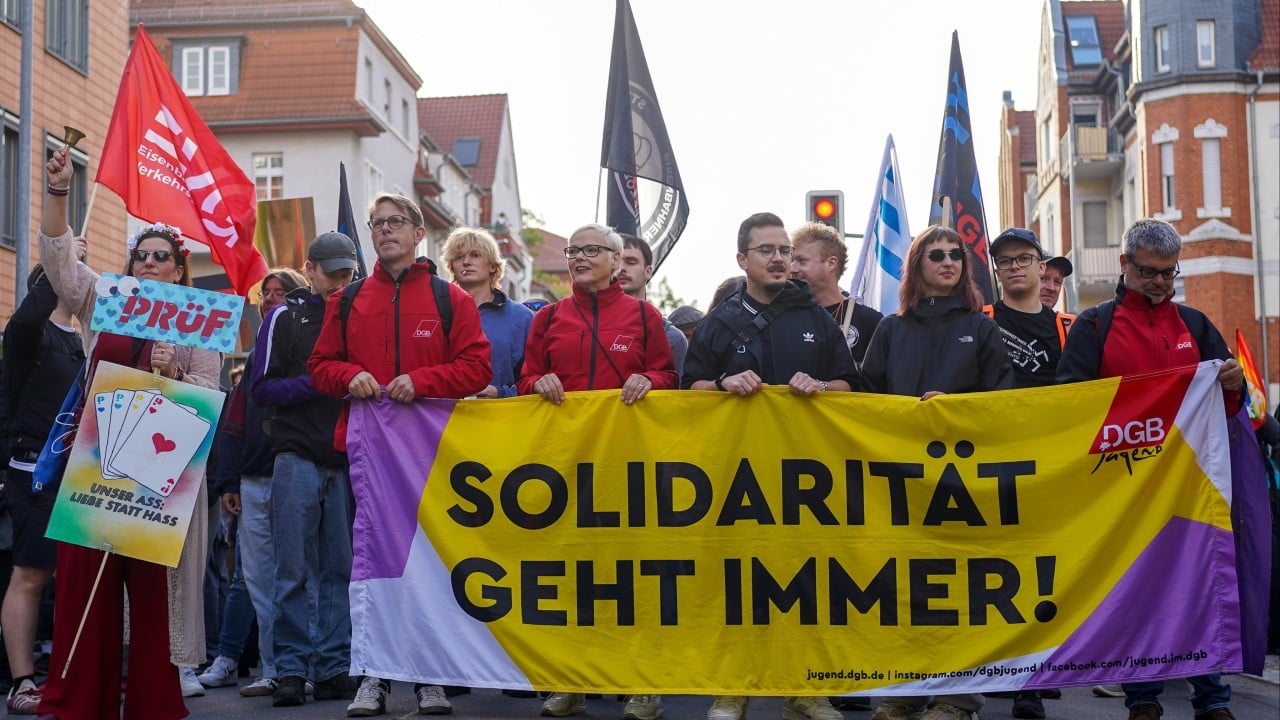
Hundreds of thousands of Germans have taken to the streets to protest against the far-right Alternative for Germany (AfD) party, marking a massive wave of civil mobilization. The immediate catalyst was a leaked report exposing a secret meeting where senior right-wing figures discussed "remigration"—a euphemism for the mass deportation of millions of immigrants and citizens deemed insufficiently assimilated. While mainstream media frames these protests as a definitive turning point for German democracy, the underlying political mechanics suggest a much more complex reality. The rallies mask a profound structural shift in European politics. If the establishment relies solely on moral outrage to counter the AfD, it will fail.
The Secret Meeting That Broke the Levee
For years, the AfD operated on the fringes of acceptable political discourse, gradually moving from an anti-Euro technocratic party to an ethno-nationalist force. The breaking point arrived when Correctiv, an investigative journalism outlet, revealed details of a November gathering at a hotel near Potsdam.
Among the attendees were high-ranking AfD officials, neo-Nazi activists, and wealthy backers. The central agenda item was a strategic plan for systemic deportations. The inclusion of naturalized German citizens in this plan crossed a red line for the broader public, triggering immediate flashbacks to the darkest chapters of twentieth-century German history.
The public reaction was swift. In Munich, Berlin, Hamburg, and Frankfurt, crowds swelled far beyond official expectations, paralyzing city centers.
The scale was undeniable. It demonstrated that a silent majority was willing to stand up for the constitutional order. However, street protests are a lagging indicator of public anxiety, not a leading indicator of political change.
The Failure of the Cordon Sanitaire
For a decade, Germany's mainstream political parties relied on a strategy known as the cordon sanitaire—a systematic refusal to form coalitions or work with the AfD at any level of government. The goal was simple. Isolate the party, label it untouchable, and wait for its internal contradictions to destroy it.
That strategy is completely broken.
Instead of suffocating the AfD, isolation allowed the party to position itself as the sole authentic alternative to a failing political establishment. When every major party from the center-right CDU to the leftist Greens forms a unified front, voters who are deeply dissatisfied with the status quo see only one option for a protest vote. The AfD capitalized on this, building a robust parallel media ecosystem that bypassed traditional journalistic scrutiny entirely.
Economic Anxiety and the Green Transition
To understand why the AfD commands over 20 percent of the electorate in national polls—and significantly more in the former East Germany—one must look beyond ideology to the material conditions of the German working class.
Germany’s economic model, long the powerhouse of Europe, was built on two pillars: cheap Russian energy and booming export markets in China. Both pillars collapsed simultaneously. The war in Ukraine forced an abrupt decoupling from Russian gas, while global supply chain shifts cooled the export engine.
Simultaneously, the federal coalition government pushed through aggressive, expensive decarbonization policies. The "Heating Law," which mandated the replacement of fossil-fuel heating systems with eco-friendly heat pumps, became a symbol of Berlin's perceived disconnect from regular citizens. For a homeowner in a struggling town in Saxony or Thuringia, the law felt like an existential financial threat imposed by urban elites.
The AfD did not need to craft complex economic theories. They simply pointed at the rising energy bills and the shuttering factories, attributing the pain entirely to the government's climate agenda and immigration costs.
The East West Divide That Never Closed
More than three decades after the fall of the Berlin Wall, Germany remains a deeply divided nation psychologically and economically. The anti-AfD protests were massive in western cities, but noticeably smaller and more fraught in the East.
+-----------------------------------+-----------------------------------+
| Western Federal States            | Eastern Federal States            |
+-----------------------------------+-----------------------------------+
| Stronger institutional trust      | Widespread institutional skepticism|
| Higher average household wealth   | Lower wages, fewer corporate HQs  |
| Protests viewed as civic duty     | Protests viewed as establishment  |
|                                   | interference                      |
+-----------------------------------+-----------------------------------+
In the East, many citizens view the current political order through the lens of the post-1989 transition, which saw local industries liquidated and millions of easterners treated as second-class citizens. When mainstream politicians warn that the AfD threatens democracy, a significant portion of the eastern electorate responds with deep skepticism. To them, the "democracy" being defended is a system that left them behind. The AfD has successfully rebranded itself as the true champion of the eastern underdog, turning grievance into a potent electoral currency.
The Legal Dilemma of a Party Ban
As protests filled the streets, a contentious debate moved to the forefront of the legal community: whether to petition the Federal Constitutional Court to ban the AfD entirely under Germany’s concept of a "defensive democracy" (streitbare Demokratie).
The German constitution allows for the prohibition of parties that seek to undermine or destroy the democratic order. It is a high-stakes legal mechanism designed precisely to prevent an authoritarian takeover from within.
However, invoking this option carries catastrophic risks.
A ban requires ironclad proof that the party actively intends to overthrow the constitutional system through aggressive, unconstitutional means. The legal proceedings would take years. During this time, the AfD would paint itself as a martyr, arguing that the establishment is using the courts to subvert the will of millions of voters because it cannot win at the ballot box. If the court challenge failed, it would serve as an official judicial stamp of approval, supercharging the AfD’s legitimacy.
The Limits of Moral Outrage
Rallies provide an emotional release for a worried populace, but they do not solve structural political crises. History shows that sustained political movements require more than opposition to an enemy; they require a compelling, viable alternative vision for the future.
The current federal coalition, plagued by internal bickering over budget deficits and social spending, has struggled to offer that vision. When the banners are packed away and the protesters return home, the fundamental issues driving the AfD’s rise remain completely unaddressed. High inflation, a crumbling infrastructure network, a strained social safety net, and a lack of a coherent, managed immigration strategy continue to erode public trust in governance.
Relying on citizens to repeatedly take to the streets to defend the status quo is an unsustainable strategy. Democracy cannot be preserved by merely shouting down its critics; it must actively demonstrate its utility by solving the material problems of the people it serves. The crowds in Germany have bought the political establishment some time, but the clock is ticking loudly.