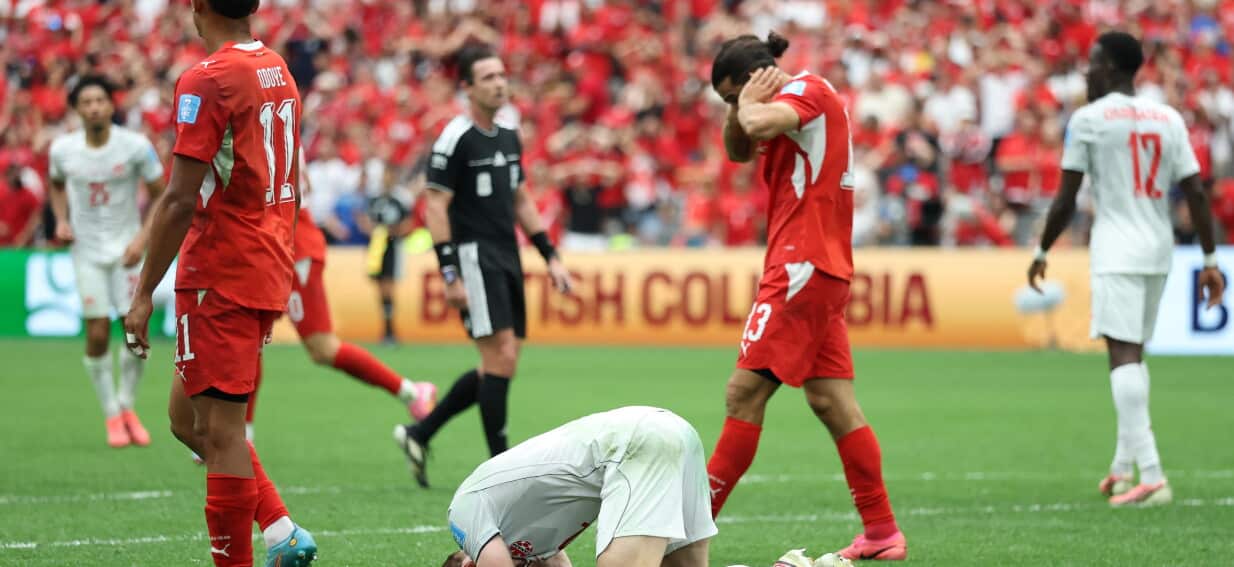
The sound did not travel through the stadium speakers, but everyone on the pitch heard it. A sharp, sickening crack. It is a noise that haunts every professional athlete, a sudden acoustic betrayal that instantly divides a career into two distinct eras: before and after.
On one side of the grass lay Ismaël Koné, the rising star of Canadian soccer, gripping his leg as the realization of a stolen season washed over him. On the other stood Assim Madibo, the Qatari midfielder whose reckless challenge had just altered the trajectory of both their lives.
Sports media treated the incident like a standard ledger entry. A five-match ban for Madibo. A fractured bone for Koné. The cold math of athletic discipline. But a broken leg in international football is never just a medical report, and a suspension is never just a vacation. When the bones of a young athlete break, the shockwaves ripple through families, national team depth charts, and the fragile psychology of competitive sports.
The Anatomy of a Split Second
Football at the highest level moves at a terrifying velocity. Players are required to make high-stakes decisions while sprinting at top speed, surrounded by bodies moving just as fast. It is a game of margins so thin that a millisecond’s delay in a tackle transforms a brilliant defensive stop into a catastrophic injury.
When Madibo lunged into the challenge during the international fixture, he likely wasn't looking to cause harm. Midfielders are conditioned to be the enforcers, the human roadblocks who disrupt the opponent’s rhythm. But desperation breeds recklessness. In that brief moment, the Qatari player miscalculated the distance, the timing, and the sheer force of his own momentum.
Consider the sheer physical reality of a tackle like that. A human shinbone can withstand tremendous pressure vertically, but lateral impacts from a studded boot acting as a fulcrum are devastating. When Madibo’s weight crashed into Koné’s planted leg, the physics were unforgiving.
The whistle blew. The referee reached into his pocket. But the red card felt entirely secondary to the human drama unfolding on the turf.
The Weight of the Invisible Stakes
For Koné, the injury represents the ultimate athletic nightmare. To understand the depth of this setback, one must understand what it takes for a player from the North American system to establish themselves on the global stage. Every match is an audition. Every minute on the pitch is a hard-fought privilege.
Imagine spending a lifetime honing your body, turning it into a precision instrument capable of competing with the best athletes on Earth, only to have it broken by someone else's carelessness. The mental recovery from a fractured leg is often far more grueling than the physical rehabilitation. A surgeon can align the bone, insert the titanium rods, and stitch the skin back together.
But who repairs the confidence?
When Koné eventually returns to the pitch, that split second will still live in his muscle memory. The next time he sees a defender lunging toward him out of the corner of his eye, his brain will scream at him to protect himself. Hesitation kills performance. Overcoming that phantom fear is the silent battle every injured player fights in empty gymnasiums long after the crowds have stopped thinking about them.
Meanwhile, the narrative surrounding Madibo shifted quickly from athletic aggression to institutional punishment. The governing body handed down a five-game suspension, a penalty meant to send a clear message about player safety.
Yet, a five-game ban feels fundamentally asymmetric. Madibo will sit out a handful of matches, train with his club, maintain his fitness, and return to the game relatively unscathed. Koné faces months of immobility, painful physical therapy, and the terrifying uncertainty of whether he will ever regain his explosive first step.
The Culture of the Limit
This incident forces a hard look at the thin line between competitive intensity and dangerous play. Coaches often praise players who "play on the edge." We celebrate the warriors who throw their bodies into harm's way for the badge on their shirt.
But we rarely reckon with the cost when someone falls off that edge.
Madibo’s suspension is a reminder that the rules of the game exist to protect the players from their own adrenaline. When those rules are crossed so violently that a peer’s livelihood is threatened, the sport loses its luster. It ceases to be a display of beautiful skill and becomes a game of survival.
The Canadian national team must now navigate a crucial stretch of their journey without one of their brightest talents. The tactical systems must be rewritten. Other players must step into the void. The fans will watch the upcoming matches with a lingering sense of what could have been.
The stadium lights eventually turned off that night, and the news cycle quickly moved on to the next kickoff, the next transfer rumor, the next controversy. But in a quiet hospital room, the long, silent road back to the pitch was just beginning.
The true cost of a reckless tackle is never paid by the man who commits it. It is paid in the dark, away from the cameras, by the player trying to remember how to walk without pain.