The coffee in the corner bistro of Düsseldorf was lukewarm, the foam already collapsing into a sad gray ring against the ceramic. Across the table, a retired machinist named Stefan stared through the rain-streaked window at a billboard bearing the crisp, confident smile of Friedrich Merz.
"He looks like he owns the bank," Stefan muttered, wiping a drop of condensation from his thumb. "And maybe he does. But he doesn't know what it costs to fill a cart at the discounter anymore."
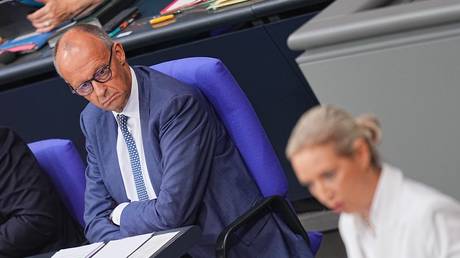
That sentiment, muttered in kitchens and train stations from the Ruhr Valley to the rolling hills of Bavaria, has begun to transform the tectonic plates of European politics. Recent polling numbers reveal a startling contraction: support for Merz’s Christian Democratic Union and its Bavarian sister party, the CSU, has hit a sharp, uncomfortable low. Simultaneously, the Alternative for Germany, the AfD, continues its relentless upward climb, gathering the discontented and the disillusioned into a movement that mainstream leaders long dismissed as a passing storm.
To understand this shift, one must abandon the sterile vocabulary of spreadsheets and focus groups. This is not merely an electoral fluctuation. It is a profound, visceral anxiety about identity, security, and the feeling of being left behind by a country that is changing too fast to follow.
Consider the kitchen table physics of modern survival. For decades, the promise of the German republic was simple: work hard, pay your taxes, keep your head down, and the foundation will hold. The autobahn will be paved, the hospitals will run, and your children will inherit a standard of living slightly better than your own. That social contract, forged in the ashes of the twentieth century, is fraying at the edges.
When inflation bites into grocery budgets and heating bills double, abstract macroeconomic metrics lose their persuasive power. Voters do not care that GDP is technically stable if their local bakery has shut its doors after three generations because the gas bill tripled.
Merz, a wealthy corporate lawyer with a private pilot's license and a demeanor that radiates boardroom certainty, was supposed to be the antidote to years of managerial stagnation. He promised competence. He promised a return to traditional conservative values, fiscal discipline, and a sharper edge against illegal immigration. Yet, as the polls show, his message is stalling precisely where it needs to resonate most: among ordinary wage earners who feel squeezed between high taxation and deteriorating public infrastructure.
The paradox of the conservative platform right now is that it speaks the language of corporate efficiency to an electorate crying out for human sanctuary. When a voter hears a leader talk about structural reforms and debt brakes, what they often translate it to is more austerity, longer hours, and less help when the floor drops out.
And into that vacuum steps the AfD.
To call the AfD's rise a simple protest vote is to misunderstand the gravity of the phenomenon. Protest votes are temporary; they fade when the rain stops. This is structural. The party has mastered the art of weaponizing legitimate grievances—fears over housing shortages, cultural integration, and deindustrialization—and channeling them into a fierce, nativist narrative. They offer simple, brutal answers to agonizingly complex problems. Close the borders, abandon the green transition, restore national sovereignty, and everything will go back to the way it was in 1995.
It is a nostalgic fairy tale. But fairy tales are powerful things when the present feels like a cold draft through a broken window.
Down the street from Stefan’s apartment, a young software developer named Lena sorts through recycling bins and wonders why her rent consumes sixty percent of her net income. She doesn't vote for the right, and she finds the conservative establishment stuffy and out of touch. But she is exhausted. She watches the political class argue over bureaucratic minutiae while the train system collapses into a daily comedy of delays and cancellations.
"Nobody is talking about the future," she says, her fingers tapping a nervous rhythm against her phone. "They are just managing the decline. Everyone is just trying to make sure they aren't the ones holding the bag when the music stops."
This is the invisible crisis facing Merz and the traditional center-right. They are caught in a historic pincer movement. On one side, the governing coalition pulls them toward technocratic compromises that satisfy neither the left nor the right. On the other, the insurgent right nibbles away at their base by tapping into a well of raw, unedited anger.
To reverse this slide, conservative strategists keep looking for better slogans, sharper soundbites, sharper angles on television debates. They miss the point entirely. You cannot algorithm your way out of a crisis of belonging.
Trust is not built in a television studio. It is rebuilt block by block, railway line by railway line, clinic by clinic. It requires acknowledging that the green transition and economic modernization have inflicted real pain on working communities, and that acknowledging that pain is not a sign of weakness, but the prerequisite for leadership.
Outside, the rain has turned into a steady, gray mist, blurring the edges of the Düsseldorf skyline. Stefan finishes his lukewarm coffee, leaves a few coins on the saucer, and pulls his woolen scarf tight against his throat. He walks out into the damp afternoon, stepping past a campaign poster that flutters loosely against a lamppost, the adhesive failing at the corners, peeling away a little more with every passing gust of wind.