Cold Tracks
Silence in the backcountry isn't peaceful. It's heavy.
If you spent any time walking the northern borders of Washington’s Mount Rainier National Park over the last twenty-four months, you felt it. The quiet wasn't the calm of a pristine wilderness. It was the unnatural stillness of an empty stage.
Two years ago, the pack vanished. Poison, legal removals after livestock conflict, or perhaps just the brutal mathematics of survival in a fractured forest—whatever the precise combination of causes, the result was absolute. The local pack died out. Just like that, the ridge lines went mute.
People like to think of wildlife management as a spreadsheet. You count the animals, you adjust the quotas, you draw a line on a map, and you call it balance. But ecosystems aren’t balance sheets. They are conversations. And when a key voice suddenly stops talking, everything else starts to scream.
The Weight of an Invisible Absence
Ask a park ranger what happens when apex predators vanish, and they won't show you a picture of a wolf. They'll show you a picture of a riverbank.
Without wolves moving through the timber, elk stop looking over their shoulders. They linger. They lounge by the creek beds like tourists who overstayed check-out time. They eat every tender willow shoot, every sapling, every blade of green cover until the banks crumble into the water. The creeks run warm and muddy. The trout die off. The songbirds move away.
It is a slow, gray collapse disguised as peace.
For two years, the biological machinery of the park ran without its governor. Biologists walked the trails, scoured the muddy washes, and set up infrared trail cameras aimed at game paths. Month after month, the memory cards came back empty. Just deer, raccoons, and the occasional black bear shuffling through the underbrush.
Reintroduction isn't as simple as driving a truck up to a trailhead, dropping a tailgate, and wishing a crate of wild animals good luck. Wolves don't care about park boundaries. They don't respect the invisible lines drawn by state legislatures or county sheriffs. Bring them back without community buy-in, and you aren't restoring nature—you are just setting up another tragic cycle of conflict, fear, and dead animals.
So the park waited. The biologists logged their data. The riverbanks kept wearing away.
A Shadow Against the Treeline
Then came the thaw.
It started with an unverified report from a timber cruiser working near the park boundary—a brief glimpse of a long-legged canine silhouette crossing an old logging road at dusk. Too big for a coyote. Too purposeful for a stray dog.
A week later, the motion-activated cameras caught what human eyes had missed.
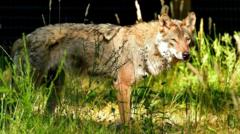
First, a single photo, blurred by snow flurries: a broad head, small rounded ears, and eyes that reflected the camera's infrared flash like cold burnished copper. Then, a second frame captured a second animal following close behind, its nose pressed to the snow, tracing the scent trail of its partner.
A male and a female. A pair.
They didn't arrive in a crate. They didn't come with radio collars attached by federal officials. They walked back on their own four feet, navigating miles of working forest, highway crossings, and human development to find the empty territory their predecessors had lost.
Two years of silence broken by a set of deep, four-toed tracks pressed into the slush.
Why We Need the Fear
It is easy to romanticize predators from the comfort of a heated kitchen. It is much harder when you live downwind of the timberline, where livestock represents a family's mortgage payment and a dark night feels a little darker when you know something is hunting out there in the timber.
That tension is real. Ignoring it is why the previous pack died in the first place.
True conservation doesn't happen in courtrooms or classrooms; it happens at kitchen tables over stale coffee, where ranchers, biologists, and local residents figure out how to share a landscape with an animal that doesn't care about human livelihoods. Fladry—bright red flags strung along fence lines to spook wary canines—range riders, and herd-guarding dogs are replacing rifles. It's harder work. It requires patience. But it’s the only way to ensure those new tracks in the snow aren't just another temporary blip.
The return of the pack isn't just a win for biodiversity metrics. It is a reality check.
An ecosystem with its top predators intact is slightly unpredictable, a bit dangerous, and entirely alive. It reminds us that nature isn't a suburban park designed for our leisure, but an ancient, working system that operates on rules far older than our laws.
The willow shoots along the riverbanks will take time to recover. The elk will start moving again, nervously scanning the tree lines, keeping their herds tight and cautious. The trout will eventually find shade under reborn creek-side foliage.
The conversation has started again. All we have to do is listen.