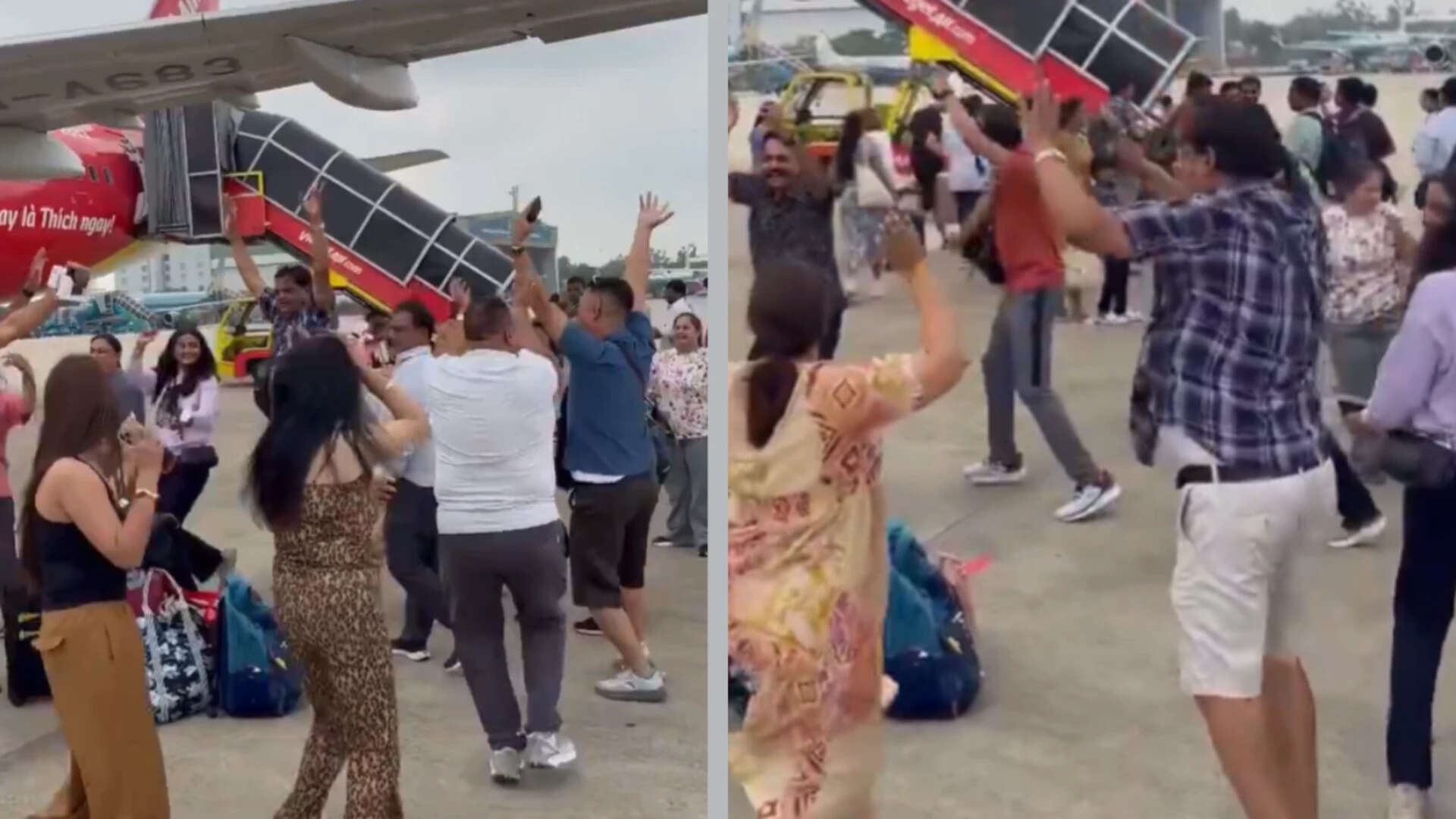
The internet is currently having a collective meltdown over a viral video. A group of Indian tourists decided to break out into a spontaneous performance of Garba—a traditional Gujarati folk dance—right on the tarmac at an airport in Vietnam.
Predictably, the comment sections erupted. Critics rushed to line up, weaponizing phrases like "reinforcing stereotypes," "crass behavior," and "embarrassing the nation abroad." Mainstream media outlets quickly amplified the scolding, framing the incident as a textbook case of bad tourist etiquette and a failure of cultural decorum. For an alternative view, consider: this related article.
They are completely missing the point.
The outrage over the tarmac Garba isn't actually about safety, and it certainly isn't about etiquette. It is a symptom of a deeply sanitized, sterile, and borderline authoritarian shift in how we view public spaces and international travel. We have become so conditioned to accept the misery of modern transit that when a group of people injects genuine human joy into a concrete wasteland, we brand them as criminals. Further coverage on this trend has been published by AFAR.
It is time to dismantle the lazy consensus of the travel purists.
The Myth of the Sacred Tarmac
Let's address the immediate, knee-jerk defense used by the outrage mob: safety and operational disruption.
To hear the critics tell it, you would think these travelers blocked a Boeing 777 mid-taxi or wandered into the path of a baggage tractor. They didn't. The video clearly shows the passengers dancing in a designated, cordoned-off walking lane while waiting to board a low-cost carrier bus.
As someone who has spent two decades navigating international aviation hubs, dealing with civil aviation authorities, and analyzing airport logistics, I can tell you exactly what a real tarmac hazard looks like. A real hazard is an unescorted passenger wandering into the fuel-servicing zone. A real hazard is loose debris—Foreign Object Debris (FOD)—left near an engine intake.
A group of people clapping and stepping in a rhythmic circle for 45 seconds while waiting for a delayed shuttle bus is not an operational crisis.
Airports have successfully weaponized the concept of "security" to strip away every ounce of human dignity from the travel experience. We accept being herded like cattle, stripped of our shoes, overcharged for water, and forced to sit on cold linoleum floors during three-hour delays. Yet, the moment a group refuses to sit in miserable silence and instead chooses to celebrate, the internet treats it as a breach of international law.
The tarmac isn't a sacred temple. It is a parking lot for airplanes. Treat it like one.
The Classist Undercurrent of Cultural Gatekeeping
The loudest complaints about the Vietnam incident don't actually come from local Vietnamese authorities or airline staff. They come from affluent, self-loathing compatriots who are terrified of looking "uncivilized" to the Western world.
This is respectability politics at its absolute worst.
There is a distinct double standard in how we judge public displays of culture. Consider these scenarios:
- When Irish football fans take over a public square in Copenhagen or Bordeaux, singing at the top of their lungs and spilling beer, the travel media calls it "infectious passion" and "local color."
- When a flash mob of theater students does a synchronized routine in the middle of London's St. Pancras station, it gets millions of views and a heartwarming headline on evening news segments.
- When a group of brown tourists performs a folk dance at a gate in Hanoi, it is labeled "cringe," "loud," and "backward."
This hypocrisy is rooted in a desire to conform to a Eurocentric ideal of the "perfect traveler"—silent, invisible, spending money quietly, and blending into the background. The critics are projecting their own deep-seated insecurities about identity onto a group of people who simply do not care about seeking validation from the global elite.
The Pathology of the Modern Sanitized Traveler
We have entered an era of hyper-individualistic travel where any deviation from absolute silence in public space is treated as an assault.
The modern traveler wants to exist in a bubble. They want noise-canceling headphones on, eyes glued to a screen, moving through airports and cities without ever interacting with a soul or experiencing an unscripted moment. To these people, friction is an existential threat. And to them, culture is something that should only exist where it is invited—inside a museum, a ticketed theater, or a curated resort performance.
When real culture spills over into the mundane reality of an airport delay, it shatters that illusion. It forces people to acknowledge that they are sharing space with a vibrant, living world that refuses to be quieted for their comfort.
Imagine a scenario where every culture completely conformed to this sterile ideal. Travel would become entirely transactional. Every airport would look, sound, and smell exactly like a sterile medical clinic. If that is your idea of a perfect journey, you don't actually want to travel; you just want to arrive.
The Operational Reality: Aviation Has Bigger Problems
If the aviation industry wants to fixate on things that actually ruin the travel experience, they can start by looking at their own balance sheets and operational failures rather than a brief dance circle.
| Disruptive Behavior | Real Impact on Travel Experience |
|---|---|
| Spontaneous Folk Dancing | Zero delays. Minor social media noise. Temporary distraction. |
| Aggressive Air Rage (Alcohol-induced) | Flight diversions. Thousands of dollars in fuel costs. Physical danger to crew. |
| Overbooking and Cancellations | Systemic misery. Stranded families. Massive financial losses for consumers. |
| Predatory Baggage and Seat Fees | Psychological wear and tear on passengers before they even board. |
The aviation industry is fundamentally broken. Delays are at an all-time high, service quality has plummeted, and passenger tempers are permanently on a hair-trigger. In this pressure cooker environment, criticizing passengers for finding a harmless, sober outlet to pass the time is a spectacular misallocation of outrage.
Stop Trying to Fix Tourist Behavior
The travel industry loves to issue manifestos on how to be a "good tourist." They publish guides on quiet zones, proper queuing, and spatial awareness.
It is entirely the wrong approach.
The best travel experiences are inherently messy, loud, and unscripted. The people dancing in Vietnam were not vandalizing property, they were not harassing staff, and they were not delaying the flight. They took a moment of collective boredom and transformed it into a shared cultural experience.
If your sense of order is so fragile that a 45-second display of communal joy ruins your day, the problem isn't the people dancing. The problem is you.
Pack your noise-canceling headphones, stare at your phone, and let the rest of the world live.