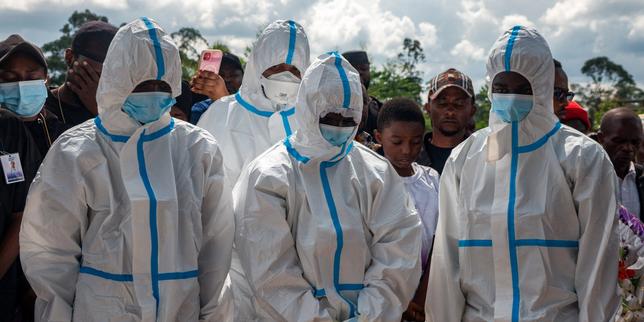
Five thousand three hundred deaths.
Say that number slowly in a quiet room until the syllables lose their crispness and turn into weight, into wood, into red laterite mud drying beneath a equatorial sun. On a screen, a death toll above 5,300 across Africa—with the overwhelming share concentrated in the Democratic Republic of the Congo—reads like a finished ledger. A sober line in a wire report. A tally you scroll past while waiting for coffee to brew.
Stop.
Numbers are tidy. Outbreaks are not. A spreadsheet never shows the wet plastic apron sticking to a nurse's shoulders at noon, nor the way a mother hesitates before touching her child's forehead when fear has made every warm skin feel like a spark near dry thatch.
To understand what a toll beyond 5,300 deaths in Africa—and overwhelmingly in the Democratic Republic of the Congo—actually means, we have to step out of the summary box and walk into the heat, the distrust, the exhaustion, and the quiet acts of courage that never make the headline.
The Weight of a Number That Refuses to Sit Still
When a news report states that an Ebola epidemic has claimed more than 5,300 lives across Africa, most of them in the Democratic Republic of the Congo, it compresses years of grief, frantic logistics, and fragile recoveries into a single sentence. A reader thousands of miles away sees a statistic and asks a reasonable question: Why does this keep happening in the Congo?
No single answer survives contact with reality. Geography plays a role, of course—vast distances, unpaved roads that turn into rivers of red clay when the rains arrive, and dense forest corridors where wildlife and human settlements brush against one another. Yet geography alone does not pull people into harm's way. Vulnerability does.
Consider what happens when a family has already survived displacement, economic strain, or years of uneven access to basic clinics. When a sudden fever strikes—starting with aching joints, a crushing headache, exhaustion that feels heavier than lead—it looks at first like malaria, typhoid, or simple burnout. You do not immediately picture a hemorrhagic fever. You reach for what you know. You call a relative. You care for the person you love because love, in every culture on earth, is built on touch.
That is the cruelest trap of Ebola. The very reflexes that hold a household together—holding a shaking hand, wiping a brow, washing a body with reverence after death—are the exact pathways the virus uses to jump from one life to the next.
I have stood in clinics where the air smelled of bleach so sharp it stung the back of the throat, watching exhaustion settle into people's eyes long before evening fell. Even when you know the science, even when you have drilled the protocols until your hands move on muscle memory, fear still whispers. You hear a cough or see a sudden nosebleed and your stomach drops an inch. If I am honest, the hardest part of outbreak work was never putting on the protective gear; it was taking it off without letting a single mistake slip through, knowing how unforgiving the margins are.
A Hypothetical Evening in a Forest Edge Town
To make the mechanics of an epidemic concrete rather than abstract, let us trace a hypothetical scenario set in a small town along a forested trade route in the Democratic Republic of the Congo. The characters and exact sequence below are invented to illustrate real epidemiological dynamics, not a report of a specific real-world person.
Call the town Mbanda—not a real village name in this story, just a crossroads where motorbikes, canoes, and market traders meet before dusk. Call the young clinic nurse Beatrice, and call the elder shopkeeper Jonas.
On a Tuesday evening, Jonas comes to the small health post complaining of a fever that spiked after three days of body aches and vomiting. Beatrice has seen dozens of fevers that week. Most were malaria. A few were stomach illnesses. She checks his pulse, asks where he traveled, and notices his eyes are bloodshot and his energy is hollow—not the sharp misery of ordinary flu, but a heavy, drained stillness.
Because this is a hypothetical scenario, we can slow down the clock and watch two invisible races unfold at once.
Race one is biological. Inside Jonas's body, the filovirus is multiplying rapidly, targeting immune cells and lining of blood vessels, triggering severe fluid loss and inflammation that can overwhelm organs if supportive care arrives too late. Transmission does not happen through casual air the way a cold spreads; it requires direct contact with blood, secretions, organs, or other bodily fluids of a sick or deceased person, or contaminated surfaces.
Race two is social. By Wednesday morning, Jonas's sister has tended to him through the night. A neighbor has lent a motorcycle to carry him toward a larger facility. Rumors have already started moving faster than the motorbikes: The clinic takes people away and nobody comes back the same.
That rumor is not irrational. Imagine watching ambulances arrive with strangers in white or yellow suits who speak unfamiliar terms, watching loved ones isolated behind barriers where you cannot hold them, and hearing conflicting stories about what is happening inside. If a stranger in full protective gear walked into your home and told you not to touch your mother while she cried for water, would you trust them on instinct alone?
Most people wouldn't. I wouldn't either.
Why Distrust Is Not Ignorance
Outsiders often mistake caution during an outbreak for stubbornness. That is a mistake that costs lives.
To understand community resistance in places like the Democratic Republic of the Congo, picture a house built on shifting sand. If the foundation has been shaken for decades by conflict, economic hardship, or uneven public services, a new visitor arrives promising blueprints for safety—yet the residents have seen promises collapse before. Skepticism becomes armor.
When responders arrive with sirens, checkpoints, and rigid rules around burial practices, tensions flare. Traditional funerals in many communities are sacred farewells that honor the dead and settle grief for the living. When public health teams insist on safe and dignified burials to stop post-mortem transmission—because bodies after death can carry high viral loads—a clash of values can erupt overnight. A burial is not a technical procedure to a grieving family. It is goodbye.
Think of contact tracing as a metaphor—explicitly a metaphor—for following a thread through tall grass after dark. You cannot see the whole path at once. You hold one strand at a time—who sat beside the patient, who shared a meal, who rode in the same vehicle—and tug gently so the thread does not snap. If people hide symptoms out of fear of stigma or quarantine, the thread breaks in the dark. Every broken thread forces responders to search blind while new chains of transmission quietly form.
Yet when responders slow down—when they sit on low stools instead of standing over families, listen to local leaders, adapt burial customs safely so families can still mourn with dignity, and explain why isolation protects the rest of the household—the thread holds. Trust is never built by command. It is earned one conversation at a time.
The Invisible Stakes Beyond the Border
Why should someone reading from a quiet apartment or office on another continent care about an epidemic toll passing 5,300 deaths in Africa?
Self-interest is part of it, though it is never the whole story. Modern travel links distant cities within hours. A localized outbreak in a remote district is not sealed inside a glass jar; every transport corridor, market hub, and cross-border route connects local health security to global health security. When an outbreak is starved of resources early, it lasts longer, stretches frontline workers thinner, and creates more opportunities for transmission to widen.
But reducing human suffering to a security calculation misses the deeper truth.
Every single person behind a number above 5,300 had a voice, a laugh, a role in a family, a plan for next week. Behind every survivor who walked out of a treatment center—weak, trembling, blinking in harsh sunlight, carrying both relief and the heavy weight of stigma—stands a community trying to stitch itself back together.
Treatment has come a long way compared to the earliest decades of Ebola history. Modern supportive care—aggressive fluid and electrolyte replacement, close monitoring, and targeted medical therapeutics where available—has dramatically improved survival odds when patients reach care early. Early detection changes everything. Reaching a clinic on day two instead of day seven can be the difference between recovery and tragedy.
Still, medicine alone cannot outrun delay. A clinic ten miles away over flooded tracks might as well be on another planet if there is no safe transport, no fuel, or no confidence that going there will help.
What Happens When We Stop Looking Away
Epidemics have a strange rhythm. While cases climb, cameras point toward the region; briefings fill with charts, daily tallies, and urgent appeals. Then, as control measures take hold and numbers dip, attention drifts elsewhere—even though the recovery phase is often where communities feel the deepest aftershocks.
Children orphaned by the outbreak still need schooling and care. Survivors still face joint pain, vision changes, fatigue, and unfair whispers from neighbors who fear contagion long after recovery. Local health workers—who bore the highest risk of exposure before full protections and rapid response systems were in place—still carry memories that do not fade simply because a press release declares an outbreak over.
Consider what happens next: a new cluster of fever appears months or years later near a forest margin. If the local health system was left hollowed out after the headlines faded, responders start almost from scratch. If clinics, laboratories, local surveillance teams, and community partnerships were strengthened and kept active, the response moves in hours instead of weeks.
Speed is mercy. Preparedness is love made practical.
A headline saying an epidemic has caused over 5,300 deaths in Africa, mostly in the Democratic Republic of the Congo, gives you the scale of a tragedy. It cannot give you its soul. The soul of the story lives in the nurse wiping sweat from her brow before her next shift, the family negotiating a safe farewell that still honors love, the epidemiologist tracing a single contact by lantern light, and the survivor stepping back into the sun.
Count the numbers if you must—they remind us how high the stakes climb when neglect meets a fast-moving virus—but never forget that every single digit was once someone holding another person's hand.