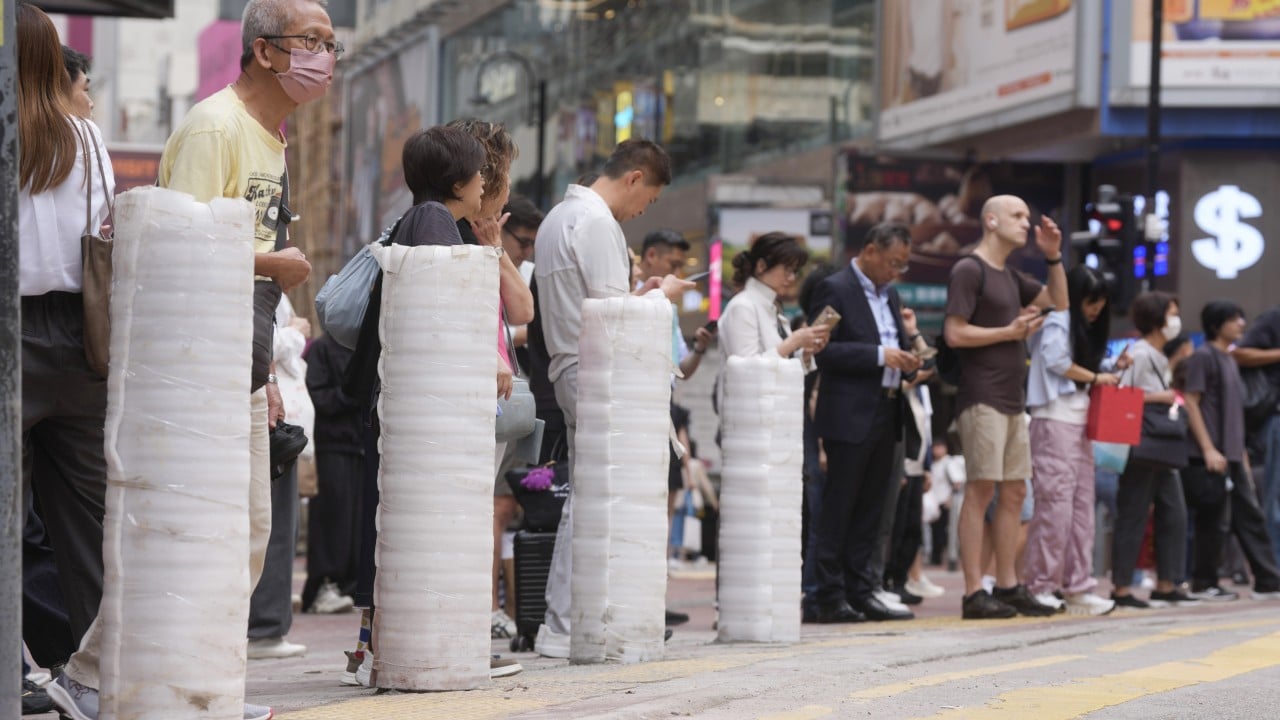
Steel. Cold, brushed, cylindrical steel, bolted straight into the concrete where thousands of tired feet drag themselves toward the MTR station every evening at six.
If you have ever stood at the Sogo crossing in Causeway Bay on a humid Friday night, you know the specific, suffocating choreography of that corner. Neon bleeds onto wet asphalt. Double-decker buses exhale hot diesel against your shins while the pedestrian light ticks down with frantic, mechanical urgency, and a river of shoppers, office workers, and tourists surges forward in a single, compressed tide. For decades, the only barrier between that sea of human flesh and two tons of speeding metal was a six-inch granite curb and the shared, unspoken agreement that drivers would stay on the asphalt and walkers would stay on the stone.
Now, there are posts. Dozens of them, rising out of the pavement like silver mushrooms after a rainstorm, part of a HK$5 million government rollout designed to stop a vehicle from ever mounting the pavement at high speed.
Walk past them today and you will hear two completely different cities arguing over the exact same piece of iron.
The Architecture of Invisible Fear
To understand why a row of metal pipes can spark such fierce debate in Hong Kong, you have to look at what happens when a city tries to insure itself against a nightmare it has never actually lived through.
Consider a hypothetical scenario—let us call her Mei, a seventy-two-year-old retired seamstress who pushes a folding wire cart down Jardine’s Bazaar every morning for fresh bok choy. Mei does not read urban security white papers. She does not track international counter-terrorism trends. What Mei knows is that the sidewalk near Russell Street was already barely wide enough for two people carrying umbrellas to pass without tangling their ribs, and now there is a row of thick steel cylinders eating into the margin where she used to pull aside to catch her breath. To Mei, the bollards are not a shield. They are an obstacle course.
Now stand ten feet away and meet David, a hypothetical civil engineer who spent fifteen years designing crowd-flow infrastructure in London before moving back to Hong Kong. When David looks at those same steel posts along Lockhart Road and Hennessy Road, he does not see clutter. He sees kinetic math. He remembers Nice, France, in 2016. He remembers Westminster Bridge and Barcelona’s Las Ramblas—places where ordinary people licking ice cream or checking their phones were turned into casualties in seconds because an attacker realized a rented delivery van requires no bomb-making skills, no black-market firearms, and no warning.
Both Mei and David are telling the truth. That is what makes this HK$5 million project so disarmingly complicated to live with.
The Hong Kong Police Force and the Transport Department did not wake up one morning and decide Causeway Bay needed more street furniture. Following global shifts in security doctrine—and heightened domestic sensitivity after years of social unrest and isolated lone-wolf incidents—authorities began identifying high-density pedestrian zones where crowds gather without escape routes. Causeway Bay, consistently ranked among the most expensive and densely packed retail corridors on Earth, sat right at the top of that spreadsheet.
How Hostile Vehicle Mitigation Actually Works
Most people glance at a bollard and assume it is just a thicker version of the flimsy gray railings Hong Kong uses to keep jaywalkers off the road. It is not.
Think of a standard roadside railing like a fence made of dry twigs; a runaway lorry snaps it without losing five kilometers per hour. A certified anti-terrorism bollard—what security planners call Hostile Vehicle Mitigation, or HVM—is more like an iceberg. What you see above the granite tiles is barely a third of the machine. Beneath the surface sits a reinforced steel cage poured into deep concrete foundations, engineered to absorb the catastrophic kinetic energy of a multi-ton truck traveling at highway speeds and bring it to a dead halt within a single meter.
When a vehicle strikes one of these posts, the bollard does not merely block the bumper; it shears the axle, crushes the engine block downward, and anchors the chassis to the spot. It is brutal, silent physics disguised as street décor.
Yet that hidden depth is precisely why the rollout has felt so disruptive on the ground. Installing a simple signpost takes a crew an afternoon. Sinking deep-foundation security bollards into Causeway Bay means slicing open one of the most tangled underground nervous systems in Asia—a subterranean spaghetti of high-voltage cables, fiber-optic trunks, freshwater mains, and gas lines buried beneath centuries of reclaimed harbor. Every hole dug on Paterson Street or Great George Street requires weeks of utility mapping, nocturnal jackhammering, and temporary metal plates that rattle like thunder every time a taxi rolls over them at two in the morning.
Shopkeepers along the affected stretches have watched plywood hoardings choke off their storefronts during an already fragile retail recovery. For a boutique owner paying six-figure monthly rent in Causeway Bay, a fenced-off pavement outside the front door is not a minor inconvenience; it is a slow bleed on the balance sheet.
The Price Tag and the Question Nobody Wants to Ask
Five million Hong Kong dollars sounds massive until you divide it by the cost of modern civil engineering—and tiny until you ask what else that money might have bought in a district where elderly residents still climb six flights of stairs in walk-up tenements.
Let us be candid about the math. In the grand ledger of Hong Kong public works, where highway viaducts and reclamation projects routinely run into the tens of billions, HK$5 million is barely a rounding error. Spread across dozens of reinforced units, underground utility diversions, night-shift labor, and crash-rated certification testing, the budget actually tracks closely with international municipal benchmarks in cities like Singapore, Melbourne, and New York.
Still, numbers rarely soothe a skeptical public when the threat itself feels abstract.
Hong Kong remains, by almost every statistical measure, one of the safest cities on the planet. Violent street crime is vanishingly rare. Car-ramming terrorism has never claimed a crowd in Causeway Bay. Because of that, a vocal segment of residents and district observers views the bollards through a lens of suspicion—wondering aloud whether the steel posts are truly about hypothetical foreign-style terror attacks, or whether they serve a quieter dual purpose of controlling future street protests and hardening the urban grid against civic gathering.
That tension is impossible to ignore, and pretending it does not exist only deepens the mistrust. I have walked these blocks for years, and I can tell you that Hong Kongers possess a finely tuned radar for official explanations that tell half the story. When people see heavy steel hardware bolted into the exact intersections where massive marches once flowed, they do not just see counter-terrorism. They see the physical reshaping of public space.
At the same time, dismissive cynicism carries its own blind spot. Security planning is, by definition, a thankless profession built on paradox: if a barrier works, nothing happens, and critics call the spending a waste; if the barrier is never built and the unthinkable occurs, the same critics ask why the government sat on its hands while every other global financial hub hardened its sidewalks.
When Safety Shrinks the Sidewalk
Step back from politics for a moment and look purely at the human body moving through space.
Urban design is an unspoken contract about who a city belongs to. In a metropolis as vertical and compressed as Hong Kong, the sidewalk is not merely a transit corridor; it is the living room of the working class. It is where couriers sort parcels beside cardboard stacks, where domestic workers share lunch boxes on Sunday afternoons, where parents steer strollers past scaffolding, and where visually impaired residents navigate by the rhythmic tap of a white cane against tactile paving strips.
Poorly placed bollards turn that living room into a pinball machine.
In several spots around Causeway Bay, the new steel cylinders sit dangerously close to existing street clutter—parking meters, fire hydrants, rubbish bins, and building columns. When a wheelchair user approaches a narrow pinch point between a storefront step and a newly planted bollard, the theoretical promise of national security collapses into a very immediate, very physical brick wall. You do not need to be anti-safety to ask why the posts were not integrated into heavier, dual-purpose street furniture—like reinforced planters, stone benches, or architecturally sculpted barriers that protect pedestrians without turning a bustling shopping district into a military perimeter.
Other cities learned this lesson the hard way. When London and Sydney first rushed out anti-ramming defenses, they dropped raw concrete blocks and naked steel pipes straight onto historic plazas, creating what urban planners grimly nicknamed "fortress architecture." Over the past decade, those same cities quietly replaced many of their starkest metal posts with thick granite seating walls, reinforced tree pits, and bronze-clad bollards that blend into the rhythm of street life. Protection works best when it does not constantly remind the citizen to be afraid.
Causeway Bay, for now, has chosen the blunt instrument.
Living Inside the Perimeter
Go down to the corner near Times Square tonight, around half past eight, when the neon finally wins its nightly battle against the dusk.
Watch how people actually interact with the HK$5 million steel forest. A teenager in oversized headphones leans casually against a bollard while waiting for a friend, using the crash-rated cylinder as a backrest. A street cleaner rests her broom handle across two posts while she wipes sweat from her neck. A delivery rider chains his e-bike to the base before darting into a noodle shop, completely oblivious to the fact that the metal bar beneath his lock was engineered to stop a seven-ton truck dead in its tracks.
Life, in Hong Kong, always finds a way to domesticate whatever gets dropped in its path.
Perhaps that is the real truth buried beneath the polarized headlines. The bollards are neither the totalitarian cage that the fiercest critics fear nor the effortless magic shield that press releases imply. They are an awkward, expensive, deeply imperfect compromise between two competing desires: the longing to keep a hyper-dense city open, fluid, and free, and the cold realization that open crowds in modern cities have become fragile targets.
Tomorrow morning, the delivery vans will roar down Hennessy Road at dawn, inches from the curb, while Mei rolls her wire cart toward the wet market and the city wakes up all over again—held apart from the traffic by four feet of buried concrete, brushed steel, and the quiet hope that those posts will spend the next fifty years doing nothing at all.


