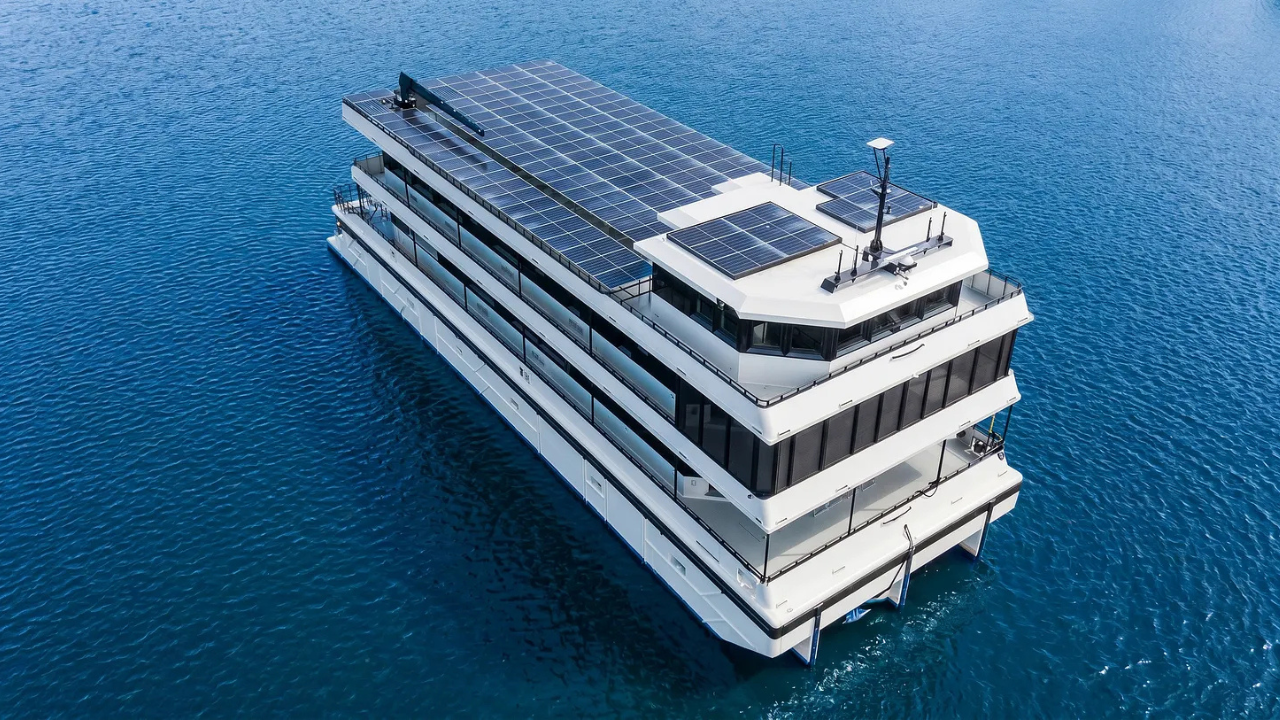
The convergence of ultra-luxury residential design and naval architecture has moved beyond conceptual renderings into high-capital execution. A self-sustaining, solar-powered floating residential asset valued at 15 million dollars—configured with five king suites, an integrated swimming pool, and an expansive rooftop photovoltaic array—is not merely a novelty; it is a complex infrastructure project. Evaluating such an asset requires moving past aesthetic admiration to analyze the structural physics, thermodynamic realities, and capital allocation frameworks that dictate its viability.
Navigating the engineering constraints of a vessel that functions as a high-density estate demands an understanding of weight distribution, energy balances, and maritime regulatory hurdles. The traditional metrics used to evaluate terrestrial real estate fail when applied to an asset that must simultaneously manage hydrodynamic stability and off-grid survival.
Hydrodynamic Stability and the Physics of Elevated Structural Mass
The primary engineering challenge of a multi-story floating residence lies in the management of its center of gravity relative to its center of buoyancy. Terrestrial architects design for static downward loads and seismic shear forces; naval architects must account for dynamic, multi-axis rotation caused by wind, current, and wave action.
The inclusion of five king suites implies a massive superstructure, but the integration of a swimming pool introduces a severe structural liability: liquid ballast at an elevated position.
The Metacentric Height and Free Surface Effect
To prevent capsizing, the vessel must maintain a positive metacentric height ($GM$). The metacentric height is defined by the formula:
$$GM = KB + BM - KG$$
Where $KB$ is the center of buoyancy, $BM$ is the metacentric radius (a function of the waterplane area's moment of inertia and displaced volume), and $KG$ is the height of the center of gravity above the keel.
An elevated swimming pool spikes the $KG$ variable upward, narrowing the margin of stability. This vulnerability is compounded by the free surface effect. When the vessel heels due to wind or wave action, the water within the pool shifts to the low side. This movement creates a dynamic overturning moment that artificially reduces the virtual metacentric height ($GM_v$), calculated as:
$$GM_v = GM - \frac{i \cdot \rho_w}{V \cdot \rho_m}$$
Where $i$ is the second moment of area of the liquid surface, $\rho_w$ is the density of the liquid in the pool, $V$ is the total volume of displacement of the vessel, and $\rho_m$ is the density of the water in which the vessel floats.
To counteract this destabilization, the hull architecture must utilize specific design mechanisms:
- Wide-Beam Barges or Catamaran Pontoons: Maximizing the beam increases the waterplane area’s moment of inertia, raising the $BM$ component to offset the elevated $KG$.
- Dynamic Ballast Systems: Automated pumping systems must shift internal liquid ballast rapidly across lower compartments to counteract wind-induced listing or asymmetrical passenger distribution.
- Hydraulic Spud Poles: For semi-permanent anchoring in shallow waters, heavy vertical steel shafts (spuds) are hydraulically driven into the seabed. This anchors the vessel and shifts a portion of the environmental lateral loads directly into the earth, bypassing the buoyancy equation entirely during standard operations.
The Off Grid Energy Equation and Thermal Load Management
Operating a 15-million-dollar asset with five luxury suites requires an uninterrupted supply of high-voltage power. In an off-grid marine environment, the energy matrix relies entirely on the relationship between solar collection area, battery storage capacity, and thermal efficiency.
Photovoltaic Harvesting Constraints
A rooftop covered in solar panels provides a finite surface area for energy capture. Assuming a roof footprint of 300 square meters utilizing premium monocrystalline silicon cells with a 22% efficiency rating, the peak theoretical output under optimal solar irradiance ($1\text{ kW/m}^2$) is approximately 66 kW.
$$\text{Peak Power} = 300\text{ m}^2 \times 1\text{ kW/m}^2 \times 0.22 = 66\text{ kW}$$
Real-world factors immediately degrade this performance. Marine environments introduce salt-crust accumulation on the panels, which can reduce efficiency by 15% to 20% within days if not serviced by automated fresh-water rinsing cycles. Furthermore, high ambient temperatures raise the operating temperature of the cells, triggering a negative temperature coefficient that reduces voltage output.
The Baseload and Peak Demand Matrix
The solar harvest must satisfy two distinct operational profiles: the daytime baseload (which includes running the asset and charging the batteries) and the nighttime discharge period.
[Solar Array: 66 kW Peak]
        │
        ├──> [Direct Consumption (Daytime Baseload: ~25 kW)]
        │           ├── HVAC Cooling & Dehumidification
        │           ├── Water Desalination (Reverse Osmosis)
        │           └── Pool Filtration & Heating
        │
        └──> [Battery Storage Bank (LiFePO4: ~400 kWh Capacity)]
                    │
                    └──> [Nighttime Consumption (Baseload: ~15 kW)]
The energy consumption of a five-suite luxury vessel breaks down into highly predictable, high-draw vectors:
- HVAC Systems (Dehumidification and Cooling): Marine environments present extreme latent heat loads due to high humidity. The air conditioning system must run continuously to prevent mold propagation and maintain luxury-tier comfort. This draws a continuous baseload of 15 kW to 25 kW.
- Water Generation: A reverse osmosis desalination system capable of producing 2,000 liters of fresh water daily requires a high-pressure pump drawing 3 kW to 5 kW during its operational cycle.
- Pool Infrastructure: Continuous filtration, UV sterilization, and temperature regulation for an exposed pool demand a constant 4 kW to 6 kW load.
To survive a 14-hour period of zero solar production while maintaining a 15 kW overnight baseload, the vessel requires a usable battery capacity of at least 210 kWh. To avoid degrading the battery chemistry and ensure a reasonable lifecycle, the system must utilize Lithium Iron Phosphate ($LiFePO_4$) cells operated within a 20% to 80% State of Charge (SoC) window. This dictates a minimum total installed battery capacity of 350 kWh to 400 kWh, adding significant weight and requiring a dedicated, climate-controlled fire-suppression compartment within the hull.
Asset Classification, Jurisdictional Gray Areas, and Financial Lifecycle
The financial profile of a 15-million-dollar floating residence diverges sharply from that of terrestrial luxury real estate. The most critical distinction lies in land ownership: terrestrial assets derive their long-term appreciation from the scarcity of the underlying real estate, while the structure itself depreciates. A floating mansion owns no land, reversing the standard real estate wealth-generation model.
The Depreciation Curve of Marine Hardware
A floating structure is legally classified either as a commercial barge, a recreational vessel, or a manufactured floating home, depending on local maritime law. Regardless of the classification, it is exposed to a highly corrosive marine environment.
- Galvanic Corrosion: The hull, whether constructed of marine-grade aluminum or steel, acts as an anode when submerged in saltwater. Without rigorous maintenance of sacrificial zinc or aluminum anodes, or the installation of an Impressed Current Cathodic Protection (ICCP) system, structural degradation occurs rapidly.
- Hull Fouling: Microorganisms, algae, and barnacles accumulate on the hull, increasing weight and dragging down hydrodynamic efficiency if the vessel needs to move. This requires dry-docking or professional dive cleaning every 24 to 36 months.
Because of these physical realities, the asset depreciates along a curve more akin to a superyacht than a mansion. While a terrestrial home in a prime coastal market might appreciate at 4% to 6% annually, a floating asset faces an annual depreciation rate of 5% to 8% without aggressive, high-cost capital reinvestment.
Regulatory and Insurability Bottlenecks
Securing financing and insurance for a 15-million-dollar un-propelled or semi-propelled floating structure is a complex undertaking. Conventional residential mortgages are unavailable because banks cannot secure a traditional lien on real property. Financing requires specialized marine mortgages, which carry higher interest rates, shorter amortization periods (typically 10 to 15 years), and require a formal marine survey by an accredited organization such as the American Bureau of Shipping (ABS) or Lloyd's Register.
The insurance profile introduces further friction. Marine hull and liability policies for high-value assets are highly sensitive to geographical risks:
- Windstorm Provisions: If the asset is moored in hurricane-prone zones (such as South Florida or the Caribbean), underwriters mandate strict hurricane evacuation plans or require the vessel to be rated to withstand category 5 wind loads (up to 157 mph) while pinned to its spud poles.
- Environmental Liability: The presence of blackwater treatment systems, greywater storage, and large lithium-ion battery banks creates environmental liability hazards. A single battery fire or a hull breach leading to a sewage leak can result in catastrophic regulatory fines under clean water legislation.
Operational Mechanics and Waste Loops
True self-sufficiency requires a closed-loop system for water and waste. A luxury estate cannot simply discharge untreated effluent into surrounding waters without violating international maritime regulations (MARPOL) and local environmental laws.
Blackwater and Greywater Processing
The five-suite configuration assumes an occupancy profile that can scale up to 10 to 15 individuals, including guests and crew. This population generates roughly 1,500 liters of wastewater daily. The vessel must deploy an onboard Type II Marine Sanitation Device (MSD).
This system utilizes aerobic digestion and biological filtration combined with chlorine or UV disinfection to treat blackwater, turning it into clear, odorless effluent that meets or exceeds federal discharge standards. If operating in a designated "No Discharge Zone" (NDZ), the asset must instead rely on massive internal holding tanks, requiring regular pump-out logistics via specialized service vessels—a significant operational constraint that limits true geographic isolation.
Strategic Verdict
Investing in or developing an ultra-luxury floating asset requires abandoning the assumptions of traditional property development. The 15-million-dollar valuation is heavily weighted toward high-cost marine engineering, custom off-grid power systems, and specialized manufacturing rather than intrinsic land value.
The optimal strategic deployment of this asset class is not as a primary residence, but as a highly mobile, yield-generating hospitality asset or a niche flagship estate for high-net-worth individuals prioritizing immediate coastal access and off-grid autonomy over long-term capital appreciation. To mitigate the steep depreciation curve, owners must implement a strict operational regime: locking in long-term submerged land leases in highly protected jurisdictions, ensuring the vessel is classed by a major maritime society to preserve resale liquidity, and sizing the photovoltaic-storage system to eliminate reliance on fossil-fuel backup generators entirely.