The wind off Big Bear Lake in the winter doesn’t just blow; it bites. It cuts through layers of heavy canvas and fleece, settling deep into your bones until your fingers stiffen and your breath freezes in mid-air. For years, thousands of people have stared through the digital lens of a live-streaming webcam into that exact freezing wind. They weren’t looking at the pristine San Bernardino mountains or the shimmering water below. They were looking for a shadow. A massive, majestic shadow with a snow-white head and a fierce, unyielding gaze.
Her name is Jackie. To the world outside the valley, she is a symbol of wild resilience, a bald eagle whose domestic triumphs and heart-wrenching nesting failures became a collective obsession. To the locals, she is something closer to a neighbor. You look up at the sky, you see that unmistakable six-foot wingspan, and you feel like everything in the world might just be alright.
Then, the sky went empty.
A few days ago, a call came into the local wildlife rehabilitation authorities. A bird was down. Not just any bird. A bald eagle, found grounded, battered, and unable to fly near the very shores Jackie has ruled for a generation. The news hit the community like a sudden drop in barometric pressure. The collective intake of breath could be heard across every local forum and nature group. Could the matriarch of Big Bear truly be facing her final descent?
The Anatomy of an Obsession
To understand why a single injured bird can cause an entire region to hold its breath, you have to understand the strange, modern phenomenon of the nature cam. We live lives mediated by glowing rectangles, insulated from the raw brutality and beauty of the natural world. But the Big Bear eagle cam changed that. It brought the wilderness into our living rooms, unfiltered.
We watched Jackie and her mate, Shadow, endure relentless blizzards. We saw them buried up to their beaks in fresh powder, refusing to leave their eggs, turning themselves into living incubators against the freezing alpine climate. We also watched, with shattering collective grief, when those eggs failed to hatch. Year after year, the drama played out in high definition.
People who had never laced up a pair of hiking boots found themselves crying at their desks because a wild animal’s nest remained silent.
This isn't mere sentimentality. It is a biological tether. Humans have an ancient, hardwired need to connect with the apex predators of our environments. When they thrive, we feel a deep, subconscious reassurance that the ecosystem holding us up is still functioning. When they fall, a quiet panic sets in.
When the report surfaced of an injured adult female eagle found in the brush near the lake, it wasn't just a wildlife log entry. It felt like a crisis of faith.
The Rescue in the Brush
Picture the scene through the eyes of the rescuers who got the call. The coordinates led them off the beaten path, away from the tourists snapping photos of the lake, into the thick, tangled undergrowth where the forest meets the shoreline.
Finding a grounded eagle is a sobering experience. On the wing, they are gods of the sky. On the dirt, they look heartbreakingly fragile. Yet, even an injured eagle possesses weapons that can slice human flesh to the bone. Their talons exert hundreds of pounds of pressure per square inch. Rescuing one requires a delicate, terrifying dance of authority and care.
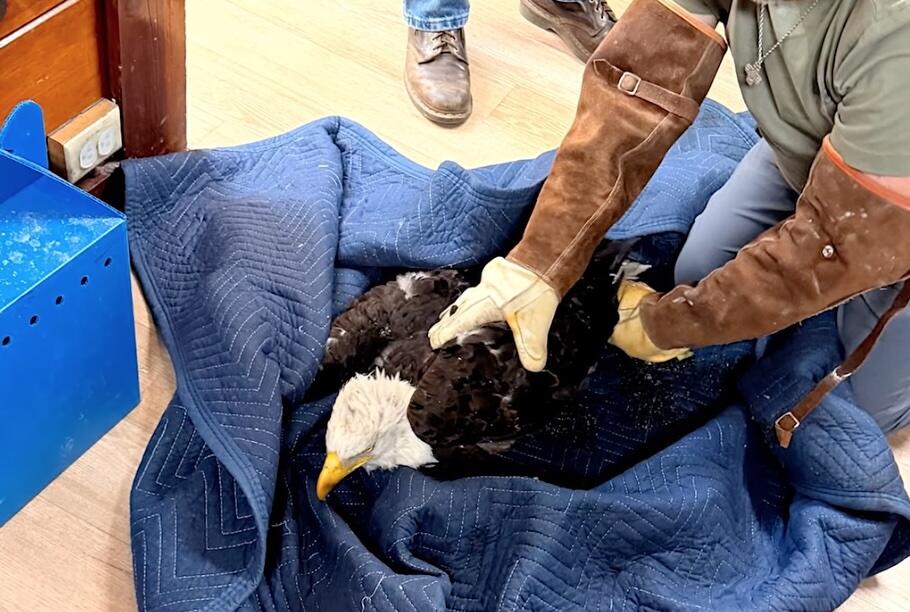
The rescuers approached with heavy blankets and thick leather welding gloves. The bird didn't fly. She couldn't. She tilted her head, her piercing yellow eyes tracking every movement, a low hiss escaping her beak. The fierce dignity remained, even as her left wing drooped heavily against the pine needles.
With a swift, practiced motion, the blanket went over her, darkening her world to calm her racing heart. They gathered her up—a bundle of hollow bones, heavy feathers, and fierce, unyielding spirit—and rushed her to a specialized medical facility.
The immediate question hanging in the damp mountain air was simple. Is it her?
The Forensic Hunt for an Identity
Determining whether a rescued wild eagle is a specific, famous individual isn't as simple as checking a collar. Jackie does not wear a satellite transmitter. She belongs entirely to the wild.
Wildlife veterinarians and biologists immediately began a meticulous examination. They weren't just checking her injuries; they were looking for clues written on her body. They measured her beak depth. They cataloged the specific shading of her plumage. They checked for federal leg bands, those tiny aluminum bracelets that act as a wild bird's passport.
Consider the reality of the situation facing the medical team. The bird was suffering from significant trauma, likely from a territorial fight with another eagle or a collision with a hidden obstacle during a high-speed hunt. Her immediate survival depended on fluids, anti-inflammatories, and absolute quiet.
But outside the clinic walls, the hunger for information was ravenous.
Biologists urged patience. The public demanded certainty. In the vacuum of official confirmation, rumors swirled. Some claimed the markings on her tail matched perfectly with screenshots taken from the nest camera three weeks prior. Others noted the distinct shape of her brow. We want so badly to name the things we love, to believe that the specific character we have invested our hearts into is the one we are currently trying to save.
But nature doesn't care about our narratives. If it is Jackie, the story is a tragedy of a fallen queen. If it is a stranger, a nameless intruder who fought her for the territory, the story is entirely different. It means Jackie might still be out there, watching from the high canopy, wondering why her domain has suddenly gone quiet.
The True Cost of the Wild
We often view nature as a beautiful backdrop for our weekend getaways. We drive up the mountain, buy our hot chocolate, and look at the trees. We forget that the forest is a theater of constant, low-intensity warfare. Survival is a daily negotiation with death.
Every time Jackie leaves that nest, she faces power lines, lead poisoning from fragments left in fish and carrion, rodenticides that travel up the food chain, and fierce competition from younger, hungrier eagles looking to claim the prime real estate of Big Bear Lake.
The injury of this eagle reminds us of the invisible stakes. Our presence in these mountains has compressed the wild, forcing these massive birds into smaller territories, increasing the likelihood of violent clashes over resources. The drama we watch on our screens isn't entertainment; it is the brutal reality of a species fighting to maintain its foothold in a world dominated by asphalt and concrete.
Whether this bird is Jackie or a rival, the diagnosis remains a heavy burden for the caretakers. A broken wing or severe soft-tissue damage in an apex predator is often a life sentence. An eagle that cannot fly cannot hunt. An eagle that cannot hunt cannot survive.
The rehab facility becomes a purgatory of hope and clinical precision. The staff moves in whispers, avoiding eye contact with the patient to prevent her from imprinting or becoming overly stressed by human presence. They treat her not as a celebrity, but as a wild entity demanding reverence.
The webcam over the empty nest continues to stream. The wind still howls through the microphone, rattling the frame. Thousands of miles away, people still log on, staring at the empty cradle of branches, waiting for a sign.
They are looking for the return of a ghost. They want to see the sky broken by those familiar wings, to hear that high-pitched, chattering call that echoes across the water. They want to know that the wild is still wild, and that the queen has returned to her throne.
Deep in the quiet of the medical ward, beneath the soft glow of an examination lamp, a pair of yellow eyes blazes open, staring into the dark, waiting for the strength to strike back.