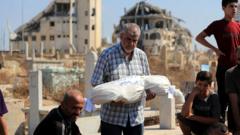
Standard media narratives on modern urban warfare are broken. Headline-driven casualty counts, framed in vacuum-sealed daily snapshots, treat complex asymmetric military strategy like an accounting ledger. When a report announces twelve dead in a strike, it provides a emotional data point while deliberately ignoring the structural mechanics of modern urban combat.
This is not a defense of tragedy. It is a critique of intellectual laziness.
For decades, international reporting has relied on a predictable formula: tally the immediate casualties, quote local medical officials, insert standard military statements, and move on to the next cycle. This approach actively misinforms the public about how urban warfare functions, how human shield strategies operate in practice, and how strategic objectives are weighed against tactical costs.
The Mirage of Micro-Reporting
Daily casualty tickers create a dangerous illusion. They suggest that urban combat can be judged minute-by-minute through single strikes, isolated from the broader operational environment.
When combatants embed military infrastructure—command nodes, weapons depots, and transit tunnels—within dense civilian sectors, every tactical decision becomes a lose-lose calculation. Traditional journalism treats each strike as an isolated event of aggressive intent rather than the culmination of intelligence cycles tracking high-value targets operating within civilian buffers.
Consider how asymmetric warfare works on the ground:
- Target Selection Cycles: Strikes are rarely sporadic; they target specific command structures, logistical hubs, or weapons stores identified through prolonged signals and human intelligence.
- The Urban Density Trap: High-population density is not an accidental backdrop—it is a deliberate strategic defense mechanism utilized by non-state actors to deter precise targeting or maximize political fallout when strikes occur.
- The Propaganda Dividend: In modern asymmetric warfare, operational loss for an embedded force can be converted into a strategic communications victory if the civilian casualty ratio is high enough to generate international pressure for a ceasefire.
By focusing exclusively on the immediate count without interrogating the structural deployment of combat forces in those exact zones, media outlets become passive distribution channels for asymmetric propaganda strategies.
The Math Behind Modern Urban Operations
Modern military doctrines operate under legal frameworks defined by international humanitarian law, specifically the principles of distinction, necessity, and proportionality. Media coverage consistently misinterprets "proportionality."
Proportionality in military doctrine does not mean equal casualties. It does not mean an eye for an eye.
Proportionality requires that the anticipated military advantage gained from a strike must outweigh the expected incidental civilian harm. When high-level operational commanders or critical strategic assets are present in a civilian structure, the military value assessment shifts drastically under established legal frameworks.
Proportionality is a prospective legal calculation based on operational value, not a retrospective body count published in a morning press release.
When coverage ignores this distinction, it conflates legal violations with tactical realities. It evaluates complex legal and operational decisions solely through the lens of tragic outcomes, flattening the strategic reality of urban warfare into a simplified narrative of raw numbers.
Beyond the Headline Ticker
To understand the trajectory of modern conflict, readers must stop consuming war coverage as a daily ledger of casualties and start analyzing it through operational metrics that actually shape outcomes.
Examine Infrastructure Destruction vs. Force Degradation
Raw casualty numbers rarely indicate who is winning or losing a conflict. Look instead at command-and-control degradation, supply chain disruption, and operational freedom of movement.Evaluate Source Attribution Critically
Reports relying on "medics say" or "local officials report" often funnel information through entities controlled by local combatant groups. In asymmetric zones, medical and civil administration infrastructure rarely operates independent of the governing military entity.Recognize Strategic Dilemmas
Understand that refusing to strike an embedded target carries concrete operational costs, just as striking it carries immediate civilian costs. Modern warfare is an exercise in choosing between catastrophic options.
The daily casualty headline gives readers a sense of moral clarity at the expense of actual comprehension. Continuing to consume war reporting through this narrow lens ensures that the public remains entirely blind to the strategic, legal, and operational realities defining modern urban combat.