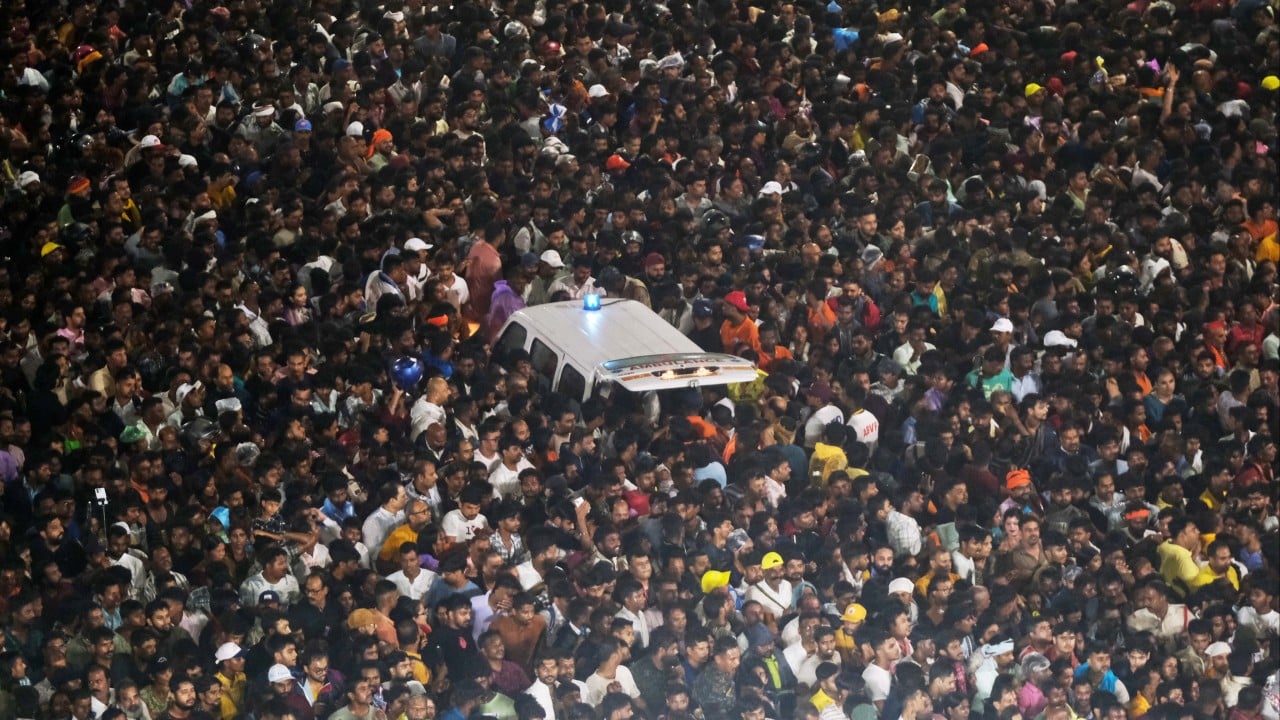
Crowd disasters at major religious gatherings are frequently dismissed as acts of God or blamed on the unpredictable panic of the masses. This is a convenient lie. The recent tragedy at a prominent Indian chariot festival—where one devotee lost their life and nearly a hundred others suffered injuries under the crushing weight of a surging crowd—was entirely preventable. It was not a sudden stroke of bad luck. It was the predictable result of structural failure, inadequate space management, and a systemic refusal to modernize crowd dynamics in high-density spaces.
When hundreds of thousands of people squeeze into narrow streets to pull massive wooden chariots, the margin for error is zero.
The Mechanics of a Crowd Crush
To understand why these tragedies keep happening, we must discard the term "stampede." Stampedes imply people running wildly, trampling over one another in a frantic escape. In reality, almost all major festival disasters are crowd crushes.
When crowd density exceeds a critical threshold—typically four to five people per square meter—the crowd begins to behave not like a group of individuals, but like a fluid.
The physics of pressure
At high densities, physical contact becomes unavoidable. A single push or a minor trip at the front creates a shockwave that travels backward through the crowd. This is known as a crowd wave.
- Compressive asphyxia: People do not die from being stepped on; they die because the pressure from all sides is so intense that they cannot expand their lungs to breathe.
- Loss of control: Individuals lose the ability to move of their own volition. They are carried along by the collective momentum of the mass.
- The domino effect: If one person falls, a void is created. Nearby people, pushed by the pressure behind them, fall into that void, creating a pileup that is nearly impossible to dismantle in real-time.
During chariot festivals, these physics are complicated by the presence of the chariot itself. These colossal wooden structures, weighing several tons, act as moving barricades. Devotees compete to pull the heavy ropes, creating opposing forces of motion in a tightly confined corridor.
Why Chariot Festivals are Inherently Volatile
Traditional chariot festivals, such as the famous Rath Yatra or localized regional iterations across India, present a unique set of logistical nightmares that standard sporting events or concerts do not.
The pull of the sacred rope
The act of touching or pulling the chariot’s rope is believed to wash away sins and grant salvation. This religious imperative transforms a passive audience into an active, highly motivated mass. Everyone is trying to reach the exact same two-inch-thick piece of rope at the exact same time. The psychological drive overrides basic self-preservation instincts.
Ancient streets versus modern populations
Most of these festivals take place in historic temple towns. The roads were designed centuries ago for small agrarian communities, not the millions of pilgrims who descend upon them today.
"You cannot fit a stadium-sized crowd into a medieval alleyway without expecting physical compression."
When the physical capacity of the street is exceeded, the surplus crowd has nowhere to go. Nearby buildings, shops, and barricades act as solid walls, leaving no escape valves for the building pressure.
The unpredictability of the chariot's movement
Unlike a train or a motor vehicle, a traditional chariot is pulled by human power and steered using rudimentary wooden logs placed under its massive wheels. Its movement is halting, erratic, and sudden. If the chariot suddenly surges forward, those pulling the rope are forced to run; if it stops abruptly, the crowd behind them collides with those in front.
The Failure of Administrative Imaginations
When a disaster occurs, local administrations are quick to point fingers at "unruly crowds" or "sudden rumors." This shifts the blame from systemic planning failures to individual behavior.
Effective crowd management is not about policing people once they are already packed together like sardines. It is about preventing them from reaching that density in the first place.
| Management Failure | The Consequences on the Ground |
|---|---|
| Lack of Real-Time Counting | Authorities rely on visual estimates rather than turnstiles, overhead sensors, or drone-based count algorithms to track incoming crowds. |
| Ineffective Barricading | Linear barricades often trap people in dead-ends, turning potential escape routes into choke points. |
| Communication Breakdowns | Public address systems are frequently drowned out by the noise of the festival, leaving the crowd blind to emerging dangers. |
Police forces deployed to these events are often trained in riot control, not crowd management. Using batons or physical force to push back a surging crowd only increases panic and pressure, exacerbating the very crisis they are trying to resolve.
Re-engineering the Pilgrimage
Preventing the next tragedy requires a shift in how these festivals are organized. We must treat religious gatherings with the same rigorous engineering standards applied to transit hubs and modern stadiums.
Implementing the "flow" model
Instead of allowing people to congregate freely around the chariot, organizers must implement a continuous flow model.
- Holding pens: Devotees should be held in designated, spacious zones outside the main arena and released in controlled batches.
- One-way routing: The path around the chariot must be strictly one-way. People should enter from one direction, pay their respects, and be guided out through an alternate exit.
- Physical barriers between crowd and wheels: Heavy-duty, permanent barricades must isolate the chariot's path from the general public, allowing only designated, trained pullers near the ropes.
Digital monitoring and predictive logistics
Modern computer vision technology can monitor crowd density in real-time. By utilizing existing CCTV networks equipped with density-estimation software, authorities can receive automated alerts when a specific sector reaches four people per square meter. This allows police to divert incoming traffic before a critical mass forms.
The tragedy that claimed a life and left dozens injured was not an inevitable consequence of faith. It was the predictable outcome of treating crowd safety as an afterthought. Until local administrations stop relying on luck and start investing in rigorous, science-based crowd engineering, the sacred ropes of these historic festivals will continue to be pulled at a devastating human cost.