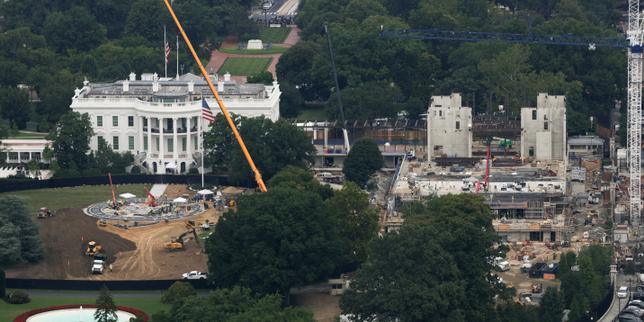
The recent administrative stay issued by Chief Justice John Roberts regarding the East Wing ballroom construction at the White House provides a case study in the friction between executive autonomy and legislative oversight. By allowing construction to proceed temporarily while the Supreme Court reviews an emergency petition, the court has prioritized the preservation of the project’s physical status quo over the immediate enforcement of a lower court’s injunction. This decision centers on a fundamental tension: the extent to which the executive branch may unilaterally modify federal property under the guise of national security and protective infrastructure.
The Anatomy of the Jurisdictional Conflict
The legal dispute rests on a binary interpretation of constitutional authority. The D.C. Circuit Court of Appeals held that Article IV of the Constitution grants Congress primary control over federal property, requiring explicit legislative authorization for significant structural alterations. Conversely, the executive branch posits that the president possesses inherent authority to manage and secure the executive residence.
This conflict creates a specific operational bottleneck. By categorizing the ballroom as an "integrated military complex," the administration attempts to transition the project from the domain of property maintenance—subject to congressional appropriation and oversight—to the domain of national security. If successful, this reclassification effectively shields the project from the legislative process, transforming a contested renovation into a non-justiciable matter of presidential safety.
The Cost Function of Sunk Capital
A critical factor in the current judicial posture is the project's state of completion, estimated at 65 percent. The administration’s argument relies on the principle of technical irreversibility: once construction reaches a certain threshold of integration, the cost of remediation—tearing down or altering structural foundations—exceeds any marginal utility gained by enforcing a stay.
This creates a strategic "fait accompli" dynamic. By maintaining a high-intensity, 24/7 construction schedule with a 250-person crew, the administration has increased the structural and financial stakes of a potential court-ordered halt. When judicial systems evaluate injunctions, they weigh the "irreparable harm" to both parties. The administration’s filing successfully positioned the continuation of work as a necessity for structural integrity and presidential security, while framing a stop-work order as an irreversible economic and logistical loss.
Analytical Pillars of the Litigation
The legal battle can be decomposed into three distinct variables that will dictate the eventual Supreme Court ruling:
- Appropriation vs. Executive Discretion: The project’s funding mechanism—leveraging private donations funneled through federal channels—avoids traditional congressional appropriations. If the courts determine this bypasses the Spending Clause, the project faces a structural legality issue that no security argument can remediate.
- The Security Exception: Lower courts have already bifurcated the project, permitting the construction of bunkers and medical facilities while enjoining the ballroom itself. The administration’s integration argument is a strategic attempt to negate this bifurcation by claiming the ballroom and the bunker are interdependent.
- Institutional Precedent: The ruling hinges on whether the judiciary allows the president to define what constitutes "necessary" infrastructure. Granting the executive unilateral power here establishes a broader precedent for the expansion of Article II authorities regarding federal facility modification.
Strategic Implications for Federal Infrastructure
The current administrative stay is not a resolution on the merits, but an operational reprieve. For stakeholders, the takeaway is clear: the administration is testing the elasticity of presidential power regarding the physical footprint of the executive branch.
Should the Supreme Court ultimately permit the project, it will validate a model where the executive branch, under the banner of security, effectively bypasses legislative property control. If the Court sustains the injunction, it will reaffirm the necessity of congressional consent for capital projects on federal land. The immediate strategic play remains the continued acceleration of construction; by increasing the physical entanglement of the project, the administration ensures that even a negative legal ruling will face the reality of a project that is functionally impossible to reverse or dismantle without significant, perhaps prohibitive, public expenditure.