The internet spent the weekend losing its collective mind over a single photograph.
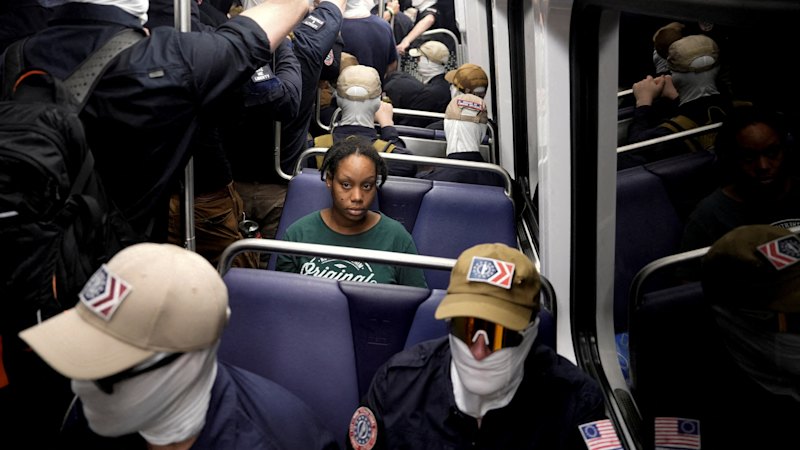
If you logged onto any social media platform during America’s 250th Independence Day, you saw it: a Black woman sitting quietly on a Washington Metro train car, completely surrounded by dozens of masked, uniform-clad members of the white nationalist group Patriot Front. For an alternative perspective, check out: this related article.
The lazy media consensus rolled out exactly on schedule. Commentators instantly branded it "the defining image of the era." Pundits compared the anonymous commuter to Rosa Parks. The prevailing narrative is that the photo perfectly captures a "fractured America" at its semiquincentennial milestone—a neat, tragic microcosm of an unfixable racial and political chasm.
It is a comforting narrative for an industry that trades in despair. It is also entirely wrong. Further insight regarding this has been provided by Al Jazeera.
By treating this highly staged, bizarrely algorithmic event as a organic snapshot of American life, the media missed the actual nuance of what happened on that train. The photo doesn’t show a nation fractured at its core. It shows a desperate, fringe political theater troupe failing to elicit anything more than profound boredom from a normal American citizen.
The Myth of the "Defining Image"
To understand why the mainstream reading of this photo is completely flawed, you have to understand the mechanics of modern political spectacle.
I have spent nearly two decades analyzing media manipulation, extremist aesthetics, and public perception. I have seen political fringe groups blow millions of dollars on elaborate stunts designed specifically to generate a single, terrifying image that makes them look like an occupying army.
That is exactly what Patriot Front engineered. They wore identical outfits, marched to military-style drumbeats, and covered their faces. They traveled in a pack specifically to create an imposing visual footprint.
But look closer at the image. Look at the actual mechanics of the scene:
- The Staged vs. The Real: The masked men are standing in rigid, self-conscious formations, intensely aware of the camera. They are performing.
- The Power Dynamic: The media wants you to believe the woman in the frame is terrified or trapped, drawing direct parallels to state-enforced segregation dynamics of the 1950s.
- The Reality of Neutrality: She is looking at her phone or staring straight ahead. She is not engaging. She is doing what every veteran public transit rider does when confronted with weirdos on a train: ignoring them until her stop arrives.
To compare this to Rosa Parks is an insult to the Civil Rights movement. Rosa Parks was defying a legal, systemic apparatus of state-sponsored oppression backed by the police, the courts, and the local government. The woman on the DC Metro was dealing with a group of internet-dwelling extremists who had to hide their faces behind cloth masks because they are terrified of losing their day jobs.
By elevating this photo to a historic monument of "American fracture," the media gave the extremists exactly what they wanted. They took a pathetic public nuisance and framed it as a dominant historical force.
Dismantling the Premise of a "Fractured 250th"
The central argument of the competitor’s piece is that America is fundamentally broken, and this photo proves it. This stems from a common "People Also Ask" query that surfaces every time civil unrest makes the evening news: Is America more divided now than ever before?
Let's answer that brutally honestly: No. Not even close.
When we look back at historical flashpoints, the country has survived a literal Civil War that killed hundreds of thousands of citizens, the total upheaval of the 1960s featuring political assassinations and massive urban riots, and the brutal labor wars of the late 19th century.
Imagine a scenario where we judge the entire health of a 340-million-person nation based purely on who happens to board the yellow line at Eastern Market station on a Saturday afternoon. It’s statistically absurd.
What the photo actually captures is a phenomenon called performative asymmetry. One side is exerting massive amounts of energy, spending money on matching khaki pants, and organizing logistics just to look intimidating. The other side—representing mainstream America—is simply trying to get to work, run errands, or go home.
The real story isn't the presence of the fringe. The real story is the complete exhaustion and indifference of the public toward them. The woman on the train didn't run away. She didn't cower. Her apathy is the ultimate counter-weight to their radicalism.
The Danger of Algorithmic Fatalism
There is a downside to my contrarian view, and I will admit it openly. By dismissing these images as mere theater, we risk downplaying the real, localized harm that extremist ideologies cause. The threat of political violence is real, and the ideas these groups espouse are genuinely toxic.
But there is a far greater danger in buying into the media's algorithmic fatalism.
When major publications take a viral photo and use it to declare that the American project is fundamentally fractured on its 250th anniversary, they create a self-fulfilling prophecy. They tell the average citizen that the battle is already lost, that your neighbors are your mortal enemies, and that coexistence is impossible.
They mistake noise for signal.
While 400 masked men were playing soldier on the Metro, millions of Americans of every racial, economic, and political background were quietly celebrating together, grilling in backyards, working shifts at hospitals, and navigating public spaces without incident. Democracy isn't sustained by the loud, terrifying images that go viral on social media; it is sustained by the quiet, boring, everyday acts of tolerance that occur when people simply allow each other to exist in public spaces.
Stop Looking for Metaphors in Public Transit
The next time a photograph trends with a caption telling you that a single frame explains the entire soul of a nation, ignore it.
The media wants you to see a fractured America because outrage drives engagement, and engagement pays the bills. They took a picture of a normal citizen exercising the ultimate urban superpower—ignoring a car full of absolute clowns—and tried to turn it into a tragedy.
The woman on the DC Metro didn't look like a victim of a fractured country. She looked like a person who had a long day, a train to catch, and absolutely zero time to waste on a bunch of men wearing matching outfits and hiding behind masks.
That isn't a symptom of a dying republic. That is the sound of a society refusing to give the fringe the attention they crave.