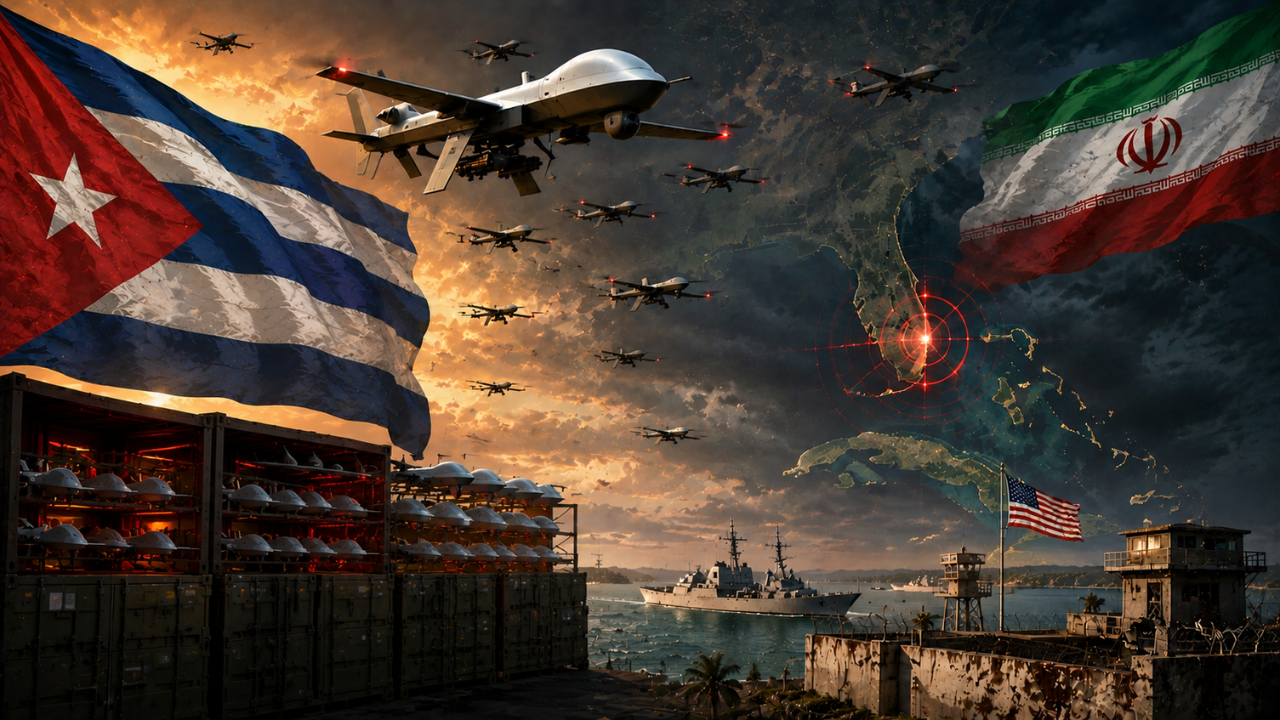
The defense establishment is experiencing collective hysteria over a fresh batch of classified intelligence. The panic du jour? A leaked U.S. intelligence assessment claiming Cuba has amassed over 300 military drones from Russia and Iran. Washington is hyperventilating over intercepts showing Cuban officials discussing hypothetical strike scenarios against Key West, U.S. naval vessels, and Guantanamo Bay. Add some reported sightings of Iranian military advisers in Havana, and the talking heads are practically treating this as a sequel to the 1962 Cuban Missile Crisis.
It is a masterful exercise in missing the point.
The entire premise of this "growing threat" narrative is fundamentally flawed. I have spent years tracking defense procurement cycles, asymmetric warfare doctrines, and the logistical realities of embargoed states. When you strip away the sensationalized headlines, you find that a fleet of 300 low-to-mid-tier commercial and tactical unmanned aerial vehicles (UAVs) in the hands of a bankrupt state is not a security crisis. It is a desperate, defensive move by an island running on fumes.
The media is selling an aggressive Axis of Evil outpost 90 miles from Florida. The reality is a hollowed-out military trying to buy a cheap insurance policy against an administration that openly talks about a friendly takeover.
The Mirage of Cuban Power Projection
Let us start with the numbers. Three hundred drones sounds menacing to a civilian reader. To anyone who understands modern theater mechanics, it is a rounding error.
To put this in perspective, Russia burns through thousands of first-person view (FPV) and Shahed-type loitering munitions every single month in Ukraine. Drones are not capital ships; they are consumable ammunition. A stockpile of 300 units does not give Cuba the capacity to wage a sustained campaign, let alone shut down the Straits of Florida.
More importantly, the intelligence itself admits these Cuban military discussions were purely defensive contingencies. Every military on earth creates hypothetical plans for worst-case scenarios. If an adversary’s navy sits on your doorstep, your staff officers calculate how to hit those ships if war breaks out. That is basic doctrine, not an active plot.
The Washington panic machine purposefully confuses two critical military metrics:
- Capability: The actual technological, logistical, and structural capacity to execute an assault and sustain it.
- Intent: An active political and military decision to initiate hostilities.
Cuba has zero intent to strike the United States. Doing so would be an act of immediate regime suicide, and the octogenarians running the Cuban Communist Party are many things, but they are not suicidal. They are survivors.
As for their capability? A senior U.S. official leaked the real punchline directly to Axios, though it was buried deep beneath the screaming headlines: "No one's worried about fighter jets from Cuba. It's not even clear they have one that can fly."
Think about that. An island that cannot keep its main conventional airframes in the sky due to a lack of spare parts, fuel, and maintenance is suddenly supposed to operate a sophisticated, integrated drone warfare network under the nose of the most dense air defense and electronic warfare umbrella on earth? It is a logistical joke.
The Real Reason Iran and Russia are Sponsoring Havana
The lazy consensus insists that Tehran and Moscow are building a forward operational base to threaten the American homeland. This completely misreads the geopolitical motivations of both regimes.
Iran and Russia do not view Cuba as a spearhead; they view it as a low-cost diplomatic shield and a distraction machine.
For Russia, sending a few batches of older-generation reconnaissance UAVs or Shahed components to Havana is a cheap way to force the Pentagon to divert attention to its southern flank. It is the classic strategy of reciprocity. Washington sends ATACMS to Ukraine; Moscow sends surplus hardware to the Caribbean. It costs Russia next to nothing, requires zero deployment of valuable Russian personnel, and scores cheap geopolitical points.
For Iran, it is a masterclass in asymmetrical deterrence learning. The intelligence intercepts note that Cuban spies are trying to learn how Iran has resisted U.S. pressure. Iran is not exporting these tools to help Cuba win a war; Tehran is exporting its survival playbook. They are teaching Havana how to build decentralized, low-tech production loops and hide assets from high-tech Western surveillance.
Imagine a scenario where a local manufacturing plant in Cuba tries to assemble these kits. They face the exact same bottlenecks that cripple the rest of the island’s economy:
- Constant rolling blackouts that disrupt precision assembly lines.
- A chronic shortage of basic industrial inputs, from fiberglass resin to wiring harnesses.
- A total lack of domestic fuel to power generators for testing.
The idea that Iranian advisers can wave a magic wand and transform Havana into a high-tech drone hub while the civilian population is literally cooking over wood fires due to fuel blockades is detached from physical reality.
Dismantling the Elite Punditry
The "People Also Ask" columns and think-tank panels are already flooded with predictable questions based on false premises. Let us answer them directly, without the sanitized diplomatic speak.
Can Cuba execute an asymmetrical blockade of Florida?
No. Pundits love to compare the Straits of Florida to the Strait of Hormuz, where Iran routinely harasses commercial shipping. This comparison ignores basic geography and naval engineering. The Strait of Hormuz is a narrow chokepoint surrounded by Iranian land-based anti-ship missile batteries, fast-attack craft bases, and sophisticated electronic warfare arrays built up over four decades.
The Straits of Florida are 90 miles of open water entirely dominated by the U.S. Navy's Atlantic fleet, the Coast Guard, and the massive military infrastructure of the American South. Any Cuban drone attempting to track or target a commercial vessel would be operating in a high-clutter environment completely painted by U.S. radar. The moment a signal is emitted, the control station becomes a target.
Does the presence of Cuban mercenaries in Ukraine alter the threat matrix?
The intelligence report notes that up to 5,000 Cuban soldiers have fought alongside Russian forces, claiming they are bringing back firsthand knowledge of drone warfare.
This is an egregious misinterpretation of why those men are in Europe. They are not an elite vanguard sent to acquire tactical expertise for a future invasion of Key West. They are economic refugees. Cuba is experiencing its worst economic collapse since the collapse of the Soviet Union. Young men are signing up to fight for Moscow because the Kremlin offers cash bounties and Russian citizenship to anyone willing to act as cannon fodder on the front lines of the Donbas. The survival rate of these foreign volunteer units is notoriously low. The few who do return are not tactical masterminds; they are traumatized survivors of a brutal trench war, returning to an island that lacks the electrical grid to even charge a drone controller.
The Peril of Manufacturing Consent
There is an obvious downside to adopting this contrarian view: it requires admitting that our own intelligence assets are occasionally used to build a political narrative rather than state objective facts.
We have seen this playbook before. The sudden rush to unseal indictments against Raúl Castro over a 30-year-old aircraft downing, combined with high-level CIA visits to Havana and aggressive rhetoric about "friendly takeovers," points to a clear political agenda.
By hyper-focusing on 300 pieces of plastic and lawnmower engines, the defense establishment is creating a convenient pretext for escalation. It justifies the tightening of fuel blockades. It manufactures consent for aggressive posturing in our hemisphere while active operations wrap up elsewhere.
If Washington truly wanted to neutralize the risk of foreign adversaries using Cuba as a playground, the solution would not be more carrier deployments or threatening indictments. The most effective way to kick Iran and Russia out of Havana is to break their monopoly on the Cuban economy. By maintaining a total embargo, the United States guarantees that Cuba has no choice but to buy its hardware and its energy from the world's premier pariah states.
Cuba's drone program is not an offensive threat. It is a symptom of an isolated, bankrupt regime buying the cheapest, loudest alarm system it can find on the black market. Stop treating a handful of slow-flying target drones like a nuclear launch sequence. Turn off the panic machine, look at the supply chains, and realize that a nation without electricity cannot launch a high-tech war.