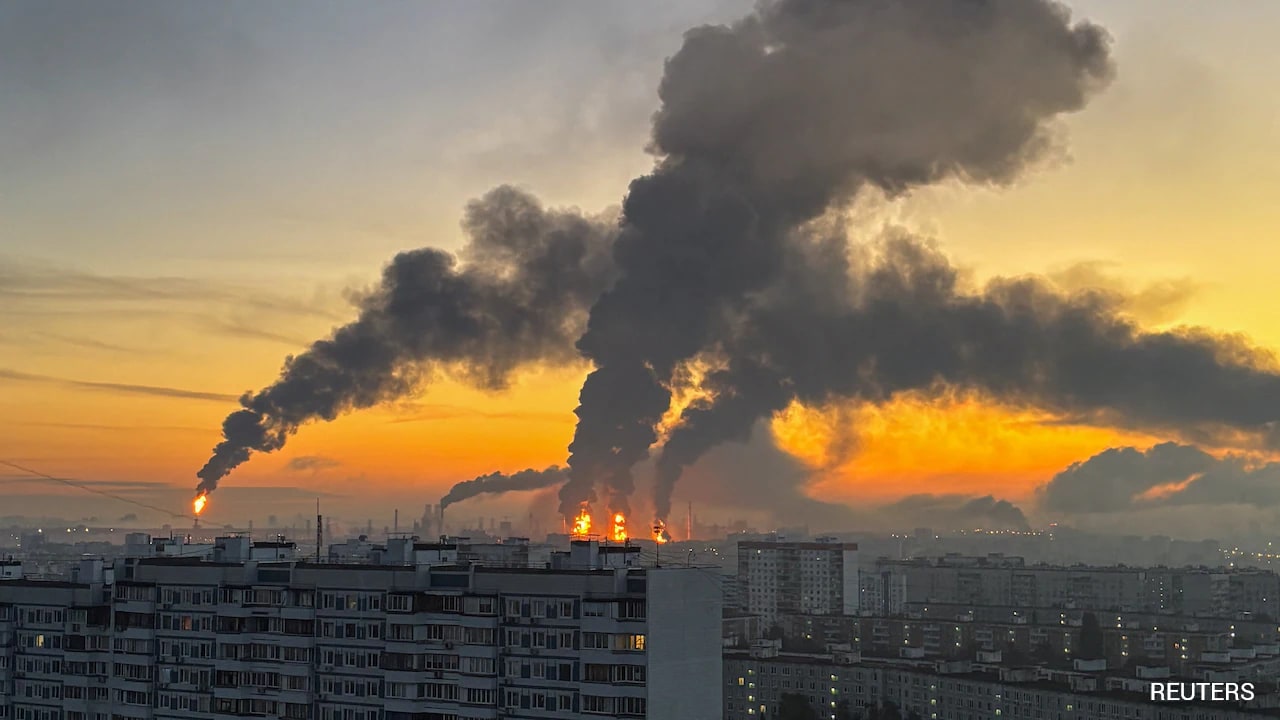
"Betrayed." That single melodramatic word does ninety percent of the heavy lifting in lazy geopolitical reporting. A leader complains about Washington. A drone hits a refinery deep inside Russia. And instantly, the headline writers mash those two facts together into a neat little soap opera: Abandoned ally lashes out in anger.
It makes for great clicks. It is terrible analysis.
When you strip away the theater, the lazy consensus around "Zelensky feels betrayed by Trump, Ukraine attacks Russian refinery" falls apart under basic strategic scrutiny. Conventional pundits treat foreign policy like a high school breakup where one side ghosts the other and the spurned party keys the car. Real statecraft does not work on hurt feelings. Sovereign governments do not launch long-range strikes against industrial fuel infrastructure just to vent emotional frustration at a White House shift.
They strike refineries because refining capacity is a physical choke point, because diplomatic leverage requires independent kinetic weight, and because waiting politely for permission from a skeptical ally is a luxury a country fighting for survival cannot afford.
Calling this "betrayal" confuses a change in transactional alignment with a moral crime. Worse, it blinds readers to the real game being played—one where friction with Washington and strikes on Russian fuel hubs are not contradictory impulses, but two halves of the same survival strategy.
The Lazy Consensus That Gets Statecraft Wrong
Look at how standard coverage frames the dynamic whenever a Ukrainian leader pushes back against a U.S. president or doubts incoming American support. The narrative usually runs on three assumptions:
- Assumption One: American policy shifts are personal rejections rather than recalculations of domestic politics, burden-sharing, and risk tolerance.
- Assumption Two: Deep strikes on Russian refineries are reactive tantrums triggered when diplomatic backing looks shaky.
- Assumption Three: A smaller or aid-dependent state has no meaningful agency once its largest patron signals reluctance.
Every one of those assumptions is fragile.
First, great powers rarely operate on permanent emotional loyalty; they operate on shifting cost-benefit math. In international relations, realists from Hans Morgenthau to John Mearsheimer have argued for decades that states align around power and perceived interest, not sentiment. When Donald Trump—or any U.S. administration—pushes for faster off-ramps, questions open-ended commitments, or ties support to tougher conditions, that is a shift in American bargaining posture. Treating every friction point as a Shakespearean "betrayal" turns hard power negotiations into gossip.
Second, hitting a refinery takes months of intelligence gathering, route planning, electronic warfare mapping, and production scheduling. You do not casually improvise a multi-hundred-kilometer strike package on a bad mood after a phone call.
Third, the idea that Kyiv is just a passive pawn waiting for instructions misses how asymmetric warfare actually evolves. When external guarantees look uncertain, a threatened state tries to manufacture its own leverage—by raising the economic and logistical cost on the adversary's side.
I have watched defense analysts and corporate strategists alike blow millions on bad assumptions because they mistook public rhetoric for private intent. In boardrooms and war rooms alike, people say things for leverage, domestic audiences, or signaling that do not match their operational moves. If you read a sharp quote and stop looking at supply chains, you miss the real story.
You Are Asking the Wrong Question
Most readers searching around this story want to know two things: Did Trump stab Ukraine in the back? and Will hitting Russian refineries end the war?
Both questions are traps.
Asking whether a superpower "betrayed" a partner assumes the partnership was ever a blank check written in blood and eternal gratitude. Alliances and security partnerships are negotiated instruments, shaped by elections, congressional math, competing global theaters, and shifting threat assessments. Feeling let down by a partner's pivot is human. Building your entire analysis around hurt feelings is analytical malpractice.
And asking whether refinery strikes alone will force a sudden collapse misses how industrial systems behave. Energy infrastructure is complex, redundant in parts, and heavily defended, yet still vulnerable to repeated attrition and repair bottlenecks. A single strike rarely snaps a massive economy overnight. What it does do is force air defenses to spread thinner, create localized fuel or logistics headaches, signal that no rear area is untouchable, and alter the bargaining table before talks even begin.
The sharper question is this: How does a country with finite munitions and shifting external backing use precision strikes to change negotiation leverage before its window narrows?
Once you ask that question, the pieces stop looking like random drama and start looking like cold calculation.
Refinery Strikes Are Leverage, Not a Tantrum
Let's be precise about terms before going further. Strategic autonomy in a wartime partnership does not mean total independence from weapons suppliers or intelligence networks. It means retaining the ability to choose targets and apply pressure that serves your survival even when your biggest backer wants restraint. Kinetic leverage means using physical force—drones, missiles, sabotage—to impose costs that alter what the other side thinks is possible or cheap.
Think about what happens when diplomatic pressure builds toward negotiations or a freeze. In any bargaining process, the side that looks desperate for lifeline approval starts from a weaker position. If Kyiv relies solely on Washington's green light and Washington's patience, Kyiv's negotiating hand shrinks the moment American political winds shift.
Striking Russian oil refining capacity changes the math in three concrete ways:
- It creates symmetric pain where it hurts. A major war economy runs on diesel, jet fuel, and refined products just as much as shells and troops. Even partial or periodic outages in refining throughput force rerouting, higher domestic strain, or export adjustments, turning quiet rear-area stability into a contested expense.
- It stretches air defense like a cheap blanket. Russia has a massive landmass and critical industrial assets spread across huge distances. Every additional refinery or depot that needs layered air defense pulls interceptors, radars, and crews away from somewhere else.
- It raises the cost of dragging things out. When an adversary believes the frontline is the only place paying a price, they can budget for a long grind. When energy and logistics assets deeper inside the country face recurring risk, the internal calculus shifts.
None of this requires a leader to be "furious" at an American president. In fact, the colder the diplomatic climate gets, the stronger the incentive becomes to build independent pressure points.
Imagine a scenario where a diplomatic backchannel opens next month with a draft ceasefire heavily favoring territorial freeze lines. If the defending side has zero ability to strike high-value targets behind the lines, the adversary can pocket its gains and keep humming along comfortably. Now imagine a scenario where key fuel and logistics nodes remain under credible threat despite diplomatic noise. Suddenly, "business as usual" is off the table. That is not emotional retaliation. That is basic bargaining power.
What People Also Ask—And Why the Premise Is Usually Flawed
"Does criticizing Trump mean Ukraine is giving up on U.S. support?"
No—and assuming it does is a classic false binary. Leaders in vulnerable positions routinely walk a tightrope: they court backing where they can, push back where they feel squeezed, and hedge against disappointment simultaneously. Public friction and quiet dependency often coexist in messy, uncomfortable ways. A sharp remark to the press does not cancel out logistics chains, intelligence ties, or ongoing diplomacy; it usually signals anxiety over terms, pace, or reliability.
"Are refinery attacks just a sign of desperation?"
Desperation is throwing everything wildly at low-value targets because you have run out of options. Methodical strikes on high-value refining nodes require specific range, payload, and navigation capabilities that only mature over time. Using long-range strike assets against energy infrastructure is an escalation of cost against the adversary, not proof that the attacker has stopped thinking strategically. Whether it succeeds long-term depends on sustainability, air-defense adaptation, and how it pairs with ground and economic realities—not on whether a pundit calls it "desperate."
"Why would Washington care if Ukraine hits Russian refineries?"
Because Washington does not live in a vacuum. U.S. policymakers weigh global energy markets, escalation risks, alliance cohesion, and domestic political fallout all at once. Concerns over oil price spikes or wider escalation have historically made some U.S. officials nervous about deep energy strikes, even when Ukrainian planners view them as vital military-economic targets. That tension—between a patron managing global market and escalation risks, and a fighting state trying to break its enemy's war machine—is structural. You do not need "betrayal" to explain why two capitals see the same target through different lenses.
The Blind Spots in My Own Contrarian Take
A contrarian argument that pretends to have zero flaws is just another form of spin. Here is where pushing the "cold strategy over emotion" thesis too far can trip you up.
First, leadership psychology and trust actually matter. Even hard-nosed realists acknowledge that credibility, personal rapport, and perceived reliability shape how leaders react under pressure. If a partner genuinely feels sidelined or cut out of talks that affect its sovereignty, resentment can sour coordination, leak into public messaging, and make quiet cooperation harder behind closed doors. Ignoring human friction completely is just as unrealistic as treating everything like a soap opera.
Second, energy strikes carry real blowback risks. Hitting refineries can trigger counter-escalations against power grids, civilian infrastructure, or remaining energy links. It can also annoy allies who worry about global fuel prices or broader regional spillover, potentially complicating diplomatic cover when you need it most.
Third, tactical hits do not automatically equal strategic victory. A dramatic fire at a refinery makes vivid footage, yet wars are decided by sustained industrial output, manpower, air superiority, logistics, and political endurance over years—not by single headlines. Overestimating the decisive punch of any one strike category is a mistake that has burned military planners since the dawn of airpower.
How to Read Headlines Like an Insider Instead of a Bystander
If you follow geopolitical coverage for work, investing, or sheer sanity, stop letting emotional nouns set your agenda. Words like betrayed, humiliated, cornered, and panicked are framing devices designed to tell you how to feel before you check the facts.
Do this instead:
- Separate rhetoric from capability. When you read a fiery quote alongside a strike report, ask what changed on the ground or in strike reach, not just who sounded upset in an interview.
- Trace the incentive structure. Ask who benefits from leaking a quote, framing a move as a breakdown, or overstating a single strike. Information in wartime and high-stakes diplomacy is always contested.
- Watch the bottlenecks, not the noise. Track fuel supply adjustments, repair times, air-defense shifts, and diplomatic proposals. Those constraints tell you what is actually binding.
- Hold two truths at once. A relationship can be strained and pragmatic at the same time. A strike can be tactically sharp and still face strategic limits. You do not have to flatten reality into a cartoon to understand it.
Sentiment makes great headlines; incentives run the world.