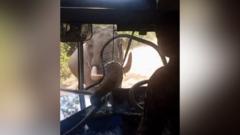
Clickbait news outlets love a predictable script. A dash of panic. A shaky smartphone video. A headline screaming about a rogue elephant "smashing" through a vehicle windscreen in a terrifying, unprovoked assault.
The internet laps it up. The comments section floods with outrage, fear, and calls for harsher wildlife management.
It is a neat, dramatic narrative. It is also completely wrong.
When you look at a bus with a shattered windshield in Sri Lanka, India, or South Africa, you are not looking at an "attack." You are looking at a highly predictable, entirely human-engineered tollbooth operation. The media frames these incidents as random acts of wildlife aggression because fear sells clicks. The uncomfortable reality is much more mundane, and far more damaging: we have systematically trained wild giants to become highway highwaymen, and then we act shocked when they demand their payment.
The Myth of the Bloodthirsty Giant
Mainstream travel and news reporting relies on a lazy consensus that wild animals exist in two states: serene backdrop or mindless monsters. When an elephant approaches a vehicle and breaks glass, the immediate reaction is to label the animal "furious" or "rogue."
Let us look at the mechanics of elephant behavior. An adult Asian elephant weighs upwards of four tons; an African bush elephant can clear six tons. If an animal of that scale truly wants to destroy a bus, it does not gently poke its trunk through the safety glass to rummage around the dashboard. It flips the vehicle into a ditch.
When an elephant shatters a windscreen, it is usually employing the minimum force required to access a known food source. Over decades, safari operators, locals, and clueless tourists have thrown bananas, sugarcane, and leftovers out of windows to get a closer look or a better photo.
You aren't watching a monster movie. You are watching a massive, highly intelligent mammal navigating a vending machine that occasionally gets stuck.
The Pavlovian Highway
Elephants possess cognitive faculties that rival primates. They map territories, remember water holes for generations, and calculate risk versus reward with extreme precision.
When a highway cuts through a migratory corridor, elephants quickly learn two things:
- Vehicles move slowly or stop entirely in these zones.
- Inside those metal boxes is a dense concentration of high-calorie, easily digestible food.
By feeding wild animals from vehicles, humans have established a classic operant conditioning loop. The sound of a diesel engine becomes a dinner bell. The sight of a bus means sugar cane. When a driver refuses to hand over the goods, or panics and revs the engine, the elephant applies a little structural pressure to get to the prize.
The media calls it a rampage. A biologist calls it behavioral conditioning.
The Fatal Flaw of Wildlife Tourism Infrastructure
I have spent years analyzing how commercial pressures warp ecological realities. Tourism boards and local operators want to guarantee "encounters." To do that, they tolerate, or tacitly encourage, habits that blur the line between wild habitats and roadside attractions.
This isn't just bad ethics; it is terrible risk management.
[Human Feeding] ➔ [Loss of Natural Fear] ➔ [Expectation of Food] ➔ [Property Damage / Injury] ➔ [Culling of the Animal]
When an incident occurs on a highway bordering a national park, the blame is invariably pinned on the animal's "unpredictable nature." This is a coward’s cop-out. The behavior is 100% predictable. If you leave a bowl of cat food on your porch every night, you don't get to act surprised when a raccoon shows up and scratches your back door.
The downside to acknowledging this truth is that it shifts the financial and moral burden squarely back onto human shoulders. It means admitting that our infrastructure planning is lazy and our tourist regulations are rarely enforced. It means realizing that the "safari experience" many consumers demand is inherently unsustainable.
Dismantling the Preconceived Questions
The public reaction to these viral videos usually centers on a few flawed premises. Let us address them with some blunt reality.
How do we protect tourists from rogue wildlife?
This is entirely the wrong question. The question assumes the tourists are passive victims. The real question is: How do we protect wildlife from the consequences of human stupidity?
Tourists do not need protection from rogue animals; they need strict, legally enforced boundaries that penalize the feeding and harassment of wildlife with massive fines or jail time. If a bus driver stops in a known elephant corridor to let passengers take selfies, that driver should lose their commercial license on the spot.
Should these dangerous animals be relocated or culled?
When an elephant repeatedly blocks roads or breaks windows, authorities often face pressure to move or kill the animal. This solves absolutely nothing. It treats a symptom while ignoring the disease. If you remove "Bully" the elephant but change nothing about the behavior of the drivers on that road, another elephant will step into that ecological vacancy within months. The food incentive remains. The vending machine is still open for business.
The Unconventional Blueprint for Real Safety
Fixing this does not require complex technology or bleeding-heart sentimentality. It requires cold, hard enforcement of spatial boundaries.
- Total Conviction Zones: Introduce zero-tolerance corridors where stopping a vehicle for any non-emergency reason carries a mandatory fine equivalent to a month's local wages. No photos, no idling, no exceptions.
- Physical Infrastructure Redesign: Where highways intersect crucial migration pathways, elevated eco-ducts or heavily reinforced underpasses must be the default standard, not a luxury afterthought. If we can build massive overpasses for semi-trucks, we can build them to keep wildlife separated from traffic.
- Acoustic and Non-Lethal Deterrents: Implement localized, non-harmful deterrents like beehive fencing or specific acoustic frequencies along road boundaries to make the asphalt zone unappealing to animals, breaking the habit loop before it starts.
Stop watching these videos with a sense of victimhood. The elephant breaking the glass isn't the aggressor. It is merely the tax collector coming to collect the debt we created by turning our wilderness into a drive-thru safari.
Put down the camera, roll up the window, and keep driving.