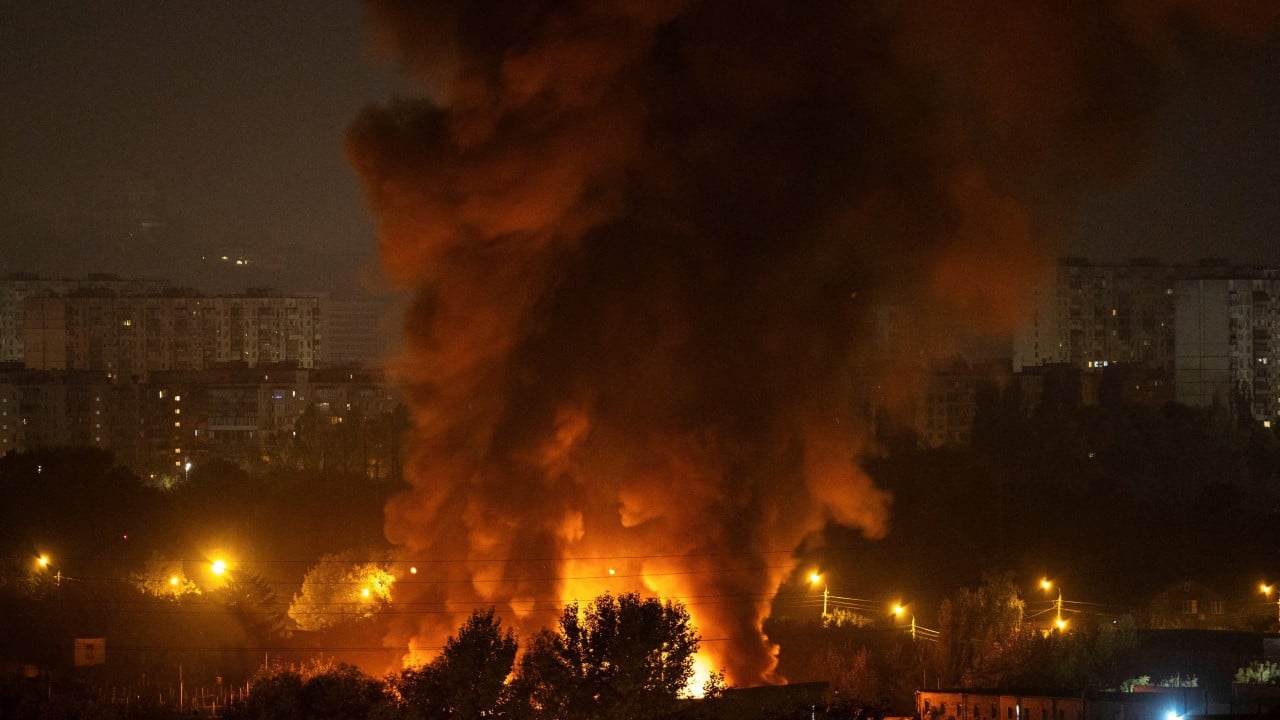
The ticker rolls across the screen with predictable, numbing repetition. Another volley of missiles. A grim casualty count. A warning from Kyiv, followed instantly by the mandatory chorus of Western condemnation.
It is the journalism of inertia.
Read any major wire service dispatch on the latest barrage across Ukraine, and you will find the exact same narrative architecture. The media treats every escalation as a distinct catastrophe, an unpredictable meteorological event descending from a cloudy sky. They frame each strike as a sign of desperation or a momentary spike in brutality, operating under the comforting illusion that this war is a series of isolated tactical aberrations rather than a grinding, systemic machine functioning precisely as designed.
I have spent years tracking military logistics and the brutal arithmetic of attritional conflict. When you strip away the cable news melodrama and look at the raw data of procurement, munitions stockpiles, and industrial output, a much colder reality emerges. We are not watching a chaotic exchange of punches in a bar fight. We are watching a deliberate, calculated campaign of structural exhaustion.
The lazy consensus among analysts is that these mass missile attacks are designed to terrorize the civilian population into submission. It is a neat, emotionally satisfying narrative because it casts the aggressor as a cartoon villain and the victim as a resilient underdog holding the line against pure malice. But it is strategically bankrupt. History tells us that bombing campaigns directed primarily at civilian morale almost universally fail to achieve political capitulation. If Moscow's primary objective were simply to break civilian spirit through sheer cruelty, the intensity and targeting patterns would look radically different.
Instead, look at the telemetry of these strikes. The targets are rarely random. They cluster with chilling consistency around power generation nodes, transformer sub-stations, railway switching yards, and domestic defense manufacturing pockets. This is not a terror campaign; it is a macroeconomic suffocation strategy.
The objective is not to make people too scared to walk outside. The objective is to make the cost of running a modern state unsustainable. When you systematically take out the high-voltage grid feeding a major industrial center, you do not just inconvenience civilians sitting in the dark. You freeze the localized repair hubs, you halt the machining of spare parts for armored vehicles, and you force the redirection of finite air defense assets away from the actual frontline.
Every time a Patriot or a NASAMS missile is fired at an incoming cruise missile or drone swarm, a silent economic calculation takes place. The interceptor costs millions of dollars. The incoming threat, particularly Iranian-designed loitering munitions or older Soviet-era airframes retrofitted with basic guidance, costs a tiny fraction of that. This asymmetry is the core engine of the current phase of the war.
Western capitals prefer to look away from this math. They prefer to pledge another package of high-end tactical hardware while ignoring the industrial base required to sustain a long-term war of attrition. You cannot manufacture resilience out of press releases and diplomatic solidarity. You need raw steel, specialized microchips, chemical precursors for solid rocket fuel, and an unbroken supply chain.
When a barrage hits eleven different oblasts simultaneously, the immediate human cost is undeniable and tragic. But focusing solely on the local devastation blinds us to the strategic horizon. Moscow is banking on the reality that Western political attention spans are short, domestic treasuries are strained, and industrial manufacturing capacity cannot pivot fast enough to match the sheer volume of low-cost mass produced ordnance.
The uncomfortable truth that nobody in the mainstream commentariat wants to admit is that time is currently being weaponized as a fiscal instrument. Every missile that lands is an invoice sent to Western taxpayers, testing the limits of how long democratic governments can subsidize a stalemate without triggering severe domestic economic backlash.
Stop treating these strikes as sudden weather anomalies. Stop looking for moral epiphanies in a war zone where the only metric that matters is gross domestic product, manufacturing output, and the cold calculus of attrition. Until Western policymakers wake up to the reality of industrial-scale warfare and stop treating logistics as an afterthought, the ticker will keep rolling, the body counts will keep rising, and the strategy will remain completely unchanged.