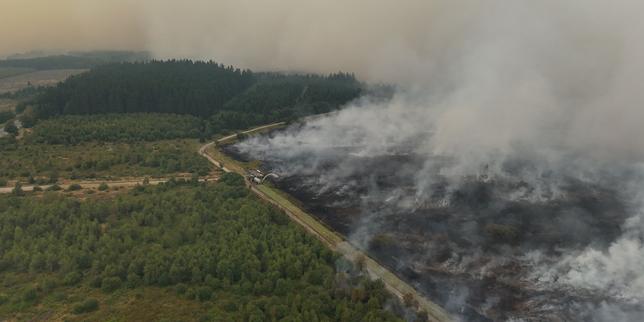
The headlines hit the wires with predictable hysteria. Dramatic aerial shots, smoke billowing over pine canopies, frantic reporters standing behind police tape talking about unprecedented ecological ruin. The lazy consensus writes itself every single time smoke crosses a European border. We get the standard mourning song about climate collapse, the breathless panic over lost hectares, and the ritualistic hand-wringing directed at local authorities for failing to predict the unpredictable.
Everyone wants to blame the heatwave. Everyone wants to point fingers at municipal budgets. Nobody wants to look at the actual mechanics of forest management and admit that the catastrophe isn't the fire itself. The catastrophe is our stubborn, institutional refusal to let nature clean house.
I have spent the better part of two decades walking burn scars across Western Europe, standing shoulder-to-shoulder with foresters who actually know the difference between a healthy canopy and a tinderbox waiting for a spark. I have seen billions of euros poured into panicked firefighting logistics while the fundamental driver of these blazes gets completely ignored by bureaucrats sitting in air-conditioned Brussels offices.
Let us strip away the emotional theater and look at what is actually happening on the ground.
The Myth of Pristine Wilderness
The foundational lie of modern environmental reporting is that European forests are wild ecosystems that need our protection from disturbance. They are not. They are heavily managed, intensely planted commercial timber grids disguised as nature.
When you plant dense stands of single-species conifers—spruce and pine planted densely for rapid harvest—you are not building a forest. You are building a green powder keg. For decades, European forestry policy prioritized immediate economic yield and aesthetic neatness over structural resilience. Deadfall was cleared down to the moss. Underbrush was suppressed. Every natural cycle of low-intensity fire was stamped out within minutes.
The result is a centuries-long accumulation of fuel load.
Imagine a warehouse where nobody ever takes out the cardboard boxes. For thirty years, packaging material piles higher and higher against the walls until it touches the ceiling. When someone finally drops a match, the entire structure doesn't just burn; it explodes. That is the actual state of the Belgian timber estates that made international news. The fire was not an anomaly. It was a mathematical certainty.
When mainstream outlets shriek about the worst fire in the country's history, they are diagnosing a symptom while completely ignoring the disease. The high temperatures and dry winds provided the ignition conditions, sure. But the ignition source is irrelevant if the fuel isn't waiting there to catch.
The Bureaucratic Paralysis of Modern Forestry
Talk to any veteran forester off the record and you will hear the same exhausted sigh. They know how to fix this. They know that controlled burning, species diversification, and creating natural fire breaks are the only proven methods to break the cycle.
Yet, try getting a permit for a controlled burn near a residential zone in Wallonia or Flanders. Environmental impact assessments take eighteen months. Public consultations attract panicked suburbanites who think any smoke near their property line is an apocalypse. Local politicians, terrified of losing votes on social media, defer to inaction every single time.
So the brush keeps piling up. The pine needles keep accumulating. The resin content in the stressed trees keeps rising as prolonged dry spells hit root systems trapped in compacted soil.
We have engineered a system where doing nothing feels safe, even though doing nothing guarantees total destruction.
This is the dirty secret of modern conservation policy. We manage forests for the optics of preservation rather than the reality of ecology. We treat trees like museum exhibits rather than living, dynamic systems that require periodic trauma to survive. Fire is not an intruder in these ecosystems; it is a vital metabolic process. When you banish fire for fifty years, you don't prevent destruction. You simply defer it, compound the interest, and cash out with a catastrophe that consumes everything.
What Real Prevention Looks Like
If we are serious about stopping these mega-fires, we need to completely invert our strategy. Stop investing all our capital into bigger water-bombing helicopters and more high-tech thermal drones. Those are tools for managing failure. They are what you buy when you have already lost the argument.
Real prevention looks boring, expensive, and politically toxic.
It means intentionally burning thousands of hectares of underbrush every single winter when humidity is high and winds are docile. It means introducing broadleaf trees back into coniferous plantations, accepting lower immediate timber yields in exchange for ecological stability. It means cutting down healthy-looking trees to thin out the canopy so that root systems aren't competing desperately for shrinking groundwater reserves.
Do you think any regional minister wants to stand in front of cameras and announce that they are deliberately setting fire to a popular regional park? Of course not. They prefer the clean narrative of a tragic natural disaster brought on by abstract global forces. It requires no courage, offloads all responsibility, and keeps the blame safely pinned on climate change rather than local cowardice.
Climate change is real. The weather is getting hotter and drier. But using climate change as a catch-all excuse for bad forestry policy is intellectual cowardice. It absolves policymakers of the decisions they refuse to make.
The Cost of Cowardice
Every hectare that burns down to the bedrock represents a failure of imagination. It represents decades of kicking the can down the road, prioritizing suburban comfort over ecological reality, and treating nature as a postcard instead of a force multiplier.
Until we accept that fire is a necessary tool of stewardship rather than an evil invader to be fought with infinite water and zero strategy, these headlines will repeat themselves year after year. The smoke will clear, the politicians will promise tougher regulations on summer campfires, and the powder keg will start refilling itself the very next morning.
Stop crying over the ashes when we built the furnace ourselves.


