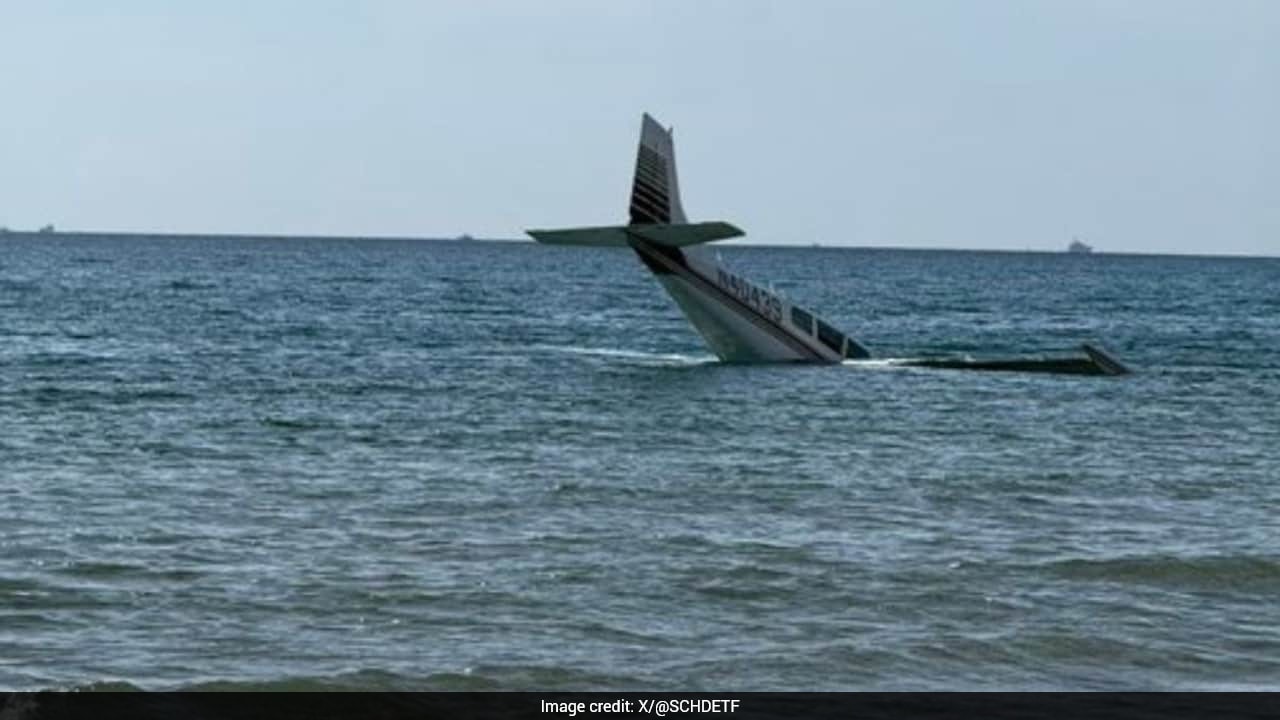
When a 23-year-old pilot sets down a single-engine aircraft into the Atlantic surf near a crowded Florida beach, public fascination naturally fixates on the survival narrative. Spectator footage captures the abrupt descent, the hydrodynamic impact, and the subsequent evacuation. Observers marvel at the statistical improbability of walking away unscathed.
However, evaluating this event through the lens of mere fortune obscures the underlying mechanics of off-airport forced landings. Aviation safety analysts do not look at such incidents as random acts of luck. They dissect them as operational stress tests. Every emergency water touchdown represents the final node in a long chain of pilot decisions, aerodynamic variables, and risk management thresholds.
The standard media treatment of viral aviation videos focuses on the adrenaline of the event. This analysis strips away the spectacle to examine the precise operational variables at play when an engine fails over a populated coastline, mapping out the precise trade-offs between airframe preservation, ballistic trajectory control, and structural hydrodynamics.
The Aerodynamic Cost Function Of Low Altitude Engine Failures
When propulsion is lost below one thousand feet, a pilot enters a constrained operational envelope where choices are measured in seconds. The primary governing principle is energy management. An aircraft in flight possesses two forms of usable energy: kinetic energy, represented by airspeed, and potential energy, represented by altitude.
An engine failure forces an immediate zero-sum conversion. Altitude must be traded for airspeed to maintain flying control, and airspeed must be managed to prevent an aerodynamic stall while maximizing gliding distance.
Total Energy = Kinetic Energy (Airspeed) + Potential Energy (Altitude)
In the Florida coastal incident, the pilot faced a critical boundary condition. The proximity of a populated shoreline introduces a severe external constraint: the absolute imperative to avoid third-party ground casualties. This constraint alters the standard glide optimization profile. Rather than flying for maximum range, the pilot must execute an emergency descent profile that prioritizes obstacle avoidance and controlled impact vectors over airframe preservation.
The human factor in this equation is governed by cognitive tunneling. Under extreme acute stress, human working memory degrades. Experienced aviators rely on trained muscle memory and standardized checklists to short-circuit panic. A 23-year-old aviator navigating this environment must execute procedural memory under conditions of maximum physiological arousal. The success of the outcome indicates that speed control during the glide phase was prioritized correctly. Allowing airspeed to decay below the best glide speed results in an immediate loss of lift and an uncontrolled spin, a fatal error at low altitudes.
Hydrodynamic Realities Of Impacting Water Surfaces
Water is often perceived by the uninitiated as a soft cushion compared to asphalt or concrete. Physics dictates a starkly different reality. At high descent velocities, water acts as a non-compressible fluid. Impact dynamics are determined by the entry angle, the aircraft belly profile, and the structural integrity of the cabin floor.
When a fixed-gear, low-wing or high-wing light aircraft contacts water, the primary hazard is not drowning on impact; it is deceleration trauma. Deceleration forces, measured in Gs, spike violently if the nose digs into the surface.
Deceleration Force (G) = Change in Velocity / (Time Interval * Gravity)
If the landing gear is fixed and lowered during a water landing, the wheels act as anchors. They catch the water, creating a massive rotational moment that pitches the aircraft nose-down, flipping it upside down instantly. This phenomenon, known as a nose-over, drastically increases the probability of structural cabin collapse and pilot entrapment.
Optimal technique requires a tail-low, wings-level attitude, touching down smoothly on the rear underside of the fuselage while holding the control yoke full aft. This bleeds off remaining kinetic energy through hull skimming rather than immediate structural crushing.
The coastal waters off Florida present unique environmental variables. Wave action, swell direction, and wind shear near the shore create chaotic surface conditions. A pilot cannot treat the ocean as a flat runway. Aligning the touchdown vector parallel to the swells rather than across them prevents asymmetrical wing loading, which can tear the aircraft apart upon contact. The visual evidence of the Florida landing demonstrates a controlled descent angle, keeping the longitudinal axis parallel to the incoming wave crests to minimize structural shock.
The Decision Matrix Of Coastal Off Airport Landings
Choosing where to ditch an aircraft involves a rapid cost-benefit analysis under extreme uncertainty. When an engine quits near a coastline, three primary impact zones present themselves, each with distinct risk profiles.
Zone 1: The Beach
- High density of civilian pedestrians
- Hard-packed sand creates high deceleration trauma
- Obstacles such as infrastructure, dunes, and vehicles

Zone 2: The Surf Zone and Shallows
- Moderate civilian density
- Fluid impact dynamics reduce peak G-forces compared to land
- High risk of immediate wave action flipping the airframe

Zone 3: Open Ocean Beyond Breakers
- Zero civilian casualties
- Uncontrolled wave action complicates rescue operations
- Extended exposure to hypothermia and sinking dynamics
Selecting the surf zone or immediate shallow water near a beach represents a calculated compromise. It balances the necessity of minimizing ground casualties against the operational requirement for rapid rescue access. Crashing into a dense crowd on the sand introduces unacceptable liability and catastrophic loss of life. Landing far out in the open ocean risks delayed rescue and potential drowning before support vessels arrive.
The pilot in this scenario navigated this trilemma by threading the needle between the dry sand and deep water. By setting the aircraft down in the shallow wash near the shoreline, rescue response times were compressed to minutes rather than hours, while ground casualties were successfully averted.
This decision points to an underlying operational framework that flight training programs emphasize: human life preservation always supersedes equipment preservation, and third-party safety supersedes occupant convenience. The airframe is a disposable asset; the coastline population and the pilot are irreplaceable variables.
Structural Failures And Post Impact Survival Dynamics
Surviving the impact is only the first phase of an emergency water landing. The secondary phase tests the egress protocols and survival systems of the pilot and aircraft.
Light single-engine aircraft are not buoyant vessels. Once settled in the water, fuel tanks, engine weight, and open cabin doors allow water to ingress rapidly. The aircraft will typically sink by the nose due to the heavy engine block in the front. This dynamic creates a narrow window for egress.
Time to Egress = Total Buoyancy Loss Rate / Cabin Volume Ingress Speed
Panic is the primary catalyst for fatalities during this phase. Seatbelts must be manually released while the occupant is disoriented, potentially inverted if a nose-over occurred. Cabin doors on many older light aircraft can jam due to fuselage warping upon water impact, requiring manual window exit strategies.
In the Florida incident, the rapid arrival of beachgoers and marine rescue assets mitigated the post-impact exposure risks. However, reliance on external rescue is a high-variance strategy. Standard operating procedures dictate that a pilot must assume immediate self-reliance upon touchdown.
The physical mechanics of exiting a sinking cabin require deliberate execution:
- Maintain physical orientation despite inversion or shock.
- Disengage the seatbelt fastener deliberately rather than blindly pulling.
- Locate structural exit points and pull body weight clear of the airframe before inflation vests are activated. Activating a life vest inside a sinking cabin traps the occupant against the cabin ceiling as the aircraft fills with water.
The success of the 23-year-old pilot in managing this sequence highlights the efficacy of baseline emergency training, even when real-world execution is put to the ultimate test.
Strategic Forecast For General Aviation Safety Protocols
As air traffic density increases and coastal populations expand, forced landings near populated areas will face stricter regulatory scrutiny. The traditional defense of general aviation relies on the judgment of individual pilots operating under Federal Aviation Administration guidelines. However, reliance on human judgment alone during off-airport emergencies leaves a wide margin for variance.
Future mitigation strategies will likely focus on three operational shifts:
- Enhanced flight path monitoring software integrated into portable electronic flight bag devices, providing real-time glide-range polygons overlaid on coastal maps.
- Expanded simulator training focused specifically on low-altitude engine failure decision trees, forcing pilots to practice off-airport targeting under cognitive load.
- Upgraded structural impact energy absorption designs in light aircraft manufacturing to widen the survivability threshold of water touchdowns.
The viral attention given to the Florida beach landing will fade, but the underlying engineering and operational lessons remain fixed. Safety in general aviation is not a product of luck. It is the mathematical outcome of disciplined energy management, rapid risk stratification, and adherence to established survival physics under pressure.