Every single year, the local headlines read like a tragedy script penned by someone who has never owned a pair of rubber boots. Right on cue, the alarmists swarm the local airwaves, screaming about the wettest summer on record, unprecedented storm systems, and how the sky is literally falling in buckets over the North Saskatchewan River valley.
It is lazy journalism. It is worse than that. It is a convenient excuse for municipal failure.
I have spent decades watching developers, urban planners, and municipal bureaucrats throw their hands up in mock despair every time a heavy cloud rolls over the prairies. They point to the rain gauges, pat themselves on the back for recording another statistical anomaly, and use it as a blanket shield to explain why basements are flooding, traffic is grinding to a halt, and infrastructure is buckling.
Stop blaming the clouds. Edmonton is a semi-arid parkland transition zone sitting on heavy clay. High-intensity, short-duration convective summer storms are not a glitch in our climate matrix. They are the baseline design parameters. If you treat every July downpour like a black swan event, you are not managing a city. You are gaslighting the taxpayers.
The Myth of the Statistical Freak Event
Let us look at the actual math instead of the emotional panic. The lazy consensus relies on cherry-picked precipitation totals measured at a single corporate weather station at the Edmonton International Airport, which sits miles outside the actual urban heat island and microclimate basins of the city proper.
When meteorologists shriek about record-breaking rainfall numbers, they are usually combining total accumulation over a rolling thirty-day window and comparing it against historical averages that date back to eras when pavement coverage in the core was a fraction of what it is today.
Here is what they conveniently leave out of the broadcast: concrete does not drink.
Imagine a scenario where a thunderstorm dumps thirty millimeters of rain onto a natural prairie grassland. The soil absorbs it, root networks throttle the runoff, and the water table recharges quietly over forty-eight hours. Now imagine that exact same storm hitting a square mile of suburban asphalt, massive big-box store parking lots, and high-density downtown rooftops engineered to shed water as fast as gravity allows.
That is not a climate emergency. That is a hydraulic math problem.
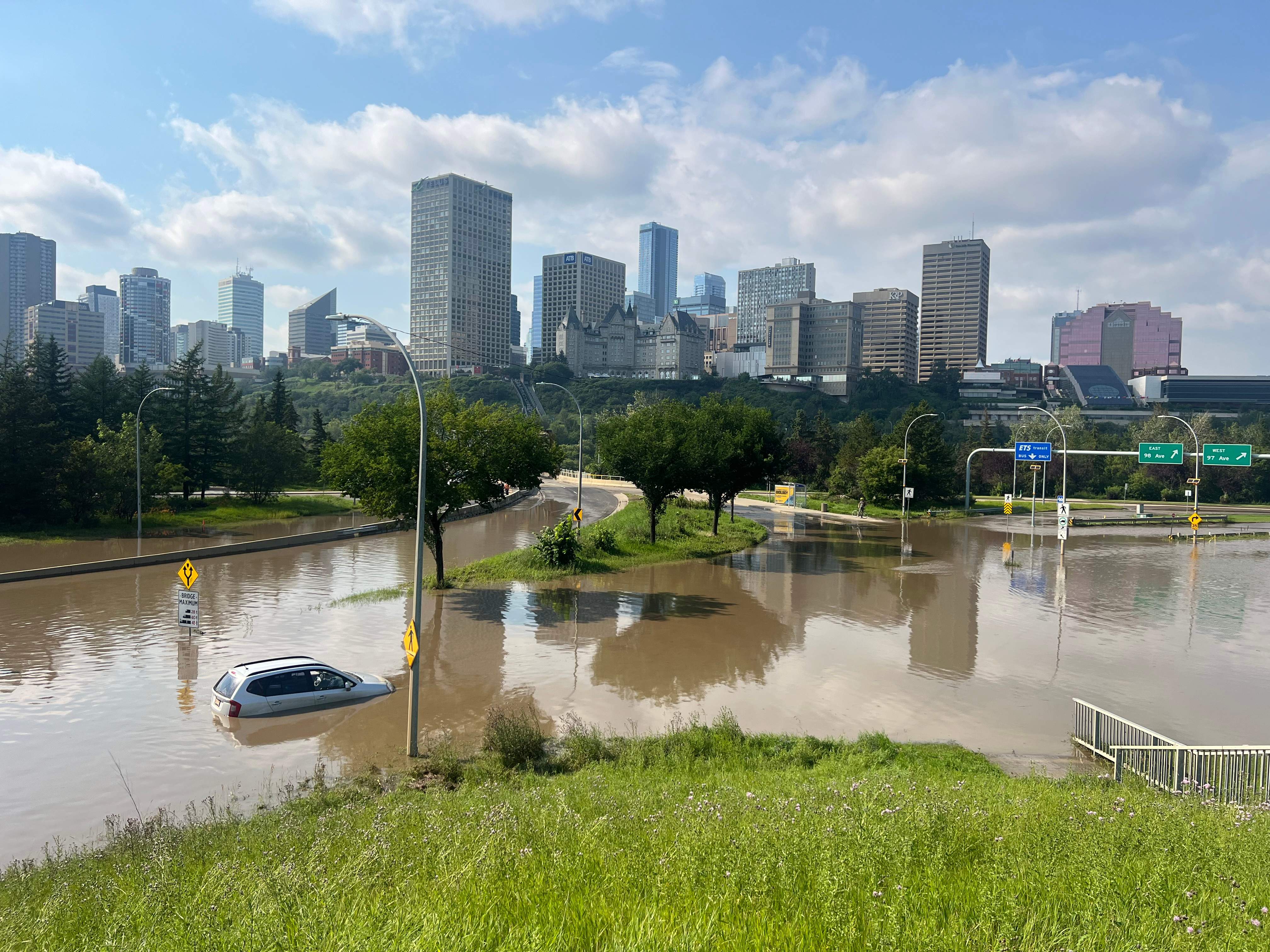
When you pave over every square inch of natural permeable surface to build oversized subdivisions with narrow setbacks and minimal green infrastructure, you turn a standard summer thunderstorm into a localized flash flood. The rain volume might not even be historically unprecedented, but the runoff velocity sure is. Municipal leaders love talking about extreme weather because talking about climate variance costs zero dollars. Upgrading stormwater trunk lines, mandating permeable paving materials, and enforcing aggressive bioswale requirements in new residential zoning codes costs millions.
The Clay Problem Nobody Wants to Talk About
Expertise means knowing the literal ground you stand on. Edmonton sits on glaciolacustrine clay. For the uninitiated, this is dense, heavy, highly plastic soil that swells when wet and shrinks into concrete-hard blocks when dry.
When you get three weeks of intermittent summer rain, that clay layer reaches saturation capacity almost immediately. Once it hits that threshold, water stops sinking entirely. It sits on top, looking for the path of least resistance, which happens to be the weeping tile surrounding your foundation or the under-engineered catch basin at the bottom of your depressed parkade.
Every spring and summer, I watch real estate agents and home inspectors pretend this is brand new information. They act shocked when a basement leaks after a torrential downpour, as if the soil composition of Edmonton changed overnight via municipal decree.
The fix is not complicated, but it requires brutal honesty. We need to stop building subterranean parking structures in high-water-table zones without multi-million-dollar dewatering systems. We need to mandate deep-root landscaping that actually breaks up the clay substrate instead of planting decorative ornamental shrubs that do nothing but look pretty for three months before drowning.
Contractors cut corners on grading. Developers slope driveways straight toward garage doors because it is cheaper to drain water inward than to slope it outward toward street-level bioswales. Then, when the inevitable puddle forms, everyone blames the jet stream.
The Cost of Cowardly Infrastructure
Let us talk about accountability. I have seen municipal budgets blow millions of dollars on vanity bridge lighting and downtown art installations while the core storm drainage network relies on century-old timber and corrugated steel pipes that were originally sized for a sleepy trading post, not a million-plus metropolitan engine.
When local politicians stand behind microphones and warn residents to stay indoors because of a severe storm warning, they are deflecting. They want you to feel helpless against the wrath of nature so you do not ask why your property taxes keep climbing while your street turns into a navigable river every time a cumulonimbus cloud looks cross-eyed at the Muttart Conservatory.
A real city builds for its worst-case weather scenarios on day one. Tokyo built an underground cathedral of concrete tunnels the size of a Gothic cathedral to handle catastrophic typhoon surges beneath a sprawling metropolis. Edmonton panics because a park trail near the river gets muddy.
We treat extreme summer rain like an uninvited guest instead of a regular roommate we signed a lease with.
What You Should Actually Do
If you own property or live in this city, stop waiting for the municipal government to save your basement or rewrite stormwater management policy. They are too busy commissioning feasibility studies for problems we solved in civil engineering textbooks fifty years ago.
- Audit your grading immediately. The number one cause of water intrusion during a heavy summer storm is not the sky; it is the two feet of soil directly adjacent to your foundation wall sloping inward toward your basement windows. Get a shovel, buy some clay loam, and fix your negative grade before the next front moves in.
- Disconnect your weeping tile from the sanitary sewer. If your home was built during certain eras, your foundation drainage might be tied directly into the municipal wastewater system, overwhelming the system and backing raw sewage straight up your floor drain. Install a dedicated sump pump with a battery backup system. Treat municipal infrastructure failure as a personal logistical certainty.
- Demand radical transparency from developers. When buying a new build in suburban expansions, ask to see the neighborhood's major event overland drainage route. If the salesperson looks at you blankly or tells you not to worry about it, walk away.
The weather in Edmonton is not broken. The way we build, talk about, and manage our urban environment is. Stop waiting for the rain to stop and start building for the climate we actually have.