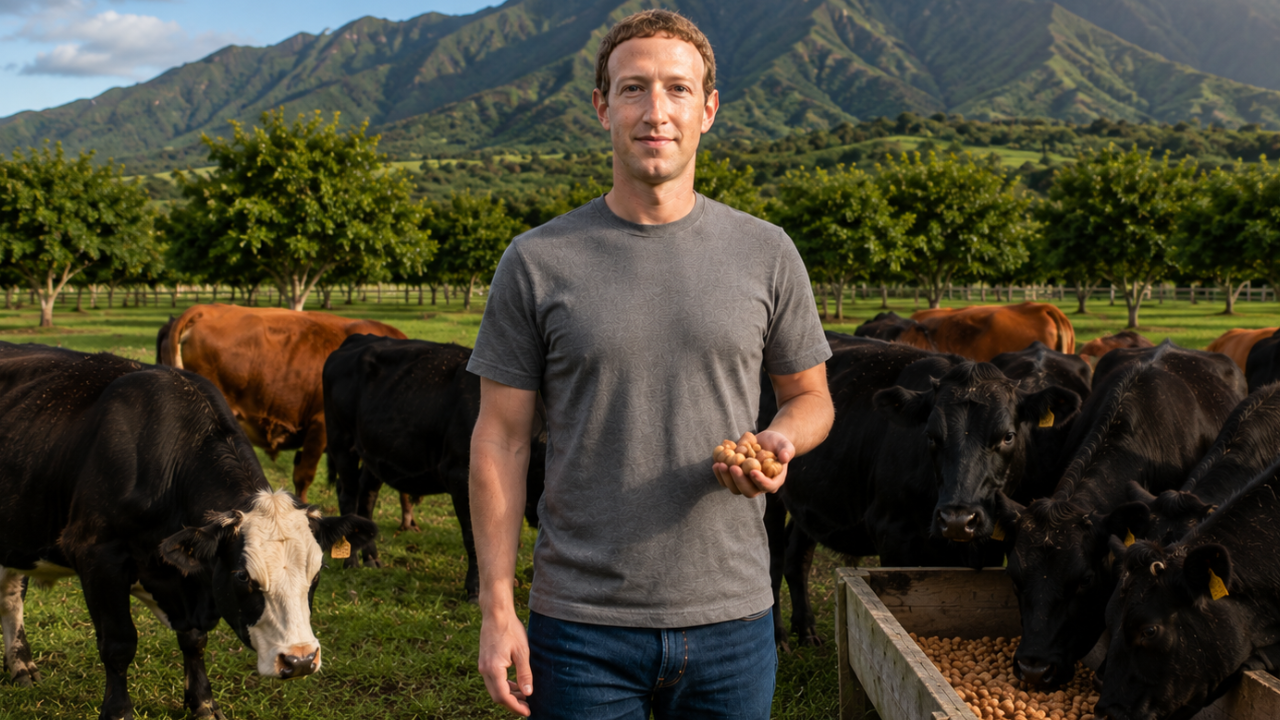
Mark Zuckerberg’s public pivot into ultra-luxury cattle ranching on Kauai’s Ko'olau Ranch represents more than a billionaire’s eccentric hobby. It is a highly calculated, vertically integrated agribusiness experiment that tests the absolute limits of caloric conversion efficiency and premium brand positioning. By feeding Wagyu and Angus cattle a strict diet of macadamia nuts and locally brewed beer, the operation attempts to solve a fundamental optimization problem: maximizing intramuscular fat deposition (marbling) through hyper-local, energy-dense waste streams.
Understanding this venture requires stripping away the lifestyle-journalism fluff and analyzing it through the cold lens of agricultural economics, nutritional thermodynamics, and supply chain constraints.
The Thermodynamic Bottleneck of Premium Beef Production
To appreciate the strategy, one must understand the biological limitations of high-grade beef production. The Japanese beef grading system (BMS, or Beef Marbling Score) and the USDA Prime designation prioritize intramuscular fat. Achieving this requires a prolonged period of high-energy feeding, typically utilizing corn or barley in conventional feedlots.
Zuckerberg’s model replaces traditional grain infrastructure with a localized, hyper-dense caloric matrix comprised of macadamia nuts and beer. This creates a distinct input-output equation governed by specific nutritional mechanics.
The Macadamia Nutrient Matrix
Macadamia nuts are exceptionally high in monounsaturated fatty acids, particularly oleic acid and palmitoleic acid. In ruminant nutrition, the composition of dietary fat directly influences the melting point and flavor profile of the carcass fat.
- Lipid Optimization: Oleic acid lowers the melting point of beef fat, producing the characteristic "melt-in-your-mouth" texture prized in A5 Wagyu.
- Caloric Density: Nuts provide a higher caloric density per pound than standard corn silage. This accelerates the rate of gain during the finishing phase, assuming the rumen microbiota can tolerate the lipid load without triggering acidosis.
The Rumen Fermentation Variable
The inclusion of beer serves a dual psychological and physiological purpose. While public perception views it as a luxury indulgence for the animal, the operational reality centers on rumen stimulation and appetite enhancement.
- Appetite Stimulation: During the final 100 to 200 days of a beef animal's life, dry matter intake typically declines as the animal approaches physiological maturity. Alcohol and yeast byproducts from beer act as appetite stimulants, ensuring the cattle continue to consume the dense macadamia rations required for elite marbling.
- Microbial Efficiency: The spent grains and yeast remnants within unpasteurized beer introduce specialized carbohydrates and B-vitamins that support the rumen's microbial population, optimizing the fermentation process that converts fiber into volatile fatty acids.
The Vertical Integration and Capital Infrastructure Constraint
Ko'olau Ranch operates under a strict, closed-loop thesis. Zuckerberg noted that the feed is grown and produced entirely on the ranch, utilizing a highly localized supply chain. While this mitigates geopolitical supply chain risks, it introduces severe scale limitations and exponential cost functions.
The Land-to-Calorie Ratios
Macadamia trees require years to mature and yield significant crop volumes. A single Wagyu-Angus crossbreed animal consumes between 20 to 30 pounds of feed per day during the finishing phase. To sustain a herd entirely on-site, the land allocation matrix must balance pasture grazing acreage with macadamia orchard square footage.
[Total Acreage]
   ├──> Pasture Land (Cow-Calf & Stocker Phases)
   └──> Macadamia Orchards ──> Processing Waste ──> Finishing Feed Component
This structural dependency creates a hard ceiling on herd size. The enterprise cannot scale linearly because adding one animal requires a mathematically proportionate expansion of both grazing land and mature orchard acreage.
The Labor and Opportunity Cost of Local Sourcing
Standard commercial beef production leverages massive economies of scale by sourcing feed from the global commodities market. By internalizing feed production, Ko'olau Ranch assumes the operational overhead of an agricultural conglomerate: managing orchards, running a small-scale brewery or processing facility, and harvesting feed manually.
The cost per pound of beef produced under this model likely exceeds market rates by an order of magnitude, shifting the product entirely out of the commodity space and into the realm of Veblen goods—where high prices actively drive demand and prestige.
Genetic Architecture: Wagyu vs. Angus Crossbreeding
The choice of livestock genetics is the foundational engine of the entire operation. Zuckerberg’s strategy utilizes a composite herd, blending purebred Wagyu with Angus. This is a classic industry methodology optimized for specific operational outcomes.
Maximizing Heterosis (Hybrid Vigor)
Purebred Japanese Black Wagyu excel at marbling but possess slower growth rates and lighter carcass weights. Commercial Angus cattle offer superior feed conversion efficiency, rapid growth, and robust skeletal structures. Crossing the two breeds yields F1 composites that inherit the marbling propensity of the Wagyu and the growth velocity of the Angus.
Adapting to the Hawaiian Microclimate
Kauai’s humid, tropical environment presents a challenge for high-input beef production. Purebred Wagyu can suffer from heat stress, which drastically reduces dry matter intake and halts fat deposition. Angus genetics introduce hardiness and climate adaptability, ensuring the herd maintains metabolic efficiency under persistent thermal pressure.
Systemic Vulnerabilities of the Zuckerberg Model
An objective analysis reveals several critical vulnerabilities that threaten the long-term viability of this agricultural framework.
1. Rumen Acidosis and Lipid Saturation
Ruminants are not naturally evolved to process high-fat diets. If the percentage of lipids in the total ration exceeds 6-8%, it coats the fiber particles in the rumen, inhibiting microbial digestion. Managing the precise ratio of macadamia nuts to forage is a precarious balancing act; a slight miscalculation can induce chronic bloat or acidosis, permanently damaging the animal’s metabolic capacity.
2. The Biosecurity and Environmental Bottleneck
Island ecosystems are fragile. A localized pest or blight affecting the macadamia orchards would instantly collapse the feed supply chain. Because shipping external grain to Hawaii is cost-prohibitive and violates the "closed-loop" branding thesis, the entire operation possesses a single point of failure: the health of the ranch's orchards.
The Strategic Play
For operators looking to extract value from this ultra-luxury template without matching a billionaire's capital reserves, the strategy must be modified.
Do not attempt to replicate the closed-loop, multi-crop infrastructure unless you possess integrated land assets that are already producing cash-crop waste streams. Instead, identify local food-manufacturing byproducts—such as spent distillers' grains, fruit pomace, or nut processing waste—and pair them with highly adaptable F1 terminal crossbreeds. The value lies not in the eccentricity of the ingredient, but in the precise calibration of the fatty acid profile to elevate the final eating experience.