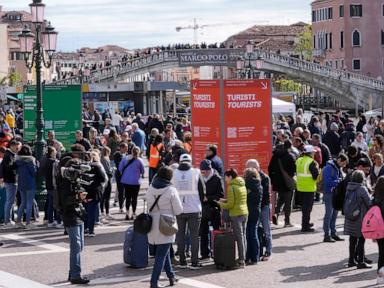
The implementation of a dynamic access fee by a municipal government represents a shift from administrative crowd management to a pure price-elasticity experiment. The announcement by the Mayor of Venice regarding a proposed dynamic pricing mechanism for day-trippers—introducing a variable scale with a 50-euro ceiling—is fundamentally a resource allocation strategy wrapped in civic policy. To understand whether this fiscal lever can successfully mitigate overtourism, the initiative must be evaluated not as a tourism tax, but as a congestion pricing model operating under specific structural constraints.
The core failure of traditional flat-fee systems, such as Venice's initial 5-euro pilot program, lies in their inability to alter consumer behavior at peak demand periods. A flat fee operates as a static friction point; it deters only the most price-sensitive consumers while failing to flatten the demand curves during high-velocity holiday weekends. By shifting to a dynamic model that escalates up to 50 euros, the municipality is attempting to establish an economic disincentive strong enough to exceed the marginal utility of a peak-day visit for a significant segment of day-trippers.
The Tripartite Friction Framework of Urban Congestion
To analyze the efficacy of the 50-euro dynamic ceiling, the day-tripper market must be segmented through a framework of economic friction. Total friction experienced by a traveler is comprised of three distinct vectors:
1. Fiscal Friction
This is the direct monetary cost of entry. At 5 euros, the fiscal friction was negligible relative to the total sunk cost of a European holiday. At 50 euros, the fiscal friction becomes a primary variable in the consumer decision-making matrix, particularly for regional domestic travelers and low-cost carrier passengers.
2. Administrative Friction
The requirement to pre-book, acquire a QR code, and pass through physical check-points creates non-monetary barriers to entry. This transaction cost disproportionately affects spontaneous, regional day-trippers while leaving international tourists—who plan itineraries months in advance—largely unaffected.
3. Psychological Friction
The transition of a historic city from an open public space to a ticketed, gated ecosystem alters the consumer's perception of value. This shifts the experience from an aspirational cultural journey to a transactional entertainment purchase, fundamentally shifting the demographic profile of the visitor base.
The Elasticity Paradox in Hyper-Leisure Destinations
The structural flaw in the municipality’s strategy rests on a miscalculation of price elasticity of demand ($E_d$). In standard economic models, an increase in price yields a corresponding decrease in demand. However, Venice operates as an positional good with highly inelastic demand curves for specific international segments.
$$% \Delta Q_d = E_d \times % \Delta P$$
For a transcontinental tourist who has invested thousands of euros in flights and lodging within the region, the marginal increase of 50 euros to enter the historic center is statistically insignificant. The utility of checking off a bucket-list destination outweighs the fiscal penalty.
Conversely, the domestic regional traveler—the resident of the Veneto region who visits for an afternoon—exhibits high price elasticity. For this group, a 50-euro fee is prohibitive relative to the alternative leisure options available nearby. Therefore, the dynamic pricing model will not uniformly reduce crowd density; instead, it will aggressively filter out local and regional visitors while preserving high-net-worth international crowds. This creates an demographic monoculture, accelerating the transformation of the living city into a sterilized open-air museum.
The Leakage and Displacement Vectors
A critical omission in basic congestion pricing models is the failure to account for geographic and temporal displacement. When fiscal friction is applied to a hyper-localized zone, demand does not vanish; it refracts.
[Peak Day Demand] ---> [50-Euro Fiscal Friction Triggered]
                             |
                             +---> Temporal Displacement (Mid-week shifts)
                             |
                             +---> Geographic Displacement (Murano, Burano, Lido)
                             |
                             +---> Overnight Conversion (Exempt from access fee)
The 50-euro ceiling applies strictly to day-trippers. This creates an immediate regulatory arbitrage opportunity. Travelers will actively seek methods to bypass the fee, creating three distinct displacement loops:
- The Overnight Conversion Loop: Visitors may calculate that paying for a budget accommodation within the municipal boundaries, which grants an exemption from the day-tripper fee via the existing tourist tax structure, yields higher utility than paying multiple day fees for a family. This increases pressure on the local housing stock via short-term rentals.
- The Geographic Refraction Loop: Crowds unable or unwilling to pay the peak fee will spill over into non-gated adjacent areas. Secondary islands like Murano, Burano, or the mainland hub of Mestre will experience secondary congestion spikes without possessing the infrastructure to absorb them.
- The Temporal Compression Loop: If prices drop significantly on weekdays, demand will compress into those lower-cost windows. This eliminates the traditional mid-week operational breathing room required by municipal sanitization, logistics, and residential services, leading to a state of perpetual medium-high congestion rather than sharp, manageable peaks.
Operational Limitations of the Dynamic Algorithm
For a dynamic pricing mechanism to function effectively, it requires real-time calibration based on predictive data feeds. Aviation and hospitality industries adjust prices using sophisticated yield management systems that process historical booking velocity, weather forecasts, and macroeconomic indicators. The Venice municipality faces severe operational constraints in executing this level of algorithmic precision.
The primary bottleneck is data asymmetry. While the city can track historical QR code bookings, it cannot accurately predict spontaneous regional influxes driven by short-term weather changes or impromptu local events until the administrative booking occurs. If the algorithm raises prices too slowly, the city caps out on capacity before the economic deterrent takes effect. If it raises prices too quickly based on flawed forecasts, it artificially suppresses economic activity for local merchants who rely on foot traffic.
Furthermore, enforcement infrastructure presents a scaling bottleneck. Checking the digital credentials of tens of thousands of individuals entering through a limited number of transit nodes (Santa Lucia station, Piazzale Roma) creates physical lines. This administrative friction risks transferring the congestion from the interior walkways of the city to its primary entry portals, compromising public safety and transit efficiency.
The Local Merchant Dilemma and Revenue Allocation
The economic impact of a 50-euro ceiling extends directly to the internal commercial ecosystem of the city. Day-trippers possess a specific spending profile: they consume low-margin goods, frequent quick-service food establishments, and purchase souvenir items, while contributing little to high-end dining or cultural institutions.
By suppressing the volume of regional day-trippers, the city reduces the customer base for these baseline merchants. While luxury retailers and hotels may welcome a lower-volume, higher-spend demographic, the mid-tier service economy of Venice faces structural contraction.
To remain economically viable, the revenue generated from the 50-euro fee must be explicitly earmarked for structural offsets rather than absorbed into general municipal funds.
Essential Infrastructure Investment Vectors
- Subsidization of Residential Services: Directing fee revenue toward reducing waste management costs, water-taxi subsidies, and property tax relief for permanent residents to stem the ongoing demographic collapse.
- Logistical Modernization: Funding quiet, automated freight delivery systems to minimize the physical wear and tear on the city’s fragile pedestrian infrastructure caused by increased commercial supply chains.
- Physical Preservation Endowments: Allocating capital directly to the restoration of foundations and salt-water damage mitigation, linking tourist volume directly to the structural preservation of the asset they consume.
Strategic Forecast and the Tiered Access Reality
The proposal of a 50-euro dynamic pricing ceiling is the opening move toward a fully commodified urban ecosystem. Over a multi-year horizon, this model will inevitably evolve from a mechanism designed to regulate tourism into a rigid, tiered access system.
Municipalities globally will monitor this execution. If Venice successfully establishes a 50-euro threshold without catastrophic damage to its baseline merchant economy, it will set a precedent for historic city centers across Europe. The future of high-demand cultural spaces will not be defined by public accessibility, but by variable fiscal gates.
For corporate strategists, hospitality operators, and urban planners, the takeaway is clear: the era of frictionless urban exploration is concluding. True strategic differentiation will belong to operators who can bundle the cost of these municipal access fees into premium, end-to-end travel products, thereby removing the psychological friction for the consumer and capturing the inelastic segment of the market before they ever reach the gate.