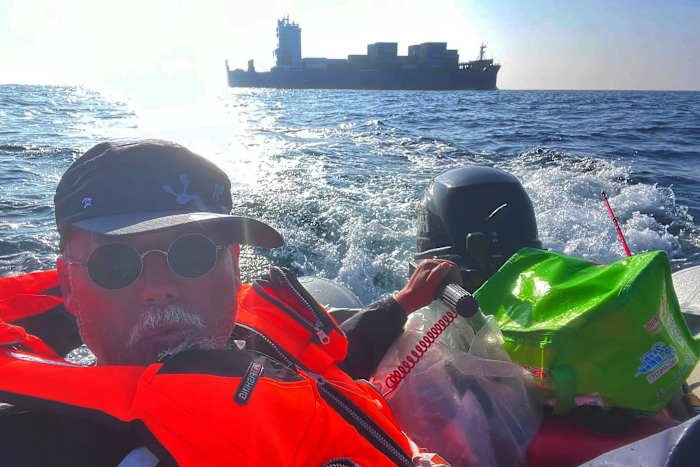
Imagine sitting in a 3.3-meter gray rubber dinghy in the middle of the open ocean. The fog rolls in, thick and blinding. You look down at your phone, your only navigation tool, and see the battery icon flashing on its last bar. Your portable power bank is already completely dead. Behind you lies a country where you are constantly watched, denied your retirement, and treated like a prisoner in your own home. Ahead of you is nothing but rough waves and the very real chance of drowning.
For 68-year-old Chinese dissident Dong Guangping, this was not a hypothetical nightmare. It was the exact reality he faced in late May 2026. If you found value in this post, you should check out: this related article.
Dong spent roughly 40 hours floating on the sea between China and the Korean Peninsula. He survived. On June 26, 2026, he finally stepped off an Air Canada flight in Toronto, sat down in a car with his long-time activist friend Sheng Xue, and ate a big bowl of noodles with eggs, tomatoes, and shrimp. It marked the end of an exhausting, decades-long battle against the Chinese state apparatus. It was his fourth attempt to break free.
His story is a raw window into the extreme lengths citizens must go to when they cross the Chinese Communist Party. It reveals a terrifying, increasingly desperate escape route that activists call the maritime freedom trail. For another perspective on this story, check out the latest update from Reuters.
The Long Road to a Inflatable Boat
Dong was not always a fugitive. He used to be part of the system.
He worked as a police officer in China, seeing firsthand how the state maintained control. His life changed forever in 1999. He co-signed a public letter commemorating the tenth anniversary of the 1989 Tiananmen Square crackdown. The retaliation from the government was swift. He lost his job immediately.
From that point on, he became a prime target for state security.
In 2001, authorities locked him up for three years under the broad charge of inciting subversion of state power. That is the standard legal hammer Beijing uses to crush anyone demanding democratic reforms or basic civil liberties. After his release, Dong refused to stay quiet. In 2014, he participated in another memorial for the victims of the Tiananmen square massacre. The police arrested him again, keeping him behind bars for more than eight months.
When he was out of prison, the persecution did not stop. It just shifted forms. The state cut off his retirement benefits. They refused to renew his passport. Local police monitored his every move, turning his daily life into psychological torture. Dong described the experience as living in a suffocating cage. When expression is completely choked out, the only option left is to run.
Three Failed Attempts and the Cost of Defiance
Most people would have broken after the first failed escape. Dong kept trying, paying a heavier price with each capture.
His first major break came in 2015. He managed to slip across the border into Thailand. His wife and daughter accompanied him, and the family successfully secured official refugee status from the United Nations High Commissioner for Refugees. They thought they were safe. They were wrong.
Thai authorities arrested Dong at the behest of Beijing. They deported him back to China, separating him from his family. While his ex-wife and daughter managed to resettle safely in Canada, Dong was thrown right back into a Chinese prison cell.
- 2015: Escaped to Thailand. Attained UN refugee status. Detained by Thai police and forcibly deported to China. Jailed upon arrival.
- 2019: Attempted to swim from the coast of mainland China to a Taiwanese-controlled island. The physical toll and ocean currents defeated the attempt.
- 2020: Fled into Vietnam. He hid there for two years before Vietnamese authorities located him in 2022 and handed him back over to Chinese border guards. He faced yet another prison sentence.
Every single deportation resulted in more prison time, harsher interrogation, and tighter surveillance. By 2026, his domestic situation had become entirely unlivable.
The Forty Hour Gamble on the Yellow Sea
On May 24, 2026, Dong decided to gamble his life one last time. He chose the ocean.
He traveled to Weihai, a coastal city located on the eastern tip of Shandong province. The geography matters here. Weihai juts out into the Yellow Sea, making it the closest point on the Chinese mainland to both South Korea and Japan.
In the quiet, early hours of the morning, under clear skies, Dong pushed off into the surf. His vessel was a tiny, gray rubber dinghy fitted with a small outboard motor. He had no advanced marine navigation systems, no radar, and no backup crew. He just had his smartphone for GPS tracking and a couple of portable batteries.
His original target was Japan. He knew the Japanese government would face massive international pressure if they tried to deport a high-profile political dissident back to a Chinese prison. But the ocean rarely cooperates with human plans.
By the second day of his solo voyage, a dense fog settled over the water. Visibility dropped to near zero. Then the technical disasters struck. His power banks died one by one. He checked his phone and realized the battery was about to run out completely. Without the phone, he was blind in the fog, drifting in a fragile rubber toy in shipping lanes dominated by massive cargo vessels.
He had to change plans instantly. He steered the dinghy toward the closest landmass, South Korea.
The psychological weight of those hours is difficult to comprehend. The waves could easily capsize a 3.3-meter inflatable boat if the wind picked up. If the motor failed, he would drift until he died of dehydration. Dong later stated that he simply shook off the fear of death. When your life under an authoritarian regime feels identical to being dead, risking actual physical death for a sliver of freedom becomes a logical trade.
As darkness fell on the second day, he spotted distant lights. He steered toward them, screaming for help at the first ship he encountered. The vessel passed by without hearing him. Finally, a South Korean fishing boat spotted the tiny dinghy. The crew pulled Dong aboard. Exhausted and freezing, Dong immediately asked the fishers to contact the local authorities.
The Geopolitical Chess Match in Seoul
When the South Korean Coast Guard took Dong into custody on May 26 near a western island, the legal and diplomatic machinery began to grind. Officially, he was detained for violating the country's immigration laws.
Historically, South Korea is an incredibly tough place for asylum seekers. The government accepts a tiny fraction of refugee applications each year. Seoul also walks a tight diplomatic tightrope, trying to manage its massive economic relationship with Beijing while maintaining its alliances with Western democracies.
Chinese dissidents who arrive in South Korea illegally face a terrifying legal limbo. Sometimes they are held in detention centers for years.
This time, things moved differently. The South Korean authorities applied for a formal arrest warrant to keep Dong locked up. In a surprising move, a local court rejected the warrant. The judge stated there was little justification or necessity to hold the 68-year-old activist in a jail cell.
Instead, they transferred him to an immigration refugee center in Incheon, the major port city near Seoul. That judicial decision changed everything. It kept Dong out of the standard deportation pipeline long enough for international advocates to step in.
Inside the Rapid Diplomatic Rescue
While Dong sat in the Incheon refugee center, a quiet diplomatic operation began behind closed doors. His long-time advocate Sheng Xue and international human rights organizations went to work. They pressured the Canadian government to honor the resettlement commitments tied to his family.
The breakthrough happened quickly. In mid-June, officials from the United Nations refugee agency conducted a secure video interview with Dong inside the center.
A few days later, a manager at the facility approached Dong and asked for his physical measurements, including his height, weight, and eye color. Dong admitted he was terrified at first, fearing he was being processed for removal back to China. His legal team quickly reassured him. The Canadian diplomatic mission had requested the data to issue emergency travel documents.
The cooperation between the UN refugee agency, the South Korean government, and Canadian immigration officials bypassed the usual bureaucratic delays that leave refugees stranded for years. Within days, Dong was placed on an Air Canada flight bound for Toronto.
The speed of the transfer surprised even Dong. He described the transition from a South Korean detention environment to freedom in Canada as feeling like a sudden dream.
The Realities of Life After the Sea
Dong is safe in Toronto, reunited with the family he was torn away from over a decade ago. He has expressed an overwhelming sense of relief, stating that the constant, low-level fear that follows every political activist in China has finally vanished.
But the path ahead for an aging dissident in a new country is never simple.
He is 68 years old. He does not speak fluent English or French. He cannot rely on a state pension from the country he served as a police officer because the regime stripped it away. He has already stated he wants to find work as a truck driver or an Uber driver to support himself and contribute to his new home.
He also refuses to drop his political work. Dong has vowed to continue speaking out against the authoritarian system in Beijing from his new vantage point in Canada. His survival gives him a unique, undeniable authority. He is living proof of what citizens are willing to endure just to escape the control of the state.
The maritime route across the Yellow Sea remains an incredibly dangerous option for those fleeing East Asia. Dong got lucky. His motor ran long enough, the fishing boat spotted him in the dark, and the South Korean courts showed unexpected leniency. For the thousands of others looking for a way out of tight surveillance states, his journey stands as a stark reminder of the cost of freedom.