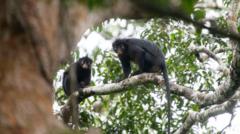
You would think we had already mapped out our closest relatives on this planet. Primates are not exactly subtle. They are loud, relatively large, and active. Yet, deep in the rainforest of the Democratic Republic of Congo (DRC), a striking black monkey with a vivid pinkish-orange pout has been hiding in plain sight.
Scientists just officially described Colobus congoensis, known locally as the "Likweli". It is only the fifth new monkey species identified in Africa over the last 75 years. While the world is losing species at an alarming rate, finding a completely undocumented primate is a massive deal. It is a reminder of how little we actually know about the dense canopy of the Congo Basin.
The Secretive Primate with a Makeup Trend Face
The Likweli is not just another monkey. It has a look that is hard to ignore. Draped in glossy, light-reflecting black fur with dramatic, cape-like shoulders, its face is framed by a stiff crown of black hair. What really stands out, though, is the vivid orange-cream patch around its mouth and nose, giving it a distinct, mask-like look.
Local communities have actually known about this animal for a long time. The Bangala people call it "Likweli," while the Mituku community refers to it as "Kasaba Nkoni," which translates to "branch shaker". The nickname is fitting. Like other colobus monkeys, the Likweli leaps through the high canopy, leaving a trail of swaying branches behind it.
But why did it take science so long to register its existence?
Basically, the Likweli is incredibly stealthy. Weighing in at a modest 15 pounds, it prefers the highest, most closed-canopy parts of the forest. When humans approach, they don’t panic and run. Instead, they climb higher into the canopy and silently watch.
The first scientific clue came in 2008 when conservationists snapped a blurry, backside-only photo of an unidentified monkey in what is now Lomami National Park. It took another ten years for a surveillance team to capture a clear frontal shot of the monkey's unique orange face, sparking a dedicated quest to find and identify the species.
Rewriting the Evolutionary Family Tree
The discovery of Colobus congoensis is throwing a wrench into what we thought we knew about primate evolution in Africa.
To confirm that the Likweli was indeed a new species, an international team of scientists led by Florida Atlantic University and the Lukuru Wildlife Research Foundation gathered a massive dataset of 114 field observations, acoustic recordings, and physical specimens. They compared skulls and pelts with historical museum collections.
The results were shocking.
- A massive geographic gap: Genetic analysis revealed that the Likweli’s closest relative is the black colobus (Colobus satanas). However, the black colobus lives in West-Central Africa, more than 1,200 kilometers (750 miles) away.
- An ancient split: The two species diverged roughly 4 to 5 million years ago. This is one of the oldest evolutionary splits ever recorded within the Colobus lineage.
- Unique vocalizations: The Likweli produces deep, booming "roars" punctuated by snorts. When they let out these calls, their bright orange lips bunch up into a distinct, visible "O" shape. Acoustic analysis proved that these calls have a totally unique structure compared to other colobus species.
This tells us that the Congo Basin has acted as a powerful evolutionary incubator, keeping lineages isolated and thriving in deep forest pockets for millions of years.
Why We Might Lose the Likweli Before We Understand It
While this discovery is a massive victory for science, it comes with a heavy dose of urgency. The Likweli is already facing an existential crisis.
Field surveys show that the monkey occupies an incredibly small geographic range of just 1,700 square kilometers (about 650 square miles) between the Lomami and Lilo rivers. Because they are restricted to this tiny pocket of closed-canopy forest, they are highly vulnerable to any changes in habitat quality.
Human populations are expanding, and with that expansion comes habitat destruction and increased hunting pressure. Because of this, researchers are urgently pushing for the Likweli to be classified as Endangered on the IUCN Red List.
This discovery highlights why protecting the Lomami National Park buffer zones is so critical. This same region yielded the discovery of another new primate, the Lesula, back in 2012. There is clearly still so much left to find in these woods.
To help protect the Likweli, conservation efforts must focus on supporting local ranger patrols, enforcing anti-poaching measures, and monitoring the boundaries of their restricted habitat. Supporting organizations like the Lukuru Wildlife Research Foundation is a direct way to keep these boots on the ground.
You can learn more about how researchers tracked down this incredibly elusive animal in this educational video detailing the Congo Basin discovery, which shows the unique environment these monkeys call home.