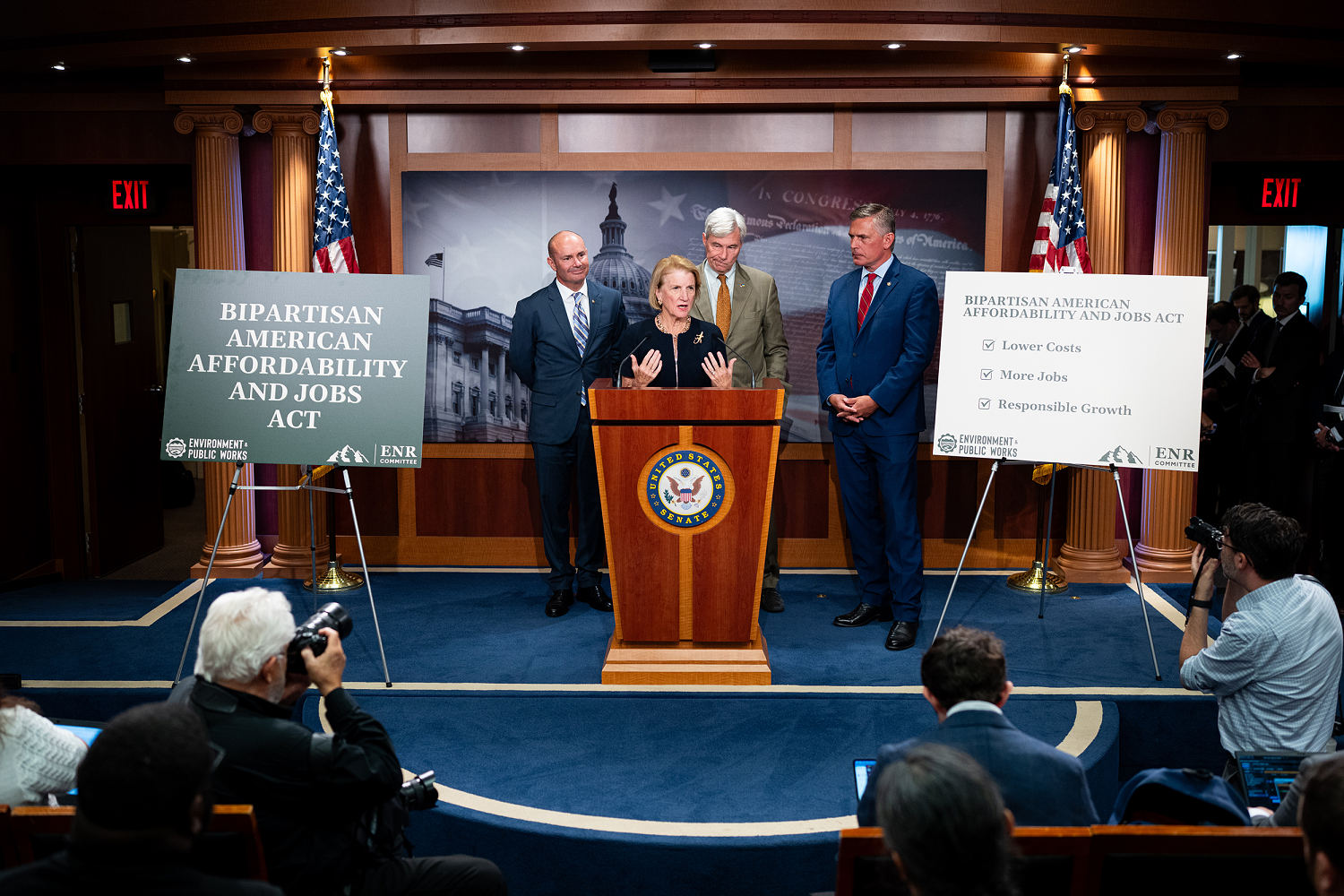
Capital allocation in American physical infrastructure has operated under a severe regulatory discount rate for decades, where the primary risk to any major energy, transit, or industrial project is not engineering failure, but procedural attrition. When the United States Senate passes legislation designed to simplify federal permitting rules and transmits that bill to the House of Representatives, the market reacts to the headline of deregulation while often missing the underlying operational mechanics. True permitting reform is not merely a reduction in paperwork; it is a fundamental restructuring of the legal and administrative vectors that govern project timelines, cost of capital, and litigation exposure. To understand whether a Senate-passed permitting bill will actually accelerate physical construction in the United States, analysts must strip away legislative rhetoric and examine the exact friction points within the National Environmental Policy Act, judicial review statutes, and multi-agency coordination frameworks.
The Anatomy of the American Permitting Bottleneck
Infrastructure development in the United States suffers from a sequential, multi-veto governance model. Unlike jurisdictions that utilize centralized clearinghouses or binding shot clocks, the American federal framework distributes authority across dozens of statutory regimes and executive agencies. A single linear infrastructure project—such as a high-voltage transmission line, a natural gas pipeline, or a utility-scale renewable generation facility—must navigate overlapping jurisdictions involving the Department of the Interior, the Environmental Protection Agency, the Army Corps of Engineers, and the Federal Energy Regulatory Commission.
This structural fragmentation creates three distinct failure modes that drive up capital expenditure and extend project schedules:
- Sequential Review Dependencies: Agencies frequently wait for the completion of parallel reviews before initiating their own statutory processes. If the Fish and Wildlife Service delays a biological opinion under the Endangered Species Act, the Army Corps of Engineers freezes its wetlands permitting under Section 404 of the Clean Water Act. The critical path of the project becomes a chain of uncoordinated queues.
- Asymmetric Litigation Risk: Under the Administrative Procedure Act, project opponents do not need to prove substantive environmental harm to halt construction; they only need to demonstrate a procedural defect in the administrative record. Because an Environmental Impact Statement can span thousands of pages, plaintiffs routinely file broad challenges targeting minor analytical omissions, forcing agencies to remand and rewrite documents over multi-year cycles.
- Scope Creep in Environmental Reviews: Over fifty years of judicial precedent, the definition of "reasonably foreseeable environmental effects" under the National Environmental Policy Act has expanded dramatically. Agencies are routinely compelled to model upstream and downstream impacts far removed from the physical footprint of the proposed asset, turning localized engineering assessments into open-ended macroeconomic and climate debates.
When the Senate advances a bill aimed at simplifying these rules, its practical efficacy depends entirely on how aggressively it alters these three mechanics. Surface-level adjustments—such as encouraging agencies to communicate better—yield zero improvement in net present value for infrastructure developers. Meaningful reform requires hard statutory caps on review durations, strict limits on the scope of environmental analysis, and shortened statutes of limitations for judicial challenges.
The Three Pillars of Legislative Permitting Reform
Any credible federal effort to compress construction timelines relies on three core structural interventions. By mapping the legislative mechanics against these pillars, capital allocators and project managers can separate symbolic political signaling from genuine operational relief.
1. Statutory Shot Clocks and Lead Agency Consolidation
The primary mechanism for eliminating sequential delays is the codification of the "One Federal Decision" framework. Under this structure, a single federal agency is designated as the lead entity responsible for managing the entire environmental review schedule. Cooperating agencies are legally bound to conduct their assessments concurrently rather than sequentially, feeding their findings into a single, unified Environmental Impact Statement and a single Record of Decision.
To prevent this consolidation from becoming purely aspirational, legislative reform introduces hard statutory deadlines—typically two years for full Environmental Impact Statements and one year for narrower Environmental Assessments. Page limits are simultaneously imposed on these documents to force agencies to synthesize data rather than engage in defensive, encyclopedic documentation designed solely to insulate the record from future lawsuits.
However, a statutory shot clock without an enforcement mechanism is functionally useless. If an agency misses a two-year deadline and the only remedy is a procedural report to Congress, the timeline will continue to slip. Effective legislation includes a "deemed approved" clause or triggers immediate judicial recourse that compels the agency to issue a decision within a fixed, non-extendable window. Furthermore, the lead agency must possess the statutory authority to resolve interagency disputes directly, preventing a junior specialist at a cooperating agency from holding a multi-billion-dollar project hostage over a secondary methodological disagreement.
2. Categorical Exclusions and Threshold Adjustments
The fastest way to accelerate a permitting process is to remove the project from the full review pipeline entirely. Federal agencies utilize Categorical Exclusions for classes of actions that have been empirically determined not to have a significant individual or cumulative effect on the human environment.
Simplifying permitting rules typically involves expanding the catalog of Categorical Exclusions and allowing agencies to borrow exclusions already established by other federal departments. For example, if the Department of Energy has established a Categorical Exclusion for upgrading existing transmission corridors, a legislative reform package might allow the Department of the Interior to apply that exact exclusion to projects crossing federal lands without conducting a new rulemaking process.
This mechanism targets the vast middle tier of infrastructure investments: grid modernization, brownfield industrial redevelopment, broadband deployment, and localized water system upgrades. By shifting these projects out of the multi-year Environmental Assessment track and into a 30-to-60-day Categorical Exclusion verification, the legislation frees up scarce agency personnel to focus on genuinely complex greenfield developments.
3. Judicial Review Truncation and Venue Reform
Even a streamlined, two-year federal review fails if the resulting permit is immediately stayed by a federal district court for four years. Historically, challenges under the Administrative Procedure Act have operated under a default six-year statute of limitations. This prolonged window creates profound financing friction; institutional lenders demand massive risk premiums or refuse to close on construction debt while litigation risk remains open.
Legislative reform attacks this bottleneck by compressing the statute of limitations for filing claims against federal infrastructure permits—often reducing the window from six years to 150 or 180 days. Beyond the filing deadline, rigorous reform proposals establish strict standards for injunctive relief. Courts are instructed not to vacate a permit or halt ongoing construction unless the plaintiff demonstrates a high likelihood of irreparable physical harm that outweighs the public interest in completing the infrastructure.
Another critical vector is remand timelines. When a court identifies a genuine flaw in an agency's environmental analysis, the standard practice has been to vacate the permit entirely, forcing the developer to cease operations and restart the administrative process. Modern permitting legislation seeks to replace vacatur with "remand without vacatur," establishing a strict 180-day clock for the agency to cure the technical defect in its paperwork while physical construction continues uninterrupted.
The Economic Cost Function of Regulatory Latency
To understand why legislative action in the Senate carries massive macroeconomic weight, one must evaluate infrastructure development through the lens of project finance. Large-scale physical assets are front-loaded capital expenditures with back-loaded, long-duration cash flows. Their viability is governed by the weighted average cost of capital and the time-to-revenue metric.
When permitting timelines stretch from two years to seven years, the project's internal rate of return collapses through three compounding financial mechanisms:
- Capitalized Interest and Carry Costs: Equity sponsors and early-stage debt providers must fund engineering, land acquisition, legal defense, and administrative compliance years before the asset generates a single dollar of operating cash flow. Every year of delay compounds the carrying cost of this pre-construction capital, forcing developers to raise equity dilution or accept punitive mezzanine financing rates.
- Supply Chain and Inflation Exposure: Equipment procurement—such as high-voltage transformers, specialized turbines, or heavy industrial piping—cannot be locked in at fixed prices if the construction start date is indeterminate. Developers either pay exorbitant option fees to hold manufacturing slots or remain exposed to raw material inflation and supply chain bottlenecks during the multi-year permitting limbo.
- Technology Obsolescence: In rapidly evolving sectors like grid-scale battery storage, semiconductor fabrication, or advanced nuclear design, a five-year regulatory delay ensures that the specific engineering parameters approved in the initial application are technologically obsolete by the time ground is broken. Modifying the permit to accommodate updated equipment often triggers a supplemental environmental review, trapping the developer in a recursive loop.
Simplifying permitting rules directly compresses the left tail of the project timeline. By reducing the variance in approval schedules, legislation lowers the risk premium demanded by infrastructure funds, effectively expanding the universe of economically viable projects without spending a single dollar of federal subsidy.
The Legislative Chasm Between Senate Passage and Enactment
The transmission of a permitting bill from the Senate to the House of Representatives marks a critical inflection point, yet it does not guarantee operational change on the ground. In the American bicameral system, passing a bill through one chamber often reflects a fragile, localized coalition that must survive a radically different ideological and procedural environment in the lower chamber.
The House of Representatives operates under majoritarian rules that frequently amplify partisan priorities compared to the Senate's cloture-driven compromises. As a Senate-passed permitting bill enters the House, three distinct political and structural pressures threaten to alter or stall its trajectory:
- The Energy Source Asymmetry: Permitting reform in Washington is perpetually caught in a tug-of-war between fossil fuel advocates and clean energy proponents. Senate compromises typically pair provisions that accelerate natural gas pipelines and mining permits with rules that streamline high-voltage electric transmission lines and renewable generation. In the House, factions frequently attempt to strip out the provisions favored by the opposing party. If the House removes transmission siting authority to appease traditional energy interests, or strips out fossil fuel leasing mandates to satisfy environmental caucuses, the bill will fail to pass a subsequent Senate reconciliation or conference vote.
- Federalism and State Preemption Friction: The most contentious aspect of transmission and pipeline permitting is the balance of power between federal agencies and state utility commissions. Accelerating interstate infrastructure almost always requires granting federal entities—such as the Federal Energy Regulatory Commission—backstop siting authority to override state-level vetoes. State governments and local property rights advocates fiercely resist this centralization of eminent domain power. House members, representing smaller, more localized geographic districts than Senators, are acutely sensitive to constituent backlash over federal land overrides.
- Committee Jurisdiction Fragmentation: Unlike the Senate, where a single committee like Energy and Natural Resources can shepherd a comprehensive package, a sweeping permitting bill in the House fractures across multiple powerful jurisdictions. The House Natural Resources Committee, the Energy and Commerce Committee, and the Transportation and Infrastructure Committee all claim authority over different statutory pieces of the permitting puzzle. Managing conflicting markups across these committees creates procedural friction that can easily run out the legislative clock before a floor vote occurs.
Operational Limitations of Statutory Reform
Even if the House passes the Senate bill intact and the President signs it into law, project developers and investors must account for the severe operational limitations inherent in federal legislative reform. Statutes do not build infrastructure; human bureaucracies and physical supply chains do.
First, state and local permitting remains untouched by federal statute. A federal bill can compress a National Environmental Policy Act review to twelve months, yet a project can still be stalled indefinitely by state water quality certifications under Section 401 of the Clean Water Act, state coastal zone management reviews, or county-level zoning and land-use ordinances. Unless developers execute parallel state-level engagement strategies, federal streamlining simply shifts the bottleneck downstream to state capitals and municipal boards.
Second, agency capacity cannot be legislated into existence overnight. Imposing a two-year deadline on the Bureau of Land Management or the Army Corps of Engineers does not automatically endow those agencies with the specialized hydrologists, biologists, and NEPA attorneys required to process a surge in applications. In the short term, strict statutory deadlines without corresponding appropriations for agency staffing and digital permitting infrastructure can lead to rushed, poorly reasoned administrative records. Ironically, a rushed review that cuts analytical corners provides plaintiffs with easier targets in federal court, potentially increasing litigation delays rather than reducing them.
Third, physical supply chains and labor markets remain hard constraints. Permitting reform unlocks the legal right to build, which immediately exposes the physical limits of the industrial base. The United States currently faces multi-year backlogs for large power transformers, high-voltage switchgear, and specialized construction labor. When regulatory barriers drop simultaneously across hundreds of delayed projects, developers will immediately collide with equipment procurement bottlenecks and skilled trades shortages, driving up hard construction costs even as soft regulatory costs decline.
Strategic Execution for Capital Allocators and Developers
Navigating the transition between Senate passage, House deliberation, and eventual regulatory implementation requires disciplined, proactive capital management. Organizations that wait for final enactment and subsequent agency rulemaking before adjusting their development pipelines will cede prime grid interconnections and supply chain slots to faster-moving competitors.
Project sponsors, infrastructure funds, and corporate real estate teams must execute four immediate tactical maneuvers:
- Front-Load Baseline Environmental Data Collection: Do not wait for the formal Notice of Intent to begin biological, cultural, and hydrological surveys. Because legislative reform compresses the formal agency review window, agencies will increasingly reject incomplete applications at the intake phase to protect their statutory shot clocks. Projects that enter the queue with two years of pre-collected, peer-reviewed baseline field data will move immediately to the front of the administrative line.
- Lock In Tier-One Equipment Supply Agreements: Anticipate the supply chain crunch that follows regulatory deregulation. Capital allocators should utilize framework agreements and early-stage reservation deposits for long-lead electrical and industrial components now, hedging against the price spikes that will occur once stalled projects receive simultaneous federal clearance.
- Target Brownfield and Existing Right-of-Way Corridors: Structure capital deployment around assets that qualify for expanded Categorical Exclusions. Acquiring or partnering on projects that utilize existing transmission rights-of-way, decommissioned industrial sites, or established pipeline corridors allows developers to bypass greenfield siting battles and capture the fastest regulatory timelines created by the legislation.
- Isolate State-Level Section 401 and Zoning Risks: Conduct an immediate audit of all non-federal permits required for active development pipelines. Reallocate legal and government affairs budgets away from federal agency lobbying—where statutory timelines are tightening—and deploy those resources directly toward state environmental agencies and local municipal boards, which now represent the primary remaining points of unmitigated veto power.