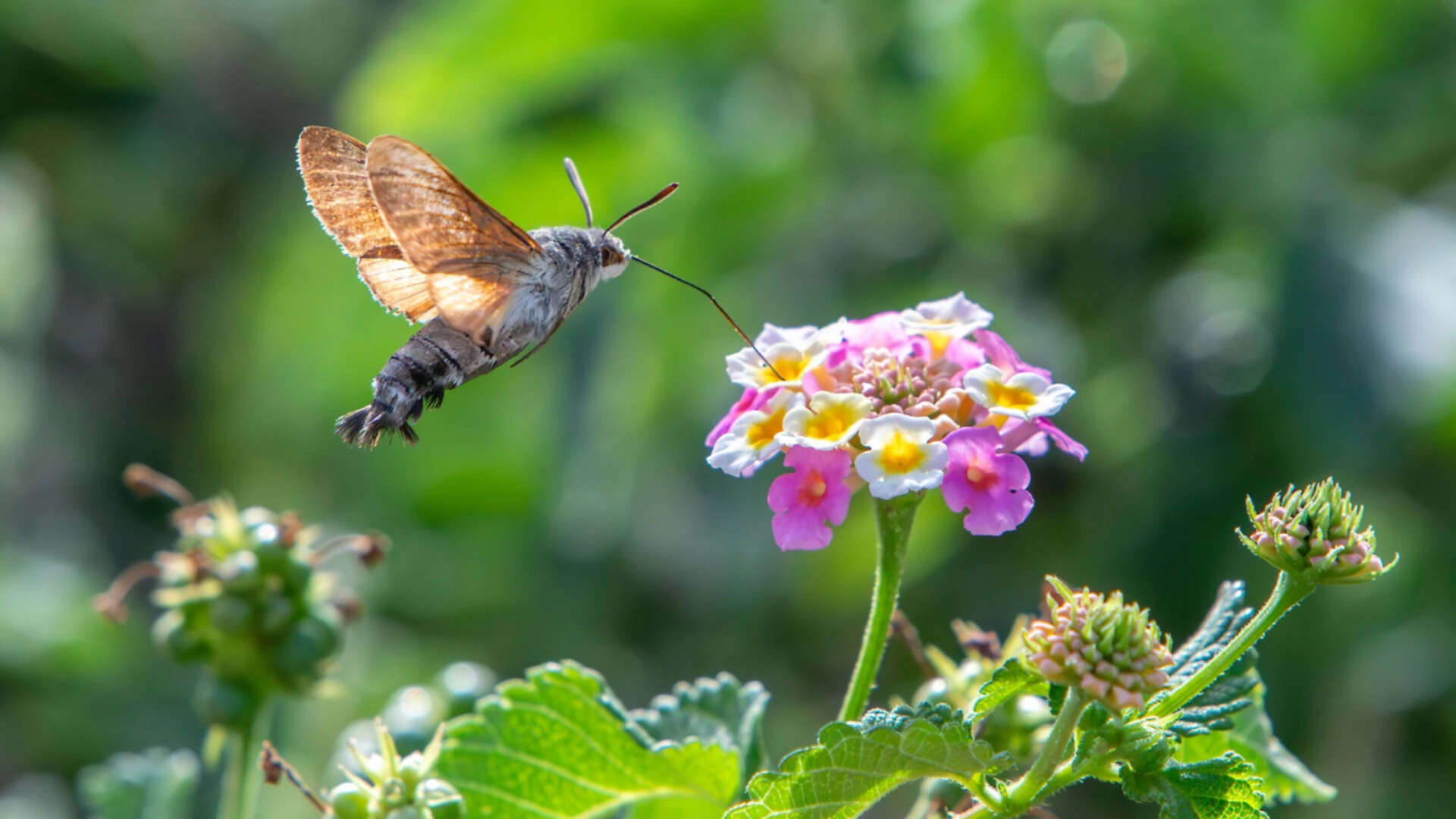
Neural processing capacity in biological organisms represents a finite economic resource. For mobile invertebrates executing high-speed, precision flight tasks, computational economy dictates survival. Recent empirical findings published in the Proceedings of the National Academy of Sciences by University of Konstanz researchers regarding Macroglossum stellatarum, the hummingbird hawkmoth, expose a structural solution to this computational constraint: the strict lateralization of an unpaired, centrally located appendage through an integrated visuo-motor axis.
This analysis deconstructs the structural mechanics of how small-brained organisms optimize sensory-motor coordination, bypassing the prohibitive energy costs of bilateral neural computation.
The Architectural Problem of Unpaired Organs
Behavioral lateralization, colloquially termed handedness, is an evolutionary constant spanning vertebrate and invertebrate taxa. From avian eye-beak coordination to primate limb preference, lateral bias minimizes neural redundancy. When an organism possesses paired limbs, assigning primary operational control to one side is a straightforward structural allocation.
The analytical challenge arises when evaluating unpaired, midline organs such as an elephant trunk, a human tongue, or a lepidopteran proboscis. An unpaired feeding apparatus operating along a strict central axis faces a persistent processing bottleneck. Without a default directional bias, every spatial targeting maneuver requires continuous, omnidirectional spatial recalculation.
For a day-active hovering insect operating under extreme metabolic demands, this computational overhead is inefficient. The hawkmoth solves this operational friction by hardcoding a directional bias into its feeding architecture.
The Visuo-Motor Control Axis
High-speed videography paired with markerless computer-vision pose estimation reveals that individual hawkmoths do not explore artificial flower surfaces symmetrically. Instead, they exhibit consistent, idiosyncratic motor preferences. When extending the proboscis to probe for nectar, an individual moth defaults to swinging the tip predominantly toward either the left or the right side of its body midline.
This side preference exhibits several distinct parameters:
- Idiosyncratic Distribution: The population splits into directional biases, mirroring the distribution curves of human handedness.
- Innate Stability: The directional preference is present from the initial flower inspection, confirming that the bias is genetically hardwired rather than acquired through operational feedback or motor learning.
- Sensory Coupling: The motor preference is structurally locked to a dominant visual field. Whichever side the proboscis favors, the ipsilateral eye maintains a direct, continuous viewing angle of the target surface.
This establishes a rigid, conserved visuo-motor axis. By permanently coupling a specific side of the proboscis with a dominant eye, the organism establishes a fixed reference frame.
The Computational Cost Function
To understand why this architecture exists, one must evaluate the computational overhead of sensory-motor integration.
In a completely symmetrical, non-lateralized processing model, the central nervous system must continuously compute spatial coordinates from shifting relative angles. This demands active neural bandwidth. For a system with limited neuronal volume, maintaining open-loop calculations for every potential approach angle risks processing lag, a critical failure mode for an insect hovering in turbulent airflow.
Lateralization functions as a biological caching mechanism. By forcing the interaction through a singular, predetermined geometric configuration, the organism reduces the degrees of freedom it must manage in real time. The neural architecture stops calculating generalized interception vectors and instead executes a pre-compiled subroutine optimized for one specific geometric orientation.
Behavioral Rigidity and Sensory Perturbation
The operational limits of this hardwired system become apparent under experimental disruption. When researchers perform monocular occlusion, blocking a portion of the moth's visual field, the structural rigidity of the strategy is exposed.
In vertebrates, sensory loss typically triggers adaptive compensation. A human or bird with restricted vision in one eye will shift a limb into the unobstructed visual field of the working eye, preserving the task while altering the execution geometry.
Macroglossum stellatarum rejects this flexible approach. When the dominant eye is partially obstructed, the moth does not switch its proboscis preference to the contralateral side, nor does it reroute visual data through the opposing eye. Instead, the insect adjusts its entire macroscopic flight posture in mid-air, shifting its bodily alignment relative to the flower to ensure that the remaining functional sector of its dominant eye retains visual lock on the target.
This behavior proves that the eye-proboscis-target axis is non-negotiable within the operational hierarchy of the insect brain. The maintenance of the native visuo-motor geometry supersedes local motor flexibility.
Strategic Implications for Biomechanical Design
The foraging strategy of the hummingbird hawkmoth provides a blueprint for decentralized, low-power control systems. Biological economy demonstrates that complex spatial problems do not necessarily require expanded computational power. They can be resolved through structural constraints that narrow the operational scope.
System architects designing autonomous micro-robotic probes or high-speed aerial drones face identical constraints regarding payload, power draw, and processing latency. Implementing artificial lateralization—hardcoding asymmetric default states that couple specific optical sensors with singular mechanical actuators—reduces processing overhead and increases response velocity in resource-constrained environments.