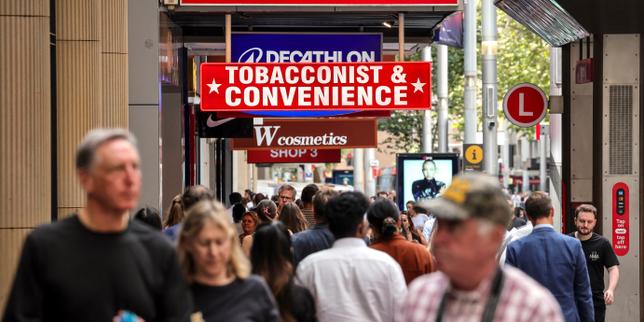
Public policy rarely achieves its intended vector when state-enforced friction exceeds consumer economic capacity. Australia stands as a prime empirical case study of this economic principle. Decades of aggressive anti-smoking policy, anchored by annual indexation and steep excise tax escalations, sought to price citizens out of nicotine consumption. Instead, the policy created an immense price wedge. This structural gap transformed the illicit market from a peripheral nuisance into the primary commercial pipeline for the nation's tobacco supply. Syndicates now control the dominant share of consumption volume, restructuring a public health objective into an industrial-scale underground economy.
The Anatomy of the Price Wedge
Every commodity market operates on supply, demand, and price elasticity. When governments apply heavy-handed taxation to inelastic goods, they inadvertently subsidize the emergence of underground competitors. In Australia, federal excise hikes drove the legal retail price of cigarettes past fifty Australian dollars per pack. Meanwhile, illicit counterparts—whether smuggled via containers or manufactured in clandestine domestic facilities—sold on the street for a fraction of that cost, often fifteen dollars or less. Meanwhile, you can find other events here: Why the Hottest Stock Market on Earth is Actually a Masterclass in National Wealth Generation.
This seventy-percent price discount represents the gross margin available to illicit operators. It functions as a powerful market signal. Traditional economic theory dictates that high risk deters illegal enterprise, but when profit margins exceed the expected cost of regulatory penalties and law enforcement intervention, rational criminal actors scale their operations. The price gap absorbed the risk premium entirely. Consumers facing cost-of-living pressures responded predictably by substituting legal purchases for illicit alternatives. By the mid-2020s, government estimates and independent economic modeling indicated that illicit products accounted for the overwhelming majority of total physical tobacco consumed nationwide, even as household spending figures dropped due to the shift toward cheaper untaxed supply.
Transnational Logistics and Domestic Production
The operational architecture of Australia's illicit tobacco trade relies on diversified sourcing models. Criminal syndicates do not depend on a single vector; they deploy a multi-tiered supply chain designed to withstand law enforcement disruptions. To explore the full picture, we recommend the excellent article by The Wall Street Journal.
The first tier involves maritime container smuggling. Transnational criminal networks exploit global shipping lanes, concealing illicit tobacco shipments behind false commercial manifests, inert cargo, or shielded pallets. Corrupted insiders within ports, freight forwarding operations, and logistics hubs facilitate the smooth transit of containers through customs checkpoints. Because customs agencies inspect only a fraction of total inbound global shipping containers due to volume constraints, the probability of interception remains low relative to the immense financial upside of a successful delivery.
The second tier involves domestic production and illicit cultivation. Rather than relying solely on cross-border logistics, syndicates organize local farming operations. Unregistered plots cultivated in regional areas yield raw loose leaf tobacco, which bypasses official processing completely. Furthermore, law enforcement agencies have uncovered clandestine manufacturing facilities equipped with industrial-grade machinery capable of producing billions of counterfeit cigarette sticks locally. This localized manufacturing reduces international shipping risks and shortens the supply chain between production and the retail front.
The Retail Distribution Network and Territorial Conflict
A supply chain requires a distribution network to reach the end consumer. In the Australian context, illicit tobacco operates through an extensive network of ostensibly legitimate storefronts. Suburban tobacconists, convenience stores, and corner shops serve as retail fronts. While these businesses may display legal inventory on shelves, their primary revenue generation relies on counter-sales of unbranded, unexcised products kept in backrooms or hidden compartments. Store owners facing fierce competition from major supermarket chains rely on the high margins of illicit tobacco to maintain solvency.
This retail structure generated intense commercial rivalry, which quickly deteriorated into violent turf wars. The conflict, particularly prominent in states like Victoria, manifested in widespread arson attacks, firebombings, extortion, and shootings targeting rival tobacconists and storefronts. Organised crime groups utilized violence and intimidation not merely to settle scores, but to enforce regional pricing monopolies and protect supply routes. The commercial battleground shifted from fair market competition to violent territorial enforcement, proving that underground markets substitute traditional corporate governance with physical coercion.
Fiscal Deficits and Regulatory Paradoxes
The rapid scaling of the illicit tobacco market triggered profound macroeconomic consequences. Tax revenue projections collapsed. Federal budgets faced billions of dollars in tax gaps as excise collections plummeted from historic peaks. Funds that treasury departments anticipated for public infrastructure and community services evaporated into the hands of criminal syndicates.
Regulatory responses faced a fundamental design flaw. Law enforcement agencies increased inland enforcement, executing high-profile raids, seizing millions of illicit cigarettes, and arresting syndicate members. Yet, these enforcement mechanisms targeted the symptom rather than the root cause. Without closing the massive price wedge between legal and illicit tobacco, supply-side interventions acted as temporary friction rather than a permanent solution. Every time law enforcement dismantled one distribution network, the profit margins ensured that new operators quickly filled the vacancy.
Independent economic assessments highlighted the limits of relying exclusively on punitive enforcement. When the price differential between legal and illicit products remains extreme, consumer demand persists, and criminal enterprises adapt their logistics to absorb enforcement losses. The regulatory apparatus found itself locked in an asymmetrical battle where traditional deterrence mechanisms failed to alter the underlying economic incentives driving the market.
Strategic Realignment
Restoring market order requires restructuring the economic incentives that initially fueled the shadow economy. Policymakers face two distinct paths, neither of which offers a simple fix.
The first path relies on radical supply-side fortification: expanding border interception capabilities, granting agencies broader investigative powers, mandating harsher mandatory minimum sentences for commercial-scale smuggling, and systematically shutting down retail fronts through asset confiscation and licensing controls. This approach demands sustained capital allocation and uncompromising enforcement across state and federal jurisdictions.
The second path involves addressing the demand-side equation through fiscal recalibration. Proponents of this view argue that narrowing the legal-illicit price gap—potentially through tax policy adjustments combined with strict public health framing—remains the only viable method to starve criminal syndicates of their revenue base. However, this strategy risks encountering political resistance and public health backlash regarding smoking cessation targets.
The trajectory of the market indicates that unless policy frameworks reconcile fiscal taxation with the economic realities of consumer purchasing power and criminal adaptability, underground syndicates will retain their position as the dominant commercial suppliers of the nation's tobacco consumption.