The lazy consensus covering the latest high-level musical chairs in Kyiv is already calcifying into a predictable, comforting narrative.
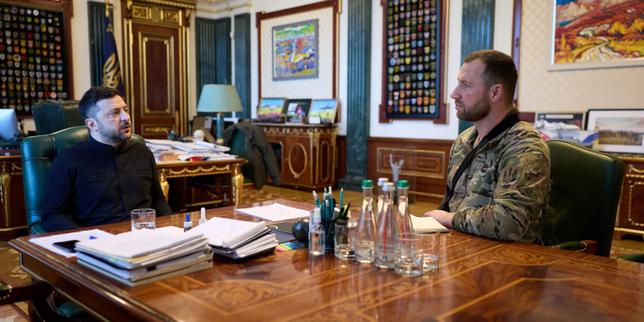
Mainstream commentators are nodding along to Volodymyr Zelensky’s appointment of Major General Yevhenii Khmara, the acting head of the Security Service of Ukraine (SBU), to replace Mykhailo Fedorov as Minister of Defence. The talking points write themselves: in a grueling war of attrition entering its fifth year, a hardened special forces veteran and intelligence chief is precisely what a military under pressure needs. We are told that Khmara’s background leading the elite SBU "Alpha" unit and coordinating deep-strike drone campaigns inside Russian territory makes him the ultimate pragmatic operator. You might also find this connected story interesting: The Mechanics of Multinational Air Integration: Deconstructing Exercise Pitch Black 2026.
This narrative is not just wrong; it is a fundamental misunderstanding of what actually keeps Ukraine in the fight.
Removing Mykhailo Fedorov—the 35-year-old tech entrepreneur who dragooned a Soviet-era military apparatus into the digital age—and replacing him with a traditional security-state insider is a profound strategic retreat. It signals that the grueling, bureaucratic gravity of Ukraine's traditional military establishment has finally crushed the reformist, high-tech insurgency that saved Kyiv in 2022. As highlighted in latest reports by BBC News, the effects are significant.
The Illusion of the "Wartime Strongman"
The political impulse behind replacing Fedorov with Khmara is easy to diagnose. Fedorov, who transitioned from the Ministry of Digital Transformation to the Ministry of Defence in January 2026, was a structural disruptor. In his short tenure, he ran an aggressive audit of the defence ministry that uncovered 300 billion hryvnias (about $6.7 billion) in overspending, forced open procurement tenders, and mandated polygraph tests for ministry employees.
Unsurprisingly, he ran headfirst into a wall of resistance from old-guard generals, most notably Commander-in-Chief Oleksandr Syrskyi. The military establishment's complaint was as classic as it was lazy: Fedorov lacks military experience. He doesn't know how to plan a war.
By capitulating to this pressure and appointing Khmara, Zelensky has chosen the path of least resistance. On paper, Khmara is bulletproof. He has real combat dirt under his fingernails. He managed the legendary "Web" long-range drone strikes that paralyzed Russian logistics. But running a highly specialized, elite special forces unit or coordinating asymmetric intelligence strikes is fundamentally different from managing a sprawling, multi-billion-dollar state bureaucracy charged with feeding, arming, and equipping over a million soldiers.
History is littered with brilliant tactical commanders who became catastrophic administrators. By putting a spy boss at the helm of the Ministry of Defence, Ukraine is doubling down on a culture of compartmentalization, secrecy, and top-down command-and-control. These are the exact opposite of the traits required to run a modern, transparent, and hyper-efficient military procurement apparatus.
What Fedorov Understood (And What the Generals Hate)
To understand why this swap is a regression, we have to look at what Fedorov actually built.
Before Fedorov, military procurement in Ukraine was a black box of Soviet-style bureaucracy, paper-based tracking, and legacy defense contractors. Fedorov treated the war like a fast-scaling tech startup. He knew that in a fast-evolving technological landscape, the traditional five-year military procurement cycle is a suicide pact.
- The Drone Revolution: Through the Brave1 defense-tech incubator, Fedorov bypassed legacy defense contractors entirely. He connected garage-level engineers directly with front-line units, shortening the feedback loop from months to days.
- The Software-Defined Battlefield: He championed the "state in a smartphone" philosophy via the Diia app and integrated it into defense management. He understood that the modern battlefield is software-defined; a commercial drone running a custom AI targeting algorithm is infinitely more cost-effective than a multi-million-dollar legacy anti-aircraft battery.
- Decentralized Production: He fought the generals to deregulate the domestic drone market, removing import duties on components and allowing private enterprises to scale up production rapidly.
The establishment hated him because he broke their monopoly. He proved that a civilian tech executive with an internet connection and a direct line to international tech founders could procure, build, and deploy battlefield solutions faster than an entire staff of decorated colonels.
By pushing Fedorov out, the Ukrainian military establishment has reclaimed its turf. They have swapped a horizontal, agile innovator for a vertical, hierarchical security officer.
+-----------------------------------+-----------------------------------+
| Fedorov's Tech-Startup Model      | Legacy Security-State Model       |
+-----------------------------------+-----------------------------------+
| - Rapid iterative prototyping     | - Top-down, rigid specifications  |
| - Decentralized private production| - Monopolistic state enterprises  |
| - Radical financial audits        | - Opaque, classified budgets      |
| - Flat organization structures    | - Strict, slow chains of command  |
| - Open-source/commercial tech     | - Custom, proprietary military tech|
+-----------------------------------+-----------------------------------+
The Fatal Flaw of the Intelligence State
There is an inherent danger in letting an intelligence officer run a nation's entire defense infrastructure. Intelligence agencies thrive on secrecy, classification, and highly centralized control. Modern defense logistics, however, require the exact opposite: radical supply-chain transparency, open communication with international commercial partners, and economic scaling.
When you put an SBU general in charge, the natural reflex is to pull the curtains closed. "Strategic security" becomes the default shield used to deflect questions about financial efficiency, procurement bottlenecks, and structural corruption. The 300 billion hryvnia audit Fedorov initiated? Expect those files to be quietly locked away under the guise of "national security".
I have watched corporate giants make this exact mistake. When a high-growth tech company faces an operational crisis, the board often panics and replaces the visionary, product-focused founder with a conservative, risk-averse compliance executive. It steadies the ship for a quarter or two, but it kills the product engine. Without the product engine, the company eventually dies.
Khmara is Ukraine's compliance executive. He will bring order, he will quiet the public disagreements with the General Staff, and he will execute strikes with ruthless precision. But he will not build the next Brave1. He will not convince Silicon Valley executives to bypass standard export controls. He will not challenge the deeply entrenched corruption in the legacy defense industrial complex because he is a product of that very same ecosystem.
The False Premise of "Military Experience"
The loudest argument for this transition is that a nation at war needs "military men" in charge of military ministries.
This is a fundamental misunderstanding of the division of labor in a modern democracy. The Minister of Defence is a political and administrative role, not a tactical command position. The Minister's job is to manage the budget, secure international partnerships, fight internal corruption, and ensure the armed forces have the raw material they need to fight. The actual planning of battles belongs to the Commander-in-Chief and the General Staff.
When you blur these lines by appointing a Major General like Khmara, you do not get better military planning; you get administrative paralysis. You get a minister who is constantly tempted to micromanage tactical decisions instead of focusing on the brutal, unglamorous work of reforming supply chains, auditing warehouses, and building a sustainable domestic defense economy.
If Ukraine wanted a clean break from its Soviet past, it needed to preserve civilian control of the military. Fedorov’s lack of military experience was not a bug; it was his greatest feature. It meant he didn't care about military protocol, didn't respect legacy hierarchies, and wasn't afraid to tell a three-star general that his procurement request was twenty years out of date.
By replacing him with a security insider, Zelensky has chosen peace with his generals at the expense of the systemic disruption Ukraine desperately needs to survive a war of attrition. The defense ministry is no longer a disruptor; it has been successfully recaptured by the state.