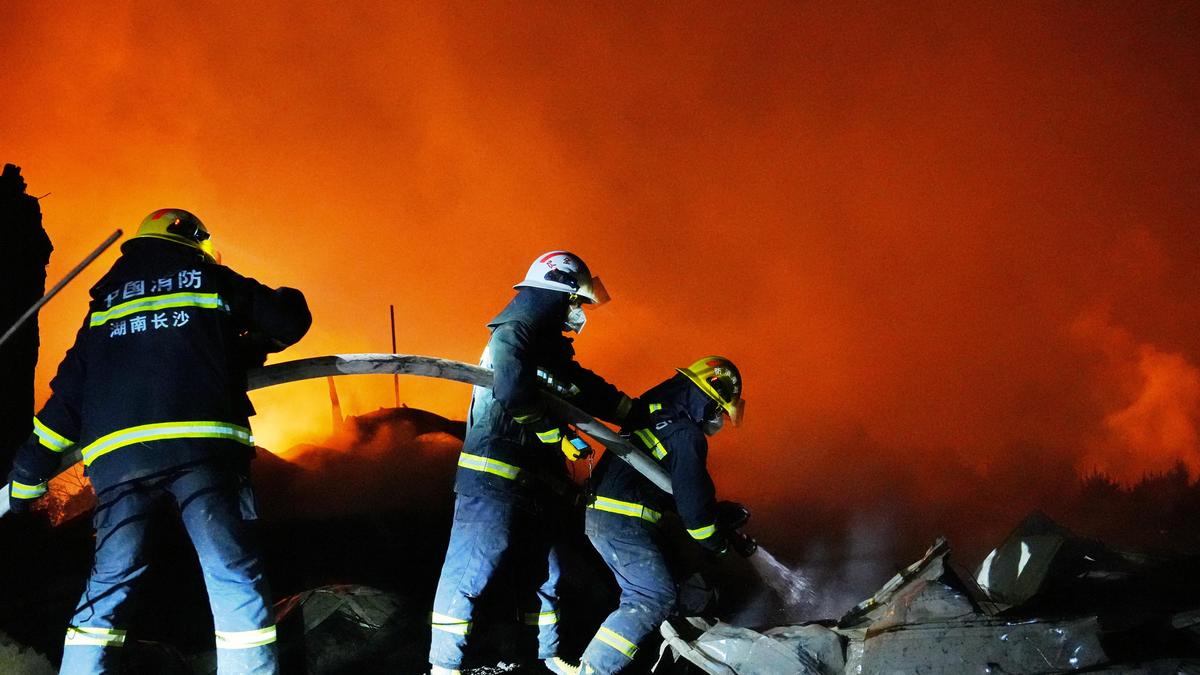
Twenty-one dead. Sixty-one shredded by flying glass and concrete. Another factory in China becomes a crater. The headlines follow a script so predictable it’s almost mechanical: "Tragedy," "Safety overhaul promised," "Investigation launched."
Most news outlets treat these industrial mass-casualty events like acts of God or freak accidents. They aren't. They are the logical, mathematical outcome of a global supply chain that demands $500 worth of explosive spectacle for $49.99 at a roadside tent. If you think this is a story about poor Chinese safety standards, you’re missing the forest for the burning trees. This is a story about the lethal physics of low-margin manufacturing.
The Myth of the Safety Regulation
Every time a facility in Jiangxi or Hunan levels a city block, the local government announces a "crackdown." Western observers nod, blaming "lax oversight" in developing nations.
That's a lazy take.
China has some of the most granular safety protocols on paper for pyrotechnic manufacturing. The problem isn't a lack of rules; it's the economic impossibility of following them while remaining a viable supplier. When a global retailer squeezes a factory on unit price to maintain "everyday low prices," something has to give. In a high-risk environment involving black powder and chemical oxidizers, "giving" means skipping the expensive humidity controls or ignoring the limit on how many kilograms of volatile material can be in one room at a time.
Safety is a luxury good. When margins are razor-thin, safety isn't the first thing to go—it’s the only thing that can go to keep the lights on. We are essentially outsourcing our industrial risk to the lowest bidder and then acting shocked when the bill comes due in human lives.
Why "Zero-Risk" Fireworks are a Lie
People ask: "Why can't we just automate this?"
It sounds like a smart question. It’s actually a fundamental misunderstanding of the material science involved. In most manufacturing, automation reduces risk. In explosives, it often creates new ones. Metal machinery creates friction. Friction creates heat. Heat creates a terminal event.
The "manual" nature of these factories—the very thing Westerners point to as "primitive"—is often a deliberate, albeit terrifying, safety measure. Human hands don't create static sparks or mechanical friction the same way a high-speed robotic arm does.
However, this reliance on manual labor creates a different kind of math. To meet the surge in demand for Western holidays—New Year’s Eve, the 4th of July, Diwali—factories must scale up rapidly. They hire seasonal, often untrained labor to handle substances that require the precision of a surgeon.
You aren't just buying cardboard tubes filled with chemicals. You are buying a high-stakes gamble performed by a person who was likely farming rice three weeks ago.
The Geography of Danger
The industry is concentrated in specific hubs, like Liuyang, for a reason. This creates a "cluster effect" that is great for business but catastrophic for safety. When one factory goes, the shockwave—or the physical debris—frequently triggers a chain reaction in neighboring workshops.
We see the same pattern in the textile industry in Bangladesh or the electronics assembly lines in Shenzhen. Concentration leads to efficiency, but it also creates a single point of failure. One cigarette, one static-heavy polyester shirt, or one dropped pallet doesn't just kill the person responsible; it clears the zip code.
Stop Blaming the Factory Owners
It’s easy to cast the factory owner as a mustache-twirling villain cutting corners to buy a Ferrari. The reality is more boring and more tragic. Most of these owners are operating on such slim profits that a single week of downtime for a "safety audit" would bankrup them.
The pressure doesn't start in China. It starts at the checkout counter in Ohio, London, and Sydney.
If we actually cared about the 21 people killed in this latest blast, we would demand a "Fair Trade" certification for explosives. We would pay triple the price to ensure the person mixing the powder is wearing specialized anti-static gear and working in a bunker designed to vent explosions upward rather than outward.
But we don't. We want the big boom and the pretty colors, and we want them for the price of a fast-food meal.
The Illusion of Progress
Wait for the "investigation" results. They will blame a specific manager. They will execute or imprison a few people. They might even bulldoze the site and turn it into a memorial.
None of that changes the underlying reality. The global market has a fixed appetite for pyrotechnics that exceeds the capacity of safe, regulated manufacturing. As long as that delta exists, these "accidents" are not outliers; they are part of the overhead.
The industry isn't "broken." It’s working exactly how a deregulated, globalized, low-margin market is supposed to work. It optimizes for cost, and it treats human life as a replaceable component in the assembly line.
If you want to stop the explosions, stop buying the product. Anything else is just performance art.
The next time you see a spectacular display in the sky, remember: the most expensive part of that firework wasn't the chemical salts used to make it turn green. It was the 21 people who didn't get to go home so you could have three seconds of "wow."
Stop asking how this happened. Start admitting you knew it was happening all along and decided the price was right.
The smoke clears, the headlines fade, and the orders for next season are already being placed. The cycle doesn't need to be fixed; it needs to be dismantled. Until then, keep your eyes on the sky and your head in the sand.