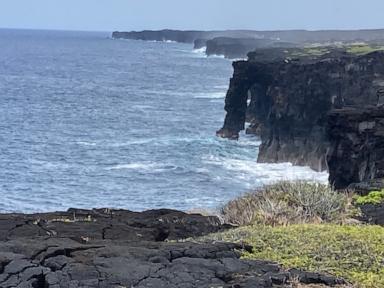
The sea does not hurry. It carves, it whispers, it tests every joint of stone for ten thousand years until, in less than a breath, it decides it has waited long enough.
Ask anyone who has stood on the jagged southern shores of Hawaii Volcanoes National Park. You do not just hear the Pacific down there; you feel it in the soles of your boots. The earth beneath you is alive, still cooling, still restless, porous as pumice and heavy with the weight of fire. For generations, visitors walked the Chain of Craters Road, drawn toward a singular architectural marvel sculpted entirely by water and basalt: the Holei Sea Arch.
It stood ninety feet above the churning brine like a natural flying buttress. A monument to endurance. A favorite frame for cameras, a pilgrimage point for weary travelers who drove past rivers of dead lava just to watch the ocean crash through a stone doorway.
Then came June 2024.
No fireworks heralded its fall. No grand human audience captured the exact millisecond of fracture on prime-time television. Instead, park rangers simply noticed a change in the horizon. The stone span, weathered by relentless swells and weakened by the continuous, unseen shifting of the Kilauea volcano, had given way. The sea had reclaimed its architecture.
Silence followed. Then, the warnings.
Park officials did not mourn the loss with poetry; they moved quickly to lock down the overlooks. They knew a fundamental truth that casual tourists often forget: when a geological giant like an arch collapses, it does not mean the drama is over. It means the stage has shifted. The cliffs surrounding the fallen arch are now dangerously unstable, fractured by the same tectonic stress and wave-pounding fatigue that brought down the monument itself.
Consider what happens when a pillar fails. The load redistributes. The neighboring rock faces, already hollowed out by sea caves and thermal stress, bear an invisible, agonizing burden. To stand near those edges now is to gamble with gravity.
To understand why the Holei Sea Arch mattered—and why its collapse is more than just a local news footnote—we have to look past the postcard aesthetics.
Geology is often taught as a slow-motion study, a science of epochs and centuries where nothing happens fast enough to startle us. But Hawaii is the exception. Here, creation and destruction happen in real time. The island of Hawaii is an unfinished draft. Every square inch of that black stone was once molten terror pouring out of the rift zones, cooling rapidly upon contact with the Pacific, creating an intricate web of underground tubes, cliffs, and arches that are inherently fragile.
Think of it like dry ice left in a warm room. It looks solid, permanent, almost metallic. But beneath the surface, microscopic sublimation is eating away at its integrity. Basalt is tougher than dry ice, yes, but against the relentless hydraulic wedge of oceanic swells, it behaves much the same way. Every wave that slams into a sea arch compresses air inside internal fractures, blasting the stone apart from the inside out. It is a process known as hydraulic fracturing, repeated millions of times a day.
When the Holei Sea Arch stood, it was living on borrowed time. Every tourist who snapped a photo beneath its span was standing underneath a giant, slow-motion hourglass.
And yet, we are always surprised when the sand runs out.
I remember the first time I smelled sulfur mixed with salt spray. It is an unforgettable sensory cocktail—raw earth meeting the endless blue. Walking the coastal trails of Volcanoes National Park makes you acutely aware of your own smallness. You see cracks in the asphalt where heat still vents from deep below. You watch waves throw themselves against black iron cliffs with a violence that feels personal.
When places like the Holei Sea Arch vanish, it triggers a peculiar kind of disorientation. We build our itineraries around landmarks. We treat monuments—whether carved by human hands or oceanic currents—as permanent anchors in an uncertain world. We assume that if a place is famous enough to be on a map, it will stay put until our grandchildren can see it.
The earth makes no such promises.
The National Park Service response was swift and absolute. Closed. Off-limits. Danger zone.
To some, these closures feel like bureaucratic overreach, an unnecessary dampening of the adventurous spirit. Why rope off a scenic overlook just because a rock fell? But spend an afternoon watching the cliff edges along the Chain of Craters. Large sections of basalt do not erode evenly; they calve in massive vertical slabs. A cliffside that looks solid in the morning can shear off by afternoon, taking yards of earth—and anyone standing on it—straight down into the boiling surf.
The collapse of the arch is a warning flare for the entire coastal fringe of the park. The unstable cliffs are ticking clocks.
What does this mean for the traveler who still dreams of flying to the Big Island, renting a car, and driving to the end of the road?
It means we have to unlearn our passive relationship with nature. We cannot treat the earth as a static theme park built for our entertainment. When we visit volcanic landscapes, we are guests in a zone of active construction and demolition. The rules, the barriers, and the closed signs are not suggestions; they are translations of a very clear message written in falling stone.
The Holei Sea Arch is gone. The water rushes uninterrupted now where tourists once marveled at the stone bridge. In time, new arches will form somewhere else along the rugged, volcanic coastline, carved out by the patient, indifferent tides.
Until then, the cliffs remain watchful, jagged, and terribly quiet, waiting for the next shift in the weight of the world.