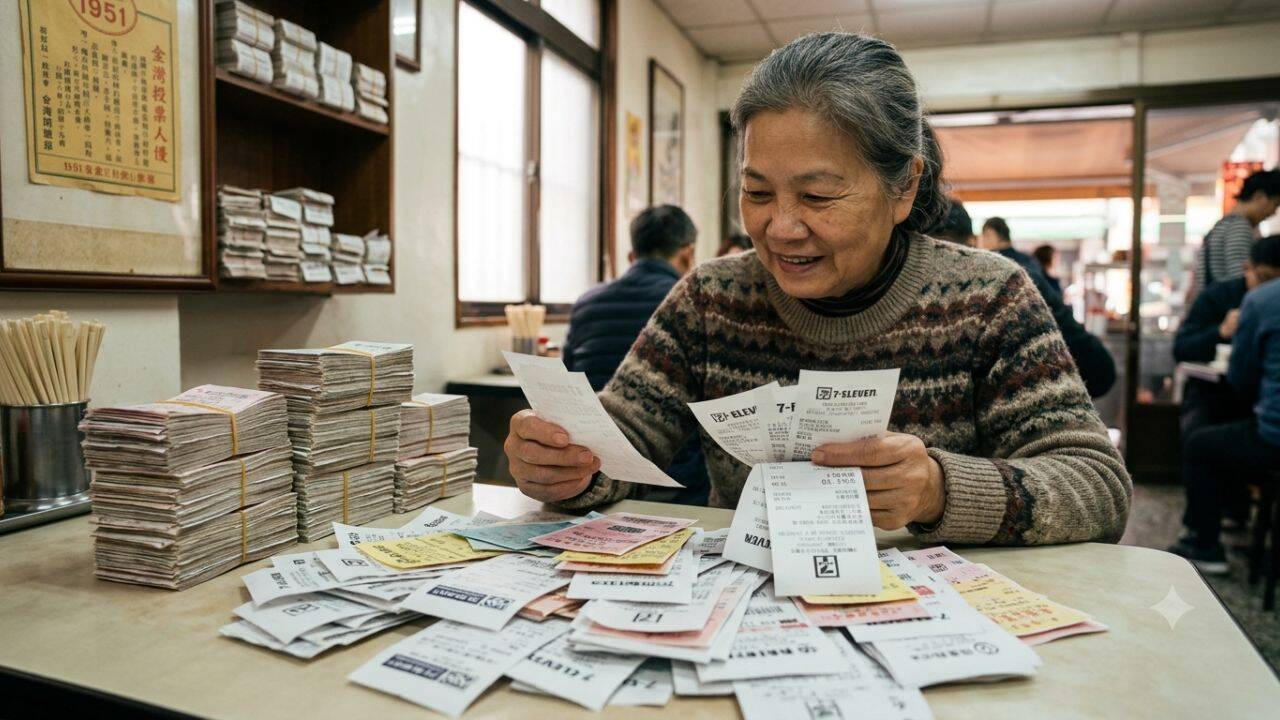
The crinkle of heat-sensitive paper is the baseline percussion of daily life in Taipei. Step into any convenience store, buy a bottle of cold green tea, and the clerk hands you a slip of paper with a sharp, synchronized snap of the wrist.
Most people in most countries treat a receipt as trash. A bureaucratic afterthought. A tiny, annoying ghost of a financial transaction meant to clutter the bottom of a purse before being jammed into a recycling bin.
Not here.
In Taiwan, that scrap of paper is a lottery ticket. It has been for exactly 75 years.
To understand how a mundane tax enforcement mechanism became a deeply ingrained cultural obsession, you have to watch an elderly woman sit at her kitchen table at the end of an odd-numbered month. Let’s call her Lin. She has a shoebox in front of her. Inside are hundreds of neatly stacked, accordion-folded slips of paper. Each one represents a breakfast of steamed buns, a frantic scooter refuel, or a late-night run for medicine.
Lin checks the winning numbers announced by the Ministry of Finance on her smartphone screen. Her eyes dart back and forth, comparing the eight-digit sequences. It is a quiet ritual performed in millions of households across the island. The stakes? Anywhere from a modest 200 New Taiwan Dollars (about six USD) to a life-changing ten million New Taiwan Dollars (roughly 300,000 USD).
Every two months, the government hands out fortunes. All because of a clever piece of psychological engineering designed in 1951 to solve a problem that seemed entirely hopeless.
The Art of the Voluntary Audit
Go back to the mid-twentieth century. The Taiwanese government faced a massive economic crisis. The island was grappling with hyperinflation, a massive influx of refugees, and a severely depleted treasury. Businesses operated almost entirely in cash.
Worse, almost nobody paid their business taxes.
The government tried traditional crackdowns. They sent out inspectors. They threatened fines. Nothing worked. In a cash-dominant society, transactions simply vanished into the air like cooking smoke. Merchants kept two sets of books—or none at all. The state could not track the money, which meant it could not fund infrastructure, schools, or public safety.
Then came Jen Hsien-chyun. As the director of the provincial finance department, he realized a fundamental truth about human nature: people hate paying taxes, but they love a gamble.
Instead of policing the shopkeepers, Jen decided to deputize the shoppers.
He launched the Uniform Invoice Lottery. The concept was elegant in its simplicity. The government forced merchants to buy standardized, numbered receipt booklets from the state. Every time a consumer made a purchase, the merchant was legally required to issue one of these receipts. To ensure the consumer actually demanded the receipt, the government turned every serial number into a lottery entry.
Suddenly, the dynamic flipped.
Customers were no longer passive bystanders in a transaction. They became aggressive auditors. If a noodle vendor tried to pocket the cash without punching it into the register, the customer would stand there, hand outstretched, waiting for their shot at a fortune. If a shopkeeper claimed the machine was broken, the customer went down the street to a competitor.
The strategy worked with astonishing speed. In the first year alone, tax revenues skyrocketed by over 75 percent. The government did not need an army of tax collectors. They had an entire population doing the work for them, driven by the intoxicating whisper of what if.
The Digital Evolution of a National Habit
For decades, the system relied on physical slips of paper. You kept them in jars, drawers, or dedicated plastic sorters bought at night markets. Winning meant squinting at newspaper listings and manually matching numbers.
But as the world shifted toward screens and silicon, the lottery had to change too. Carrying around a brick of paper receipts in a digital economy feels backward.
Enter the electronic receipt system, or cloud invoices.
Today, residents use a centralized government app linked to a unique barcode on their smartphones. When you buy something, the clerk scans your personal barcode instead of printing a physical slip. The receipt goes directly into a secure government database.
It sounds cold and sterile. It sounds like the death of a romance.
Yet, the government kept the emotional hook intact. To incentivize people to ditch the paper, they created a separate, exclusive prize pool just for digital receipts. Millions of dollars are reserved solely for those who choose the cloud.
The app even does the matching for you. On the 25th of every odd month, phones across Taiwan buzz with notifications. A friendly chime alerts you if your morning coffee just netted you a few hundred dollars. If you win a major prize, the money is deposited directly into your bank account, skipping the trip to the bank entirely.
The Small Stakes That Matter
There is a strange, comforting equity to the system. A billionaire buying a luxury watch gets a receipt. A college student buying a pack of chewing gum gets a receipt. In the eyes of the lottery machine, those two numbers have the exact same statistical probability of hitting the grand prize.
It creates a subtle undercurrent of optimism. Life can be grindingly expensive. Wages can stagnate, rent can rise, and the daily commute can wear you down. But twice a month, there is a hard reset. There is a moment where the universe might smile on you because you bought a bottle of soy milk at the right second on a Tuesday.
This hope has spawned a unique ecosystem of charity.
Walk into any supermarket or hospital, and you will see large, transparent acrylic boxes sitting next to the cash registers. They are not for coins. They are for receipts.
Because physical receipts are transferable bearer instruments, donating a receipt is the exact equivalent of donating a lottery ticket. Non-profit organizations, orphanages, and animal shelters collect millions of these slips every month. They hire volunteers to sit in rooms for days, manually checking the numbers.
For these charities, the system is a financial lifeline. A single winning ticket from a donated box can fund a shelter's operations for months. It allows citizens who might not have spare cash to give generously anyway. They donate their luck instead.
The Unbroken Ritual
The world looks vastly different than it did in 1951. Taiwan transformed from an agrarian society into a global tech powerhouse, producing the microchips that run the modern world. Governments across the globe look at this model with envy, wondering how to replicate such flawless tax compliance. Many have tried, but few have managed to capture the same cultural devotion.
Because it was never just about the tax code. It became part of the national identity.
Watch a teenager today pay for a bubble tea with their phone. Watch them tap their screen, link their cloud profile, and walk away. They are participating in an unbroken chain of behavior that spans three generations. They are doing exactly what their grandparents did with paper booklets under the glow of fluorescent street lamps decades ago.
It is a grand social contract wrapped in a game of chance. The state gets its revenue, the businesses stay honest, and the people get a pocketful of possibilities.
Tomorrow morning, millions of people will step out into the humid air, purchase breakfast, and collect a small slip of data. They will slip it into a pocket or beam it to the cloud. They will carry it with them through the day, a tiny, silent passenger. It might be worthless garbage. Or it might be the key to early retirement. Until the numbers are drawn, it is both. That is the magic of the receipt in your pocket: for two months, it is whatever you need it to be.