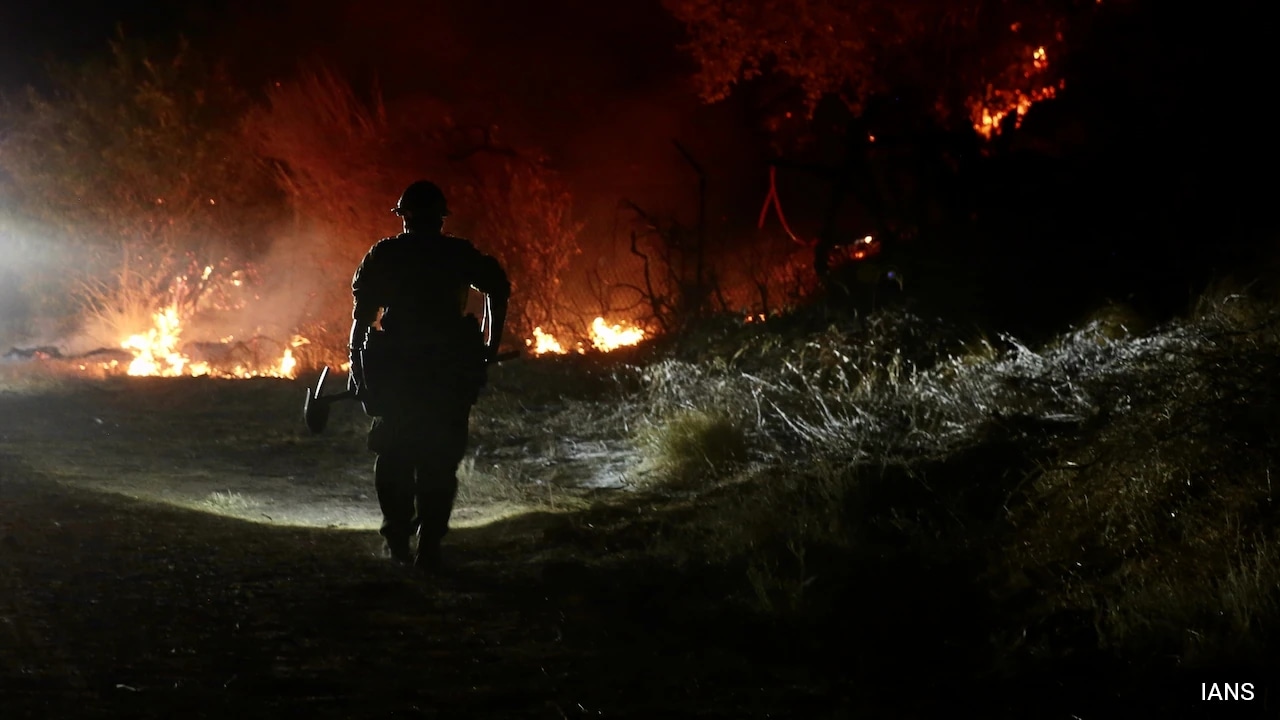
When a heavy-lift Sikorsky S-64 Skycrane operating over the Fishlake National Forest crashed near Richfield, Utah, the event underscored a persistent operational vulnerability within modern wildland fire management. The aircraft, functioning as one of seven rotary-wing assets assigned to contain the Widemouth 2 Fire, went down in steep terrain under red flag warning parameters characterized by thermal turbulence and low fuel moisture. Beyond the immediate human and operational toll, the incident triggered secondary ignition, converting a suppression asset into a vector for fire propagation. Analyzing this event requires moving past standard news reporting to examine the structural mechanics of aviation risk in high-density, high-entropy fire environments.
The Aerodynamic Cost Function of Mountainous Fire Suppression
Aerial firefighting relies on heavy-lift rotary aircraft to deliver high-volume water and retardant drops precisely onto active perimeters. However, operating heavy-lift platforms in complex mountain topography creates an unforgiving performance envelope.
The physical variables governing this environment form a strict equation of risk:
- High ambient air temperatures decrease air density, directly reducing main rotor lift efficiency.
- Steep topography generates micro-meteorological phenomena, including downdrafts, mechanical turbulence, and erratic valley winds.
- Heavy fuel loading and active burning create severe thermal updrafts that destabilize aircraft mass distribution during water release cycles.
When an S-64 Skycrane maneuvers at low altitude within a canyon or ridge system, the margin for error narrows exponentially. The transition from heavy-load transit to drop execution involves rapid shifts in collective pitch and engine torque. If thermal updrafts or wind shear collide with the localized convective column of the wildfire, the aircraft can experience a sudden loss of translational lift. The mechanics of the Utah crash highlight how environmental entropy can outpace the mechanical compensation limits of even commercial heavy-lift machinery.
Secondary Ignition Dynamics and Operational Feedback Loops
A critical dimension of the Richfield incident is the mechanics of the secondary fire ignited upon impact. Standard aviation fuel payloads, combined with hot engine components and residual electrical currents, serve as immediate ignition sources upon structural failure. In an environment already saturated with dry fuels under a red flag warning, the crash site itself transforms into a localized spot fire.
This introduces a compounding feedback loop into the incident command structure:
- The initial operational vector involves deploying scarce rotary assets to mitigate an uncontained perimeter.
- An aviation failure occurs due to environmental or mechanical stress vectors, halting regional suppression momentum.
- The resulting wreckage ignition forces the reallocation of ground and air resources to suppress the new, secondary thermal anomaly.
- Access restrictions—dictated by active fire spread and extreme radiant heat—delay search, rescue, and NTSB/FAA investigative entry, freezing incident intelligence.
This dynamic paralyzes tactical sequencing. Incident commanders must instantly pause offensive drops to account for missing crew members while simultaneously pivoting tactical resources to contain the unplanned perimeter expansion caused by the crash itself.
The Resource Allocation Dilemma Under Red Flag Constraints
The structural pressure on incident management teams during peak fire season involves balancing asset exhaustion against tactical necessity. With lightning-ignited blazes like the Fishlake complex expanding across tens of thousands of acres, the demand for heavy-lift capacity consistently exceeds supply.
Commanders operate under a calculated risk matrix where safety parameters—such as wind thresholds and visibility limits—are weighed against the rate of spread threatening infrastructure and transit corridors like Interstate 70. When conditions remain nominally compliant with flight minimums yet feature hidden atmospheric volatility, the system remains exposed to catastrophic tail risks. The decision to resume flights following an accident is not arbitrary; it is governed by the harsh economic and spatial reality that pausing air operations allows uncontained perimeters to breach geographical firebreaks, exponentially increasing downstream suppression costs and structural exposure.
Deploy real-time, Doppler-derived micro-wind sensors across high-risk ridge lines to map localized shear zones before tasking heavy-lift rotary assets into narrow canyon sectors.