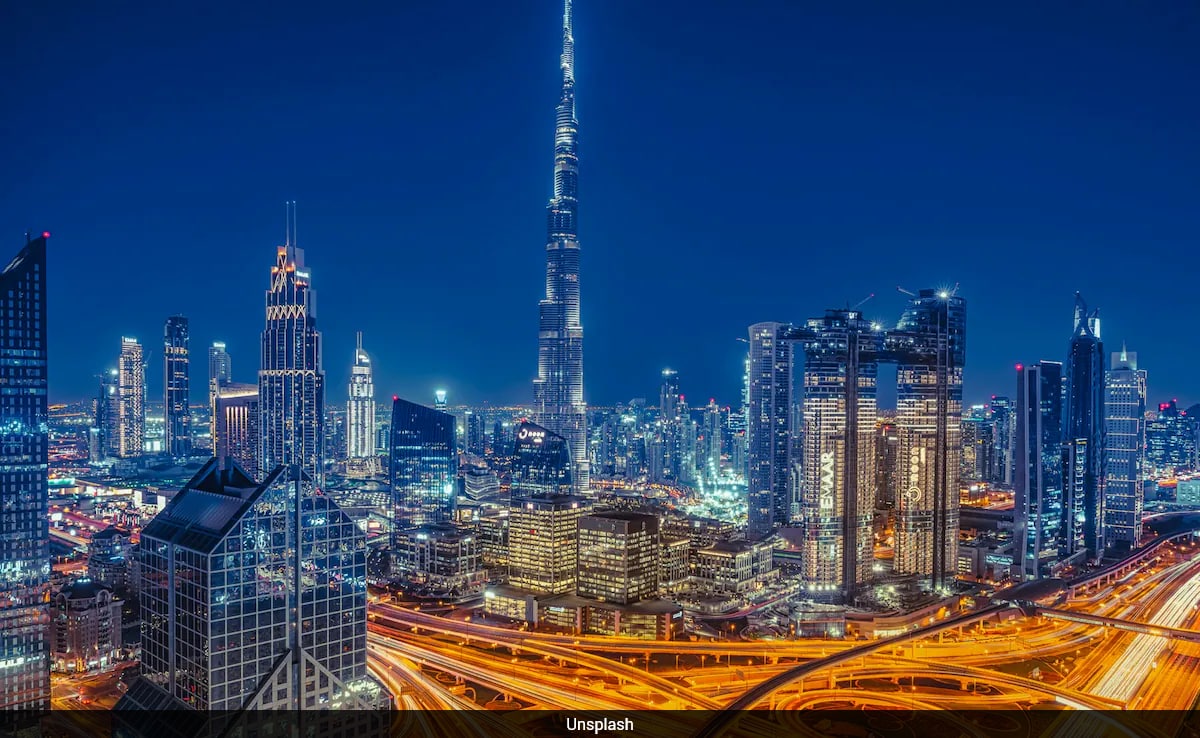
The gold leaf on the lobby pillars of the Downtown Burj district doesn't actually shine brighter when the market is up. It stays the same shade of polished, defiant amber. But for those who spend their afternoons in the marble-clad cafes watching the world go by, the air feels different. There is a specific frequency to a boomtown. It is the sound of a thousand drills, the frantic clicking of heels on pavement, and the hushed, rapid-fire negotiations of men in linen suits buying floor plans that don't yet exist.
For four years, that frequency has been set to a fever pitch. Dubai didn't just recover from the pandemic; it rewrote the rules of gravity. While the rest of the world navigated lockdowns and supply chain collapses, the emirate became a sanctuary for the global elite, a glittering lifeboat in a sea of uncertainty.
Then, the silence began to creep in.
It didn't happen with a crash or a televised panic. It started with the subtle cooling of a cup of tea. Consider a hypothetical investor—let’s call him Elias. Elias represents the thousands of individuals who flocked to the Gulf over the last thirty-six months. He is a tech consultant from London who traded gray skies for a Golden Visa and a three-bedroom villa in the hills. To Elias, the property market wasn't a spreadsheet. It was his daughter’s backyard. It was the equity he assumed would grow by ten percent every single year like clockwork.
Last week, Elias looked at the listings for his neighborhood and realized something unsettling. The numbers hadn't climbed. For the first time since the world reopened in 2020, the trajectory had flattened. Then, it dipped.
The Weight of the Horizon
The shift is measurable. Real estate data across the primary hubs of the city indicates that residential property prices have experienced their first contraction in the post-pandemic era. We aren't talking about a freefall. This isn't 2008, where the desert threatened to reclaim half-finished skeletons of concrete. This is a sigh. A long, overdue exhale.
Why now? The answer lies beyond the city’s borders. Dubai is a mirror for the world’s anxieties. When regional tensions flare—when the geopolitical map of the Middle East becomes a patchwork of "what-ifs"—the appetite for risk changes. Capital is a shy creature. It loves the sun, but it hates the storm.
As regional conflicts dominate the headlines, the influx of "wait-and-see" energy has begun to settle over the sales offices. It’s a psychological shift as much as a financial one. If you are an ultra-high-net-worth individual looking to park fifty million dollars in a branded penthouse, you don't just look at the infinity pool. You look at the horizon. And lately, the horizon looks crowded.
The Mathematics of a Cool-Down
Let’s strip away the glass and steel for a moment to look at the cold mechanics of the market. High interest rates have finally caught up with the buyers who aren't paying in suitcases of cash. While the headline-grabbing sales are often "cash-only" transactions by billionaires, the backbone of the market is the upper-middle class. These are the professionals who require mortgages.
When the cost of borrowing stays high, the pool of eligible buyers shrinks. It’s a simple tightening of the nozzle. Combine that with a massive surge in new supply—thousands of units finally hitting the market after years of construction—and you have the classic recipe for a correction.
The city is full. Or rather, it is full at the current price point. To understand this, imagine a high-stakes game of musical chairs played with luxury apartments. For years, the music was so loud and the tempo so fast that nobody cared how much the chairs cost. Now, the DJ has slowed the beat. People are starting to count the seats.
The Human Cost of the Correction
For the average resident, a dip in property prices sounds like a victory. Rents in Dubai have become a legendary burden, often requiring a massive chunk of a professional salary paid in a single check. A cooling market suggests a reprieve. But the reality is more complex.
In a city built on the promise of perpetual growth, a slowdown affects the psyche of the service worker, the contractor, and the small business owner. When property values stagnate, the "wealth effect" reverses. People spend less at the high-end malls. They hesitate to upgrade their cars. They look at their surroundings and wonder if the dream has reached its ceiling.
There is a vulnerability in realizing that even the most ambitious city on Earth is subject to the whims of global sentiment. We like to believe that if we build high enough, we can escape the gravity of traditional economics. We can't.
A Different Kind of Maturity
There is a silver lining that often gets lost in the rush to declare the "end of an era." This softening of prices might actually be the healthiest thing to happen to the region in years.
A market that only goes up is a bubble. A market that fluctuates is a real economy.
What we are witnessing is the "maturation" of a global hub. For Dubai to transition from a speculative playground into a stable, long-term home for families and international corporations, it needs to shed the volatility of its youth. It needs to be a place where a five percent drop isn't seen as a catastrophe, but as a correction.
The invisible stakes are no longer about who can make the most money in a six-month flip. They are about the long-term viability of the city as a center for global trade and living. If prices become more rational, the city becomes more accessible. If the market stabilizes, the "Eliases" of the world might actually stay for twenty years instead of five.
The Ghost of 2008
The fear, of course, is that this is the first loose stone before an avalanche. Anyone who was in the city fifteen years ago carries a form of financial PTSD. They remember the abandoned supercars at the airport and the silence of the building sites.
But the fundamentals have shifted. The regulatory environment is unrecognizable compared to the wild-west days of the mid-2000s. Escrow accounts are strictly managed. Down payment requirements are significant. This isn't a house of cards built on subprime dreams; it’s a city built on actual, realized wealth.
The regional tensions are real, and they are the primary driver of this current hesitation. But history suggests that the Gulf has a remarkable capacity for insulation. It has learned how to be an island of commerce in a sea of complexity.
The View from the Balcony
Picture a balcony on the fiftieth floor of a tower in Dubai Marina. From up there, you can see the palm trees, the yachts, and the endless stretch of the Arabian Gulf. It is a view that costs millions.
Today, the person standing on that balcony is looking at the same view, but with a different set of questions. They are wondering if the unit next door will sell for less than they paid. They are watching the news and calculating the distance between rhetoric and reality.
The cranes are still there. They haven't disappeared. But they are moving with a measured, deliberate pace. The frantic energy of the gold rush has been replaced by the steady pulse of a city trying to find its permanent place in the world.
The gold leaf in the lobby is still there, too. It doesn't need the market to be at an all-time high to look beautiful. It just needs the doors to stay open. And for now, despite the dip, despite the tension, the doors are very much open.
The party isn't over; it’s just that the lights have been dimmed, and the guests are finally sitting down to talk about the bill.
It’s a quiet moment. It’s an honest moment. And in a city that usually screams its successes from the rooftops, there is something deeply grounding about the silence of a market finally finding its floor.