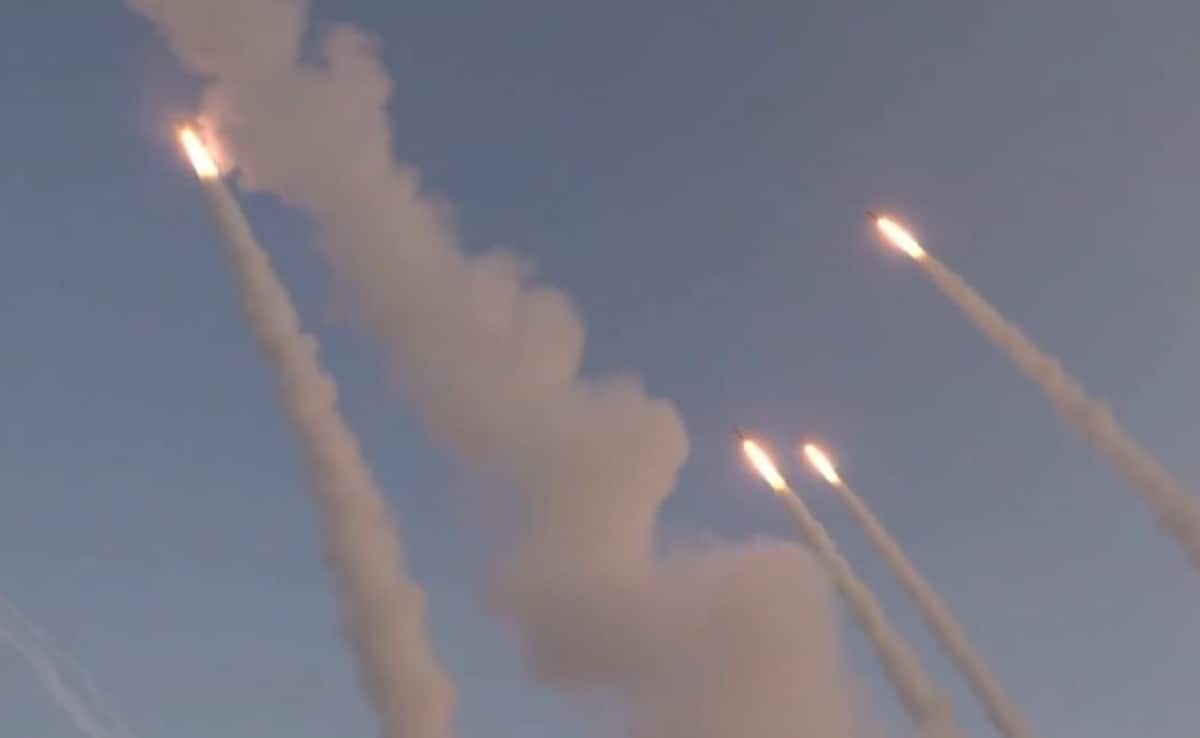
The Pentagon is stuck in 1991. When "unnamed US officials" leak that Iran still has 50% of its missile inventory or 60% of its naval assets after a series of strikes, they aren't providing a strategic assessment. They are reciting a grocery list. They are counting units as if we are still fighting a conventional land war in the European plains.
In modern attrition, the raw number of remaining tubes is the least interesting metric available. If you have 500 missiles left but your command-and-control (C2) nodes are severed, you don't have an arsenal. You have an expensive collection of lawn ornaments. The obsession with "percentage remaining" is a sedative for the public and a failure of intelligence analysis. It ignores the reality of integrated kill chains.
The Inventory Fallacy
The mainstream media loves a scoreboard. It's easy to visualize. "They had 1,000, we hit 500, they have 500 left." This logic assumes that every missile is an independent actor.
It isn't.
A missile is merely the kinetic end of a very long, very fragile digital and logistical straw. To launch a precision strike, you need:
- Targeting Data: Real-time ISR (Intelligence, Surveillance, and Reconnaissance).
- Encryption Keys: Secure communication to prevent jamming or spoofing.
- Launch Authorization: A functioning chain of command that hasn't been decapitated.
- Logistical Throughput: The ability to move those 500 missiles from deep-buried silos to active launch sites without being intercepted by loitering munitions.
When officials claim Iran has 50% of its missiles left, they are ignoring the Degradation of Utility. If I take out your eyes and your ears, it doesn't matter how big your fists are. You are swinging at shadows. We need to stop asking "How many do they have?" and start asking "How many can they actually synchronize?"
The Naval Mirage
The report claims 60% of Iran’s naval forces remain. This sounds formidable until you realize what the Iranian Navy actually is. We aren't talking about carrier strike groups. We are talking about a "Mosquito Fleet"—fast attack craft, midget submarines, and converted speedboats.
Quantity is not a quality of its own when the technological gap is an abyss.
In the Persian Gulf, a 40% loss isn't just a numerical reduction; it’s a collapse of the "swarm" logic. Swarm tactics rely on a specific density of targets to saturate an Aegis combat system’s processing power. Once you drop below a certain threshold of simultaneous attackers, the math flips. Instead of a swarm, you have a series of isolated targets that can be picked off one by one with $M_{1} = \text{total interceptors} / \text{incoming threats}$.
By focusing on the 60% that survived, officials are missing the point that the 40% destroyed likely represented the elite, front-line units capable of sophisticated coordination. The "remnants" are often the B-tier equipment, manned by terrified conscripts who have watched their commanders vanish in a cloud of kinetic energy.
The Asymmetric Trap
The US intelligence community often falls into the trap of measuring the adversary by our own standards. We look at "readiness levels" and "inventory depth." Iran looks at Psychological Persistence.
They don't need 100% of their missiles to "win." They need one. One missile that hits a high-value target or a civilian center is enough to maintain the narrative of resistance. When we tell the world "they still have half their missiles," we are unintentionally doing Iran’s propaganda work for them. We are validating their survivability.
I’ve seen military analysts spend weeks debating the circular error probable (CEP) of the Fateh-110, while completely ignoring the fact that the missile's accuracy is irrelevant if the goal is simply to keep the Strait of Hormuz in a state of permanent insurance-rate-hike anxiety.
The Silicon Ceiling
Let's talk about the hardware they can't replace. You can weld a missile tube in a garage in Isfahan. You cannot, however, manufacture high-end guidance chips, gyroscopes, or hardened sensors under a total blockade.
Every time a "50% remaining" missile is fired and misses, or is intercepted by an Arrow-3 or Patriot battery, that inventory is gone forever. There is no factory reset. There is no surge capacity for high-tech components.
The "lazy consensus" says that because Iran has a deep domestic defense industry, they are immune to attrition. This is a lie. They are immune to low-tech attrition. They are incredibly vulnerable to the loss of specialized technicians and sub-components that make their "precision" weapons actually precise.
If we destroyed 50% of their missiles, we almost certainly destroyed 90% of their best-performing units. What’s left is the bottom of the barrel.
The Myth of the Hardened Silo
We hear constantly about "missile cities" buried deep underground. The implication is that these assets are untouchable.
This is a 20th-century fear.
Modern bunker busters are impressive, but the real threat to a "missile city" isn't a bomb. It's the exit. You don't need to destroy the missile inside the mountain; you just need to collapse the five-meter stretch of tunnel at the mouth. You turn a multi-billion dollar asset into a tomb.
When officials count "remaining missiles," are they counting the ones that are currently trapped behind 200 tons of granite because the entrance was struck? Probably. On paper, they exist. In reality, they are irrelevant.
People Also Ask: The Wrong Questions
"Is the US losing the deterrence battle if Iran still has so many weapons?"
The question assumes deterrence is a volume knob. It isn't. Deterrence is about the credibility of use. If Iran has 5,000 missiles but knows that launching ten will result in the immediate vaporization of their power grid, they are deterred. The inventory count is a distraction.
"Can Iran still block the Strait of Hormuz with 60% of its navy?"
Briefly. They can cause a spike in oil prices for 72 hours. But 60% of a mosquito fleet vs. the combined electronic warfare capabilities of a modern carrier group is like bringing a knife to a drone strike. They can't "block" it; they can only make it "expensive" for a weekend.
The Brutal Reality of Modern Attrition
Warfare in 2026 is about Functional Defeat, not Numerical Depletion.
If you want to understand the threat, stop looking at the Pentagon's infographics of missile silos. Look at the data link reliability. Look at the fuel refineries. Look at the sovereign debt of the nation trying to sustain a high-intensity conflict while their industrial base is being systematically dismantled.
The "50% remaining" statistic is a security blanket for people who don't understand how systems collapse. Systems don't fail linearly. They work perfectly until they hit a breaking point, and then they fail all at once.
We are seeing the hollowed-out shell of a regional power. They have the numbers, but they’ve lost the connective tissue.
Stop counting the arrows. The bow is broken.