The dirt road leading to Esiele does not welcome visitors. It jolts the spine and fills the throat with red dust. For decades, this was the worst thing about the journey into the agrarian heart of Oyo State. You endured the bad roads because at the end of them lay peace. Southwest Nigeria was supposed to be safe. It was the quiet, educated baseline of a country accustomed to turbulence elsewhere. In the north, mass abductions had become a dark industry. Here, the biggest worry was the price of yam or the seasonal rainfall.
Then came mid-May.
Imagine a morning that begins with the ordinary clatter of plastic chairs and the drone of multiplication tables. At L.A. Primary School, thirty-nine children and seven teachers were settling into a rhythm that has sustained this community for generations. They were inside the classroom, protected by nothing more than zinc roofing and the unwritten rule that children are off-limits.
By noon, that rule was dead.
Gunmen, later identified by the military as members of the Ansaru terrorist network, shattered the quiet. They did not just take the children; they took the town's future. When Joel Adesiyan, the assistant headmaster, tried to run, tried to shield the boys and girls whose parents had trusted him, they shot him dead on the spot.
Fifty-six days followed. Fifty-six days of absolute, suffocating silence.
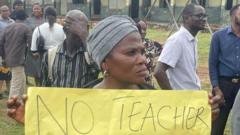
To understand the weight of nearly two months in captivity, you have to look at what happens to a community when its children vanish. The classrooms did not just empty; they froze. Across Oyo State, teachers walked out on strike. It was not a dispute over wages. It was a declaration of terror. How do you stand at a blackboard when you know that a chalk stick offers no defense against an AK-47?
The kidnappers had a specific demand. They were not looking for cash. They wanted leverage. They held the children—some as young as two and three years old—as a human shield to bargain for the release of a high-ranking terrorist commander currently facing trial. They threatened to slaughter the entire group if the army closed in.
Consider what happens next when a government refuses to negotiate.
The strategy that followed was not a sudden, cinematic raid. It was a slow, grinding war of exhaustion. Under the command of Major General Chinedu Nnebeife of the Army's 2nd Division, a coalition began to form. It brought together Special Forces, the Department of State Services, local hunters, and vigilantes who knew every thicket of the vast, unforgiving Old Oyo National Park.
They did not rush the camp. Instead, they cut the veins.
For over a month, the military targeted the logistics. They intercepted the couriers carrying food. They arrested eight critical informants who were feeding the terrorists information from within the towns. They squeezed the space around the kidnappers until the pressure became unbearable.
But the victory was not free.
During the final push that broke the network and forced the unconditional release of the hostages, the military line held, but it bled. The official statements mention "casualties on the part of the security forces" without naming the dead or counting the wounded. The cost of a child’s freedom is often paid in the currency of a soldier’s life.
When the 44 surviving hostages finally walked out of the brush into the lights of the rescue vehicles, they were unrecognizable to those who knew them. Senator Abdulfatai Buhari described seeing children so frail, so mentally tortured, that the sight brought tears to veterans of the political landscape. One teacher, her voice trembling in a video recorded shortly after the rescue, could manage only a few words: "Security operatives tried so much, and that is why we are still alive right now."
Michael Oyedokun, one of the seven teachers taken, did not make it to the microphones. He was executed in the forest before the end.
The children are home now, or at least in hospitals meant to stitch their minds and bodies back together. The classrooms in Esiele and Yawota will eventually reopen. The chalk will touch the board again. But the southwest has lost its innocence. The geography of fear has expanded, and as the dust settles on the road to Oriire, the silence left behind is no longer the silence of peace. It is the silence of a region holding its breath.

.webp)