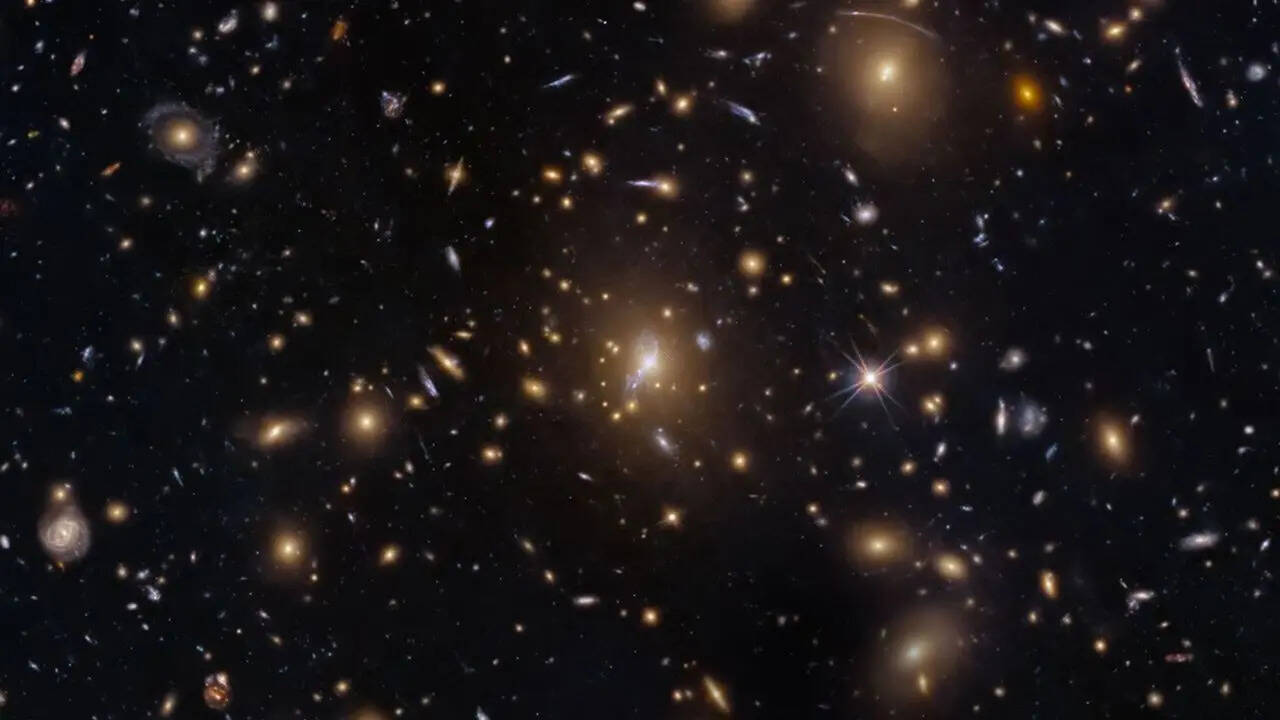
Hubble Space Telescope researchers recently captured a massive concentration of galaxies known as Abell 3192, a structure so immense it warps the fabric of space-time itself. While standard accounts treat this as a simple, picturesque postcard from the deep universe, the reality is far more chaotic. This is not a static swarm of stars. It is an active, violent gravitational trap that is fundamentally altering our understanding of how the largest structures in the cosmos form and evolve. By analyzing the distorted light of background galaxies, astrophysicists are uncovering a tense cosmic tug-of-war between dark matter, hot gas, and accelerating expansion.
The Invisible Scaffold Holding Thousands of Galaxies Together
We see the bright stars, but they are just the foam on the ocean crest. The true engine of Abell 3192 is dark matter, an invisible substance that emits no light but dictates where matter pools in the universe.
When Hubble looks at a massive galaxy cluster, it does not just record starlight. It records weight. The sheer mass of thousands of galaxies packed into a relatively small region creates a profound gravitational well. This well acts like a cosmic magnifying glass, bending and distorting the light from objects sitting billions of light-years behind it. Astronomers call this phenomenon gravitational lensing.
Through this lensing data, researchers can map the invisible. The visible galaxies within Abell 3192 account for only a tiny fraction of its total mass. The rest is a dense, sprawling halo of dark matter that acts as a structural scaffold. Without this invisible rigging, the galaxies would fly apart, scattered by the expansion of the universe. Instead, they are being pulled inward, trapped in a relentless, slow-motion collapse toward a common center of mass.
Anatomy of a Cosmic Megastructure
To comprehend the scale of what Hubble is looking at, it helps to break down the sheer composition of a massive galaxy cluster. These are not merely loose collections of stars. They are distinct ecosystems operating on a scale that defies human intuition.
- The Brightest Cluster Galaxies (BCGs): These are the behemoths sitting at the absolute center of the gravitational well. They grow by cannibalizing smaller galaxies that drift too close, swelling into massive elliptical shapes devoid of new star formation.
- The Intracluster Medium: This is a vast reservoir of superheated gas that fills the space between galaxies. It glows intensely in the X-ray spectrum, heated to tens of millions of degrees by the immense gravitational pressure of the cluster.
- The Dwarf Swarms: Thousands of tiny, faint galaxies buzz around the perimeter like hornets. They are the primary fuel source for the larger galaxies, destined to be torn apart by tidal forces over the next few billion years.
Why the Standard Model of Galaxy Growth is Fraying
For decades, the prevailing theory suggested that galaxy clusters formed smoothly, pulling in matter evenly from all directions like water draining into a sink. Abell 3192 tells a completely different story. It reveals a highly irregular, asymmetrical distribution of mass that suggests a history of violent mergers and uneven growth.
The cluster is actually a composite structure, a merging zone where smaller groups of galaxies are slamming into one another at thousands of kilometers per second. When these sub-clusters collide, the dark matter passes right through without slowing down, interacting only via gravity. However, the superheated gas between the galaxies crashes together, creating massive shockwaves that can be detected by space-based observatories.
This messy reality complicates our cosmological models. If clusters do not form smoothly, our calculations regarding the density of matter in the universe might be slightly off. We are relying on these massive structures to act as weighing scales for the universe, but the scales are constantly shaking.
[Sub-cluster A: Dark Matter & Gas]  --->  <---  [Sub-cluster B: Dark Matter & Gas]
                                   COLLISION
[DM passes through freely]          ------->     [DM passes through freely]
[Gas collides and overheats]        *SHOCKWAVE* [Gas collides and overheats]
The High Stakes Race Between Hubble and Its Successor
There is a quiet tension in the astronomical community regarding how we document these deep-space structures. Hubble has been our premier eye on the universe for over three decades, utilizing its optical capabilities to resolve the fine details of distant galaxies. Yet, it is an aging platform, operating on redundant systems and experiencing occasional software faults that pause science operations.
The James Webb Space Telescope (JWST) is often framed as Hubble's replacement, but the two instruments see the universe through fundamentally different lenses. Hubble excels in ultraviolet and visible light, allowing it to capture the hot, young stars within these distant galaxies. JWST operates in the infrared, peering through dust to see the older, colder stellar populations and even more distant background objects.
| Feature | Hubble Space Telescope | James Webb Space Telescope |
|---|---|---|
| Primary Wavelengths | Ultraviolet, Visible, Near-Infrared | Tomographic Infrared, Mid-Infrared |
| Mirror Diameter | 2.4 meters | 6.5 meters |
| Orbit Location | Low Earth Orbit (approx. 520 km) | Second Lagrange Point (1.5 million km) |
| Core Strength | High-resolution optical imaging | Deep-field infrared sensitivity |
Relying on just one of these instruments limits our view. To truly understand a structure like Abell 3192, scientists must stitch together the optical data from Hubble with infrared data from JWST and X-ray data from observatories like Chandra. Stripping away any piece of this toolkit leaves us blind to entire components of the cluster’s mass.
The Problem of Cosmic Isolation
As we look deeper into these massive structures, a sobering reality emerges about the future of our universe. Because the universe is expanding at an accelerating rate, driven by the mysterious force known as dark energy, these massive galaxy clusters are becoming islands.
Right now, gravity is winning the battle inside Abell 3192, holding its thousands of constituent galaxies in a tight grip. But outside the cluster's boundary, dark energy dominates. The space between Abell 3192 and neighboring structures is stretching faster and faster.
In the distant future, the universe will expand so much that the light from other clusters will never be able to reach Abell 3192. Any civilizations evolving inside that cluster trillions of years from now would look out into the night sky and see absolutely nothing beyond their own local swarm of galaxies. They would have no way of knowing that a broader universe ever existed, living in a state of permanent cosmic isolation.
Resolving the Optical Distortions
The crisp images processed by NASA data analysts are the result of rigorous mathematical cleanups. When Hubble stares at Abell 3192, the light must pass through our own Milky Way galaxy first. This means foreground stars, cosmic dust lanes, and instrument noise pollute every exposure.
Engineers use complex algorithms to subtract the light of foreground stars, isolated by their distinct diffraction spikes, from the final image. What remains is a raw look at the ancient universe, showing galaxies as they existed billions of years ago. The light we see from the most distant components of Abell 3192 left its source long before Earth had even formed. We are looking at a living archaeological dig, frozen in flight across the vacuum of space.
The real value of these images lies not in their aesthetic appeal, but in the precise coordinate mapping of the lensed background galaxies. By measuring the exact angle and arc of the distorted light, physicists can reverse-engineer the shape of the gravitational lens itself. This reveals the precise location of the dark matter hubs pulling the strings behind the scenes.
The Looming End of the Observational Golden Age
We are currently living through a unique window in human history where our technology allows us to witness the peak era of cluster formation. Billions of years ago, the universe was too young and chaotic for these massive structures to have stabilized. Billions of years from now, accelerated expansion will have pushed them too far apart to be studied as a cohesive whole.
The data gathered from Abell 3192 forces a re-evaluation of how quickly gravity can gather matter into these mega-structures. If we continue to find clusters of this size and complexity earlier in the cosmic timeline than expected, it means our current timelines for the early universe require a drastic overhaul. Matter may have clumped together much faster after the Big Bang than our computer simulations currently predict, suggesting an undiscovered mechanism in early cosmic history that jump-started the formation of the universe's largest structures.