Imagine waking up in the middle of the night to find a stranger standing over your bed. Now imagine that stranger is wearing tactical-looking gear, a lanyard with a badge, and a black baseball cap with the letters "RCMP" clearly emblazoned across the front. Your brain would naturally try to rationalize it. You'd think the police are executing a warrant, or maybe there's an emergency in your neighborhood.
That's exactly what a 79-year-old senior in Coquitlam, British Columbia, faced in the early morning hours of Friday, May 22, 2026. But the man in the room wasn't a cop. He was a violent intruder.
The nightmare didn't end with a quick robbery. The suspect physically assaulted the elderly homeowner, tied him up, and left him trapped inside his own home in the 2700 block of Nadina Drive. The victim remained forcibly confined for two grueling days before he finally managed to break free on Sunday, May 24, to call for help.
This isn't just another local crime story. It's a calculated, chilling example of police impersonation used to bypass our natural defenses. When criminals start wearing the badges we trust, our traditional safety habits have to change.
The Calculated Blueprint of a Modern Home Invasion
Many people assume home invasions are chaotic, random acts of desperation. This one proves otherwise. It was planned, scouted, and executed with cold precision.
According to Coquitlam RCMP Sgt. Adriana O’Malley, the suspect didn't just stumble upon the Nadina Drive residence. Earlier in the day on May 22, a man matching the suspect's description approached a neighbor. Posing as a friendly tradesperson, he asked specific, pointed questions about the elderly victim and his daily routine.
Investigators now believe that "tradesperson" and the midnight attacker are the exact same person.
The suspect used a two-step strategy to lower the neighborhood's guard. First, he played the role of a blue-collar worker during daylight hours to gather intelligence. Then, he donned fake police gear to execute the crime under the cover of authority. While inside, he took his time, systematically ransacking the house and stealing the victim's cell phone, credit cards, and his car—a distinctive green 2022 Hyundai Kona with the B.C. license plate AWE 311.
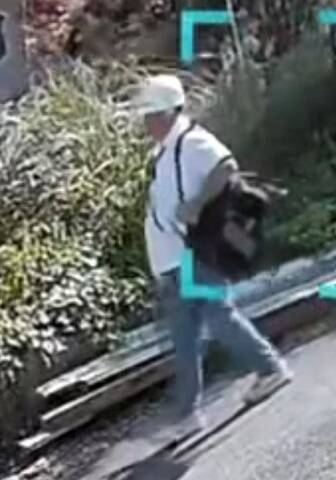
The physical description provided by the RCMP is highly specific. The suspect is described as a large, heavy-set man—"muscular and rotund"—standing between 5'10" and 5'11" tall, weighing roughly 250 pounds. During the attack, he wore black-rimmed glasses, a white collared golf shirt, tan leather gloves, and blue-and-white running shoes, alongside the fake RCMP cap and badge lanyard.
The Growing Weaponization of Public Trust
Police impersonation is one of the most insidious tactics a criminal can use. It weaponizes the natural instinct of law-and-order citizens to comply with authority figures. When someone wears an official logo, your reaction time slows down. You hesitate to challenge them.
We saw this exact vulnerability exploited on a massive, tragic scale during the 2020 Nova Scotia attacks, where a gunman used a replica police cruiser and uniform to evade suspicion. While the Coquitlam incident didn't result in mass casualties, the psychological tactic is identical.
Criminals know that if they knock on a door claiming to be a plumber, an alert homeowner might ask for a work order. If they claim to be a cop, the homeowner usually opens the door. In this specific case, the suspect bypassed the door entirely by breaking in while the victim slept, but the police gear was clearly intended to paralyze the victim with confusion and authority once he woke up.
It also serves as an exit strategy. If a neighbor looks out the window and sees a man in an RCMP hat walking out of a house, they don't call 911. They assume police business is being conducted.
How to Verify a Police Officer in British Columbia
So, how do you protect yourself when the person claiming to protect you might be a threat? You have to be willing to challenge authority safely. Real police officers understand the reality of impersonation scams and won't penalize you for doing your due diligence.
If an officer approaches your home or knocks on your door, you have the right to confirm their identity before opening it or complying with commands, especially during unusual hours.
- Look for more than a hat: A baseball cap and a lanyard are incredibly easy to buy online or replicate. Real officers carry an official badge and a photo identification card issued by their department.
- Request their name and ID number: Ask for the officer's surname and badge number through the door or a cracked window.
- Call dispatch directly: Don't rely on a phone number the person outside gives you. Hang up, find the non-emergency or emergency line for your local detachment (for Coquitlam, that's 604-945-1550), and ask the dispatcher to verify if officers were sent to your address.
- Watch the vehicle: Unmarked cars are common, but legitimate operations involving residential visits usually feature standard police cruisers nearby, or at least a vehicle equipped with hidden, functional emergency lights.
What You Need to Do Right Now
The suspect in this case is still at large. The green Hyundai Kona is still missing. The Coquitlam RCMP Investigative Support Team is actively hunting for leads under file number 2026-12958.
If you live in the Tri-Cities area, check your security cameras, Dashcam footage, or smart doorbells from Friday, May 22. Look for a large, 250-pound man wearing a white golf shirt or an RCMP cap around Nadina Drive and Chilko Drive.
Beyond this specific manhunt, take a hard look at your own home security setup. Talk to your neighbors. The biggest mistake the neighborhood made in this scenario was answering the "tradesperson's" questions without verifying who he worked for. If a stranger starts asking you about who lives next door, when they come home, or if they live alone, don't be polite. Don't give away details. Write down their description, note their vehicle plate, and tip off your local police. Polite compliance is exactly what these predators are counting on.