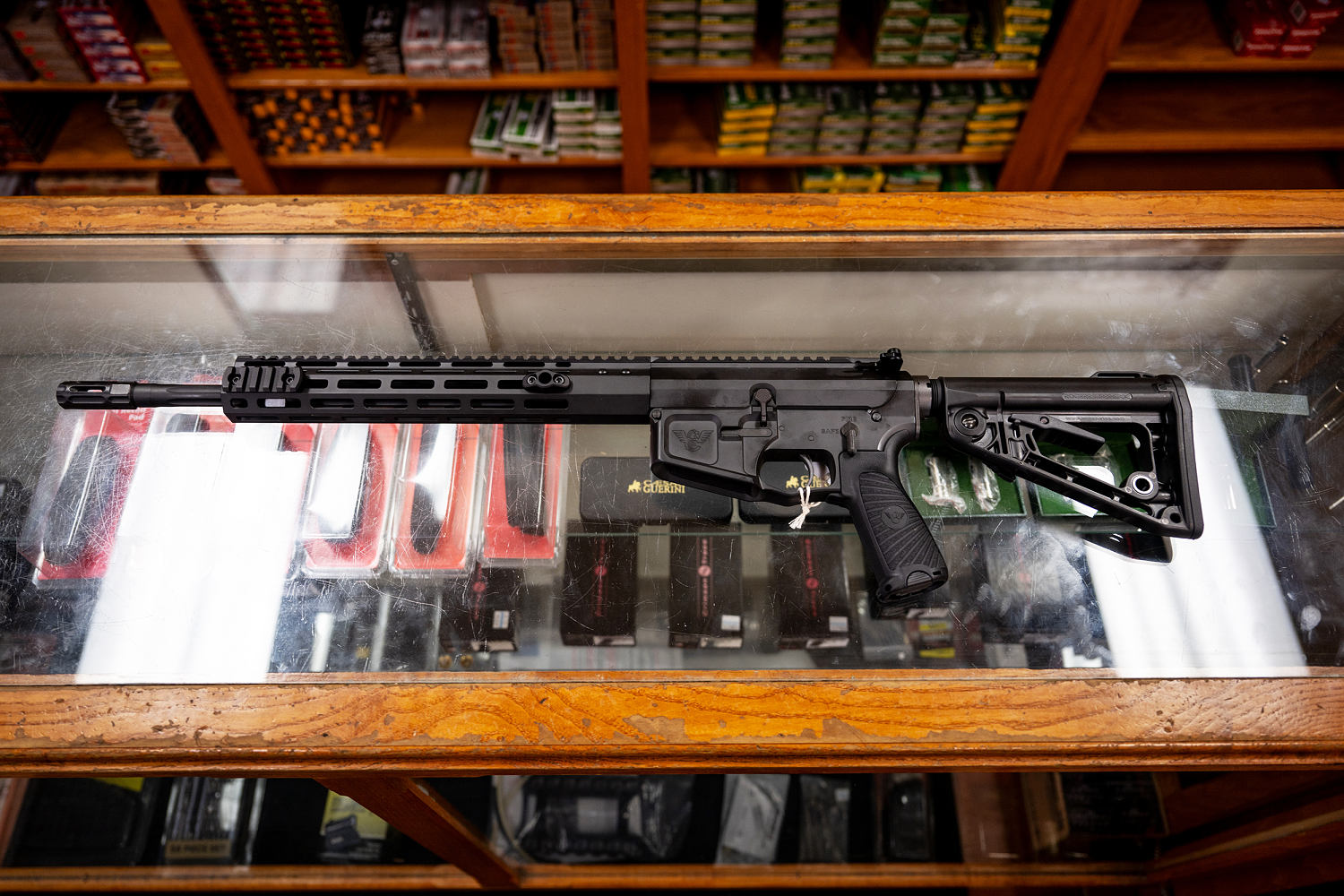
The Supreme Court’s decision to review the constitutionality of state-level bans on semi-automatic rifles shifts the second amendment debate from political rhetoric to strict legal and mechanical definitions. The core tension does not reside in public sentiment, but rather in a direct conflict between state police powers and the specific text-and-history standard established in New York State Rifle & Pistol Association, Inc. v. Bruen. To evaluate how the Court will resolve this conflict, the issue must be deconstructed into three precise vectors: the mechanical definition of "common use," the historical analogical framework, and the operational limitations of legislative bans.
The Common Use Metric and Mechanical Categorization
The primary legal pivot point for modern firearm litigation rests on whether a class of arms is "in common use for lawful purposes" or whether it qualifies as "dangerous and unusual." State bans frequently target specific platform names—most notably the AR-15—or define prohibited items via a checklist of cosmetic and ergonomic features. This approach creates an analytical disconnect between legislative definitions and empirical realities.
To quantify "common use," the Court evaluates raw ownership data and manufacturing statistics. Millions of semi-automatic rifles featuring detachable magazines and linear layouts are currently possessed by private citizens in the United States. Under the standard established in District of Columbia v. Heller, numerical ubiquity functionally satisfies the definition of common use.
The legal vulnerability of state bans lies in their attempt to classify these rifles as "dangerous and unusual" based on structural features rather than internal mechanics. From a mechanical engineering perspective, a semi-automatic rifle fires exactly one projectile per trigger pull, utilizing a portion of the energy from the fired cartridge to cycle the action and chamber the next round. This internal cycle is identical to that of standard semi-automatic handguns and traditional hunting rifles.
By focusing bans on secondary characteristics—such as adjustable stocks, pistol grips, or barrel shrouds—state legislatures have created a categorization system that lacks a distinct mechanical boundary. The legal defense of these bans must prove that these ergonomic features fundamentally alter the weapon’s lethality to such a degree that it transitions from a standard civilian arm into a specialized military instrument.
The Historical Analogy Bottleneck
Following the Bruen decision, lower courts are prohibited from using interest-balancing tests—such as weighing public safety metrics against individual rights. Instead, the government must demonstrate that the regulation is consistent with the nation’s historical tradition of firearm regulation. This requirement creates a severe structural bottleneck for defending modern bans.
The historical inquiry requires identifying twentieth-century or late nineteenth-century analogues that imposed similar restrictions for similar reasons. State defenders face a two-part structural challenge when establishing these comparisons:
- The Temporal Mismatch: The primary historical regulations regarding dangerous weapons focused on concealable arms (like bowie knives or pocket pistols) or specific trap-guns and spring-guns that operated without a human operator. Broad bans on long guns typically kept for self-defense lack a direct founding-era or Reconstruction-era precedent.
- The Technological Discontinuity: The transition from muzzle-loading flintlocks to repeating firearms occurred mid-nineteenth century. While multi-shot weapons existed in 1791, they were not the baseline civilian arm. The state must argue that the technological jump from repeating firearms to modern semi-automatic platforms represents an unprecedented societal mutation that justifies novel regulatory tools.
If the Court applies a strict temporal test, the absence of widespread, state-level prohibitions on specific classes of rifles during the late eighteenth and nineteenth centuries will invalidate modern restrictions. The state's burden is not merely to find laws that restricted weapons, but to find laws that restricted weapons of similar utility for similar defensive purposes.
The Operational Failure of Feature-Based Bans
From an enforcement and compliance perspective, statutory bans relying on feature checklists suffer from inherent architectural flaws. When a law defines an "assault weapon" by a combination of a detachable magazine and a secondary characteristic (such as a folding stock), it introduces a compliance loophole based entirely on modularity.
Modern firearm manufacturing relies heavily on standardized, modular components. If a state bans a rifle with a pistol grip, manufacturers quickly iterate the design to feature a "featureless" stock or a fixed magazine that requires a tool to release. The firearm retains its core ballistic profile, muzzle velocity, and rate of fire, while technically complying with the letter of the law.
The net result of this regulatory framework is a market balkanization that fails to achieve the state's stated objective of reducing weapon lethality. Instead, it creates a highly complex compliance landscape for legal owners while leaving the underlying mechanical function of the firearms completely untouched.
The Jurisprudential Path Forward
The Supreme Court’s review will likely eliminate the current split among federal circuit courts by establishing a hard quantitative or qualitative test for the "common use" doctrine. The Court has two primary paths for its ultimate ruling.
The first path is a formalistic application of the Heller and Bruen frameworks. Under this approach, the Court will look at the millions of semi-automatic rifles in circulation, declare them protected under the common use standard due to their sheer numbers, and strike down all state-level bans that prohibit entire classes of these firearms. This outcome would establish a clear boundary: if a weapon type is possessed by the public in the millions for lawful purposes, it cannot be banned categorically.
The second, more nuanced path involves the Court defining the precise scope of "M-16 rifles and other weapons that are most useful in military service," a phrase left open in Heller. To sustain a ban under this logic, the Court would have to provide a definitive standard for when a civilian firearm crosses the line into a military-grade weapon, focusing on characteristics like select-fire capability rather than cosmetic add-ons.
Litigants and policy makers must prepare for a significant reduction in state regulatory authority over long-gun configurations. The legal survival of any future firearm regulation will depend entirely on its alignment with historical precedents from 1791 and 1868, rendering contemporary empirical arguments regarding public safety legally irrelevant within the federal court system.


