The ground does not shake when a neighborhood dies. It sighs.
A fence goes up first, hung with yellow caution tape and the smell of hot diesel exhaust. Then the heavy machinery arrives, chewing through decades of morning porch coffees, backyard tomato patches, and the quiet comfort of knowing exactly where you belong. For generations, the legal doctrine of eminent domain has functioned as a wrecking ball for the ordinary citizen. Governments and private developers point a finger at a map, declare a patch of land vital for the greater good, and sweep away whatever—or whoever—happens to be standing in the way. Checks get written. Homes get flattened. History turns into landfill.
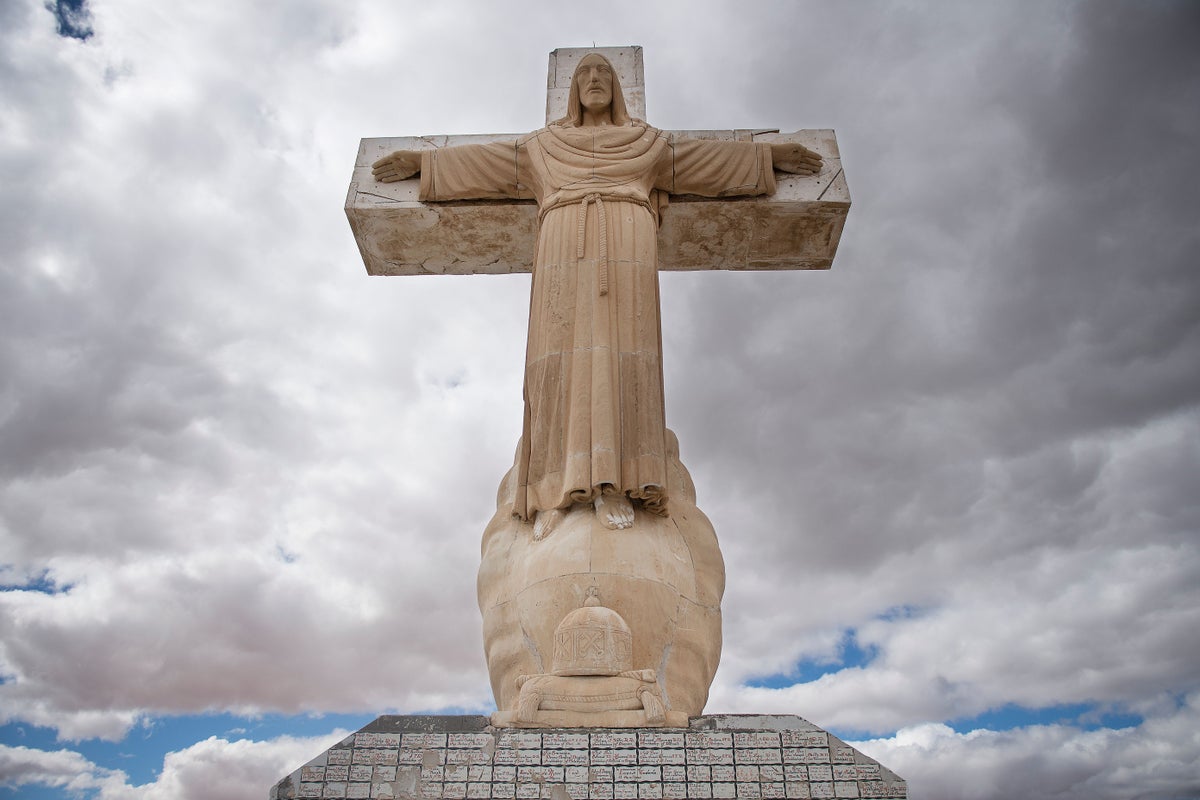
Power recognizes almost no natural predators. It respects zoning boards, highway funds, and environmental impact studies, usually just long enough to bypass them. But power rarely knows what to do with a twenty-nine-foot-tall fiberglass Jesus.
Take a drive down a particular stretch of highway in South Texas, and you will find yourself blinking hard at what looks like a modern miracle of bureaucratic defiance. Rising high above the flat, sun-bleached horizon stands a towering monument, arms outstretched in eternal benediction. It is heavy. It is conspicuous. And according to local lore, municipal planning codes, and very clever land use maneuvering, it might just be the most effective shield against the sweep of government acquisition ever devised.
To understand why a towering religious statue can accomplish what a hundred angry community meetings cannot, you have to look at the fragile mechanics of how land gets stolen by paperwork. Eminent domain relies on a specific kind of legal emptiness. It targets property that can be easily categorized as underutilized, blighted, or simply convenient for the next big infrastructure push. A modest house with an overgrown lawn is an easy target. A church parking lot is harder. But a dedicated religious shrine, built to specific heights and anchored with structural permanence, introduces an entirely different category of legal headache.
Imagine waking up to find a red line drawn directly across the middle of your family’s land.
You did nothing wrong. You paid your taxes. Your grandfather planted the oak tree that now shades the back patio. Yet, an anonymous memo from a state agency arrives, stating that a planned highway expansion, a utility easement, or a municipal revitalization project requires your square footage. They offer you a number. It is never enough to buy back what you are losing, because what you are losing cannot be listed on a spreadsheet. Memories do not have a cash value. Roots do not appraise well.
This is where the fight usually ends. Lawyers cost money. State agencies have bottomless budgets funded by the very people they are trying to evict. Resistance feels like shouting into a hurricane.
Unless you change the physics of the land itself.
Religious property enjoys a distinct, highly guarded fortress of legal protections under federal and state statutes. The Religious Land Use and Institutionalized Persons Act was not designed as a weapon for real estate developers, but it functions as one when applied with precision. When a piece of real estate becomes a designated house of worship or a permanent religious monument, the threshold for government seizure shifts dramatically. Suddenly, the state cannot simply bulldoze a path for convenience. They have to prove a compelling government interest, and they have to prove it is the absolute least restrictive means of achieving their goal.
Bureaucracy hates complication. Bureaucracy loves flat, empty dirt. A towering Jesus introduces jagged, sharp-edged legal complications that municipal attorneys prefer to avoid entirely.
Consider the sheer psychological weight of it. How does a public relations department spin the demolition of a massive religious landmark to make way for a concrete bypass? The optics are catastrophic. A highway overpass can be rerouted two hundred feet to the left. A drainage ditch can curve. But knocking down a towering icon of faith to pour asphalt generates headlines no politician wants to read on election morning.
We have spent decades romanticizing the individual standing up to the machine. We cheer for the fictional farmer who sits on his porch with a shotgun, even though we know that in the real world, the bulldozer wins every time. The law does not care about your sentimentality. The law cares about precedence, statutes, and property deeds.
That is why the twenty-nine-foot Savior in Texas represents something far more interesting than a quirky roadside attraction. It is a masterclass in tactical architecture. It is an acknowledgment that if you want to protect your ground from the relentless appetite of expansion, you have to make that ground too heavy, too loud, and too legally radioactive for them to swallow.
The strategy is not about divinity. It is about friction.
Every society builds monuments to what it values most. For a long time, those monuments were banks, capitols, and corporate headquarters. We paved over communities to make room for commerce, treating human geography as a blank slate ready for optimization. We told ourselves that progress demanded sacrifice, and that the sacrifice would always be paid by the people with the least amount of power to fight back.
But the rules of the game change the moment a community decides to anchor itself so deeply into the earth that it cannot be easily extracted.
The sun sets over the Texas plains, casting long, dramatic shadows across the asphalt and the dry grass. The giant figure stands silent against the fading violet sky, indifferent to the traffic roaring past on the interstate. Miles away, in air-conditioned boardrooms, planners look at blueprints, trace routes with yellow highlighters, and quietly curve their lines around a spot on the map that simply refuses to move.